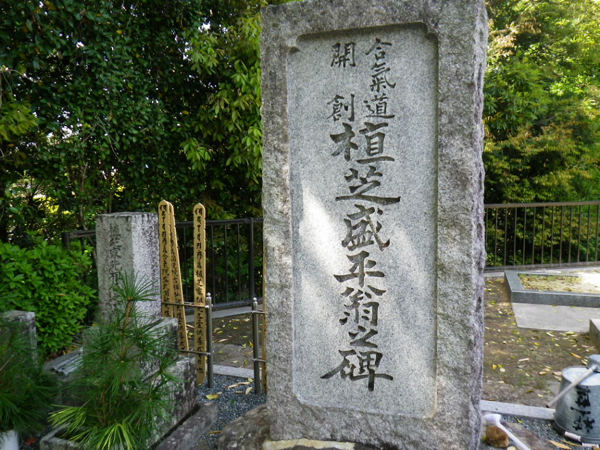
Category: Translation

  • Ai no Bujutsu – Aiki and the Bujutsu of Love

    Ai no Bujutsu – Aiki and the Bujutsu of Love

    Muko (Takeo) Nishikido

    Muko (Takeo) Nishikido

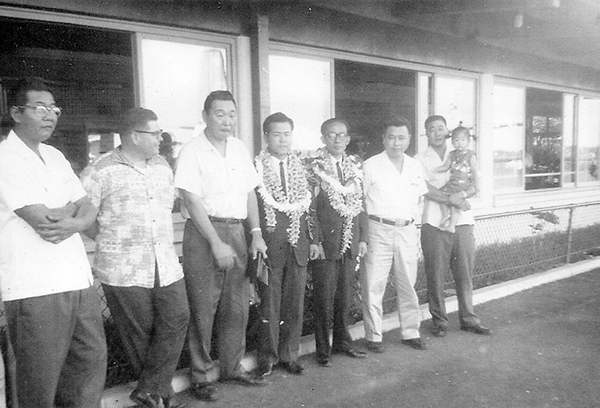
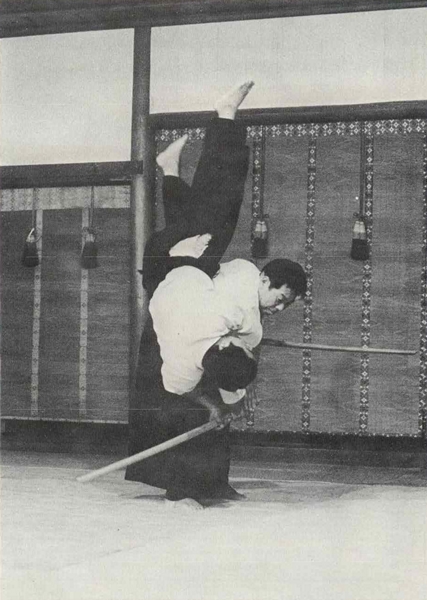
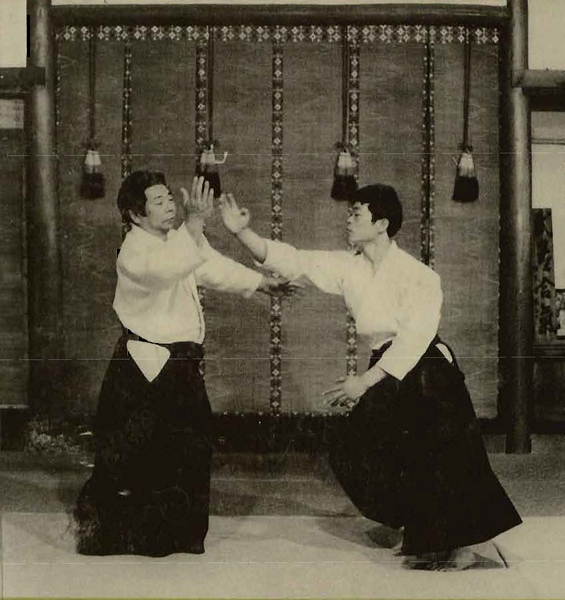
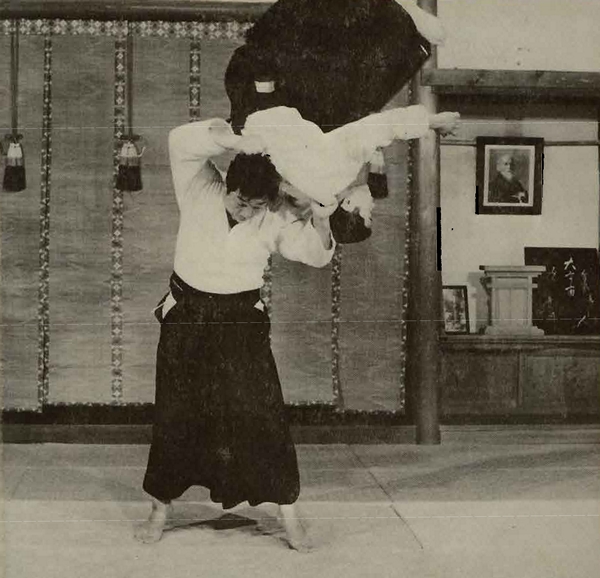
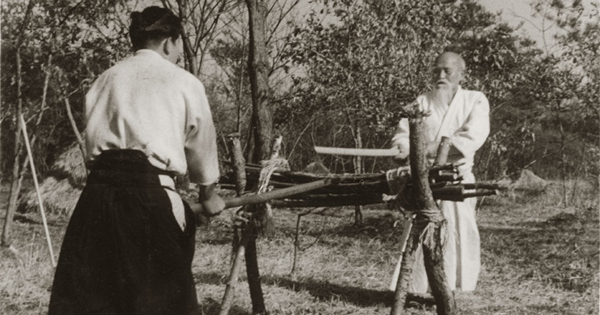
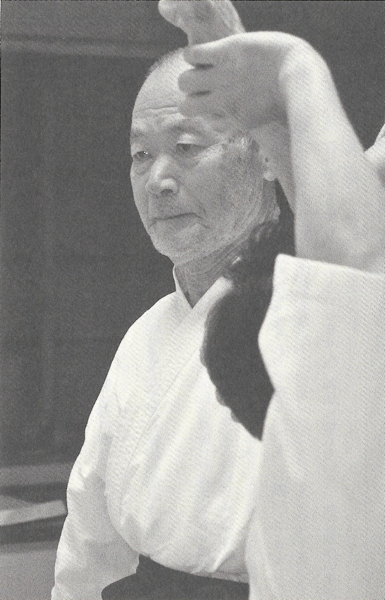
    Muko (Takeo) Nishikido (錦戸無光/武夫) was born in 1940 on Tinian in the Northern Mariana Islands near Saipan. After school in Kumamoto he moved to Osaka, where he began to train in Daito-ryu Aiki-jujutsu in 1959 and later established a dojo in Tokyo. In 1973 he met Daito-ryu Aiki-jujutsu Kodokai Founder Kodo Horikawa in Kitami City in Hokkaido through the introduction of a friend. Upon feeling his Aiki for the first time he decided to discard his previous study of jujutsu and focus on Horikawa Sensei’s approach to Aiki.
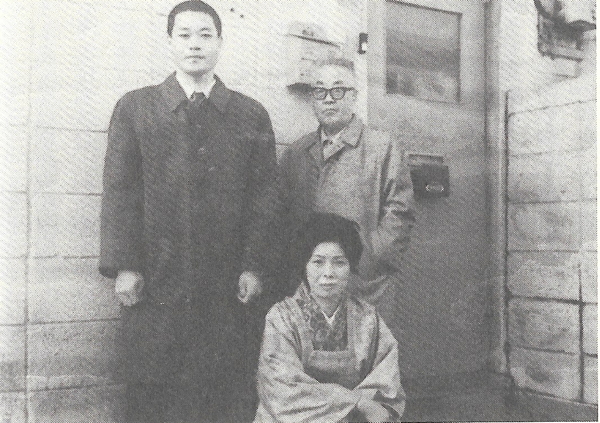
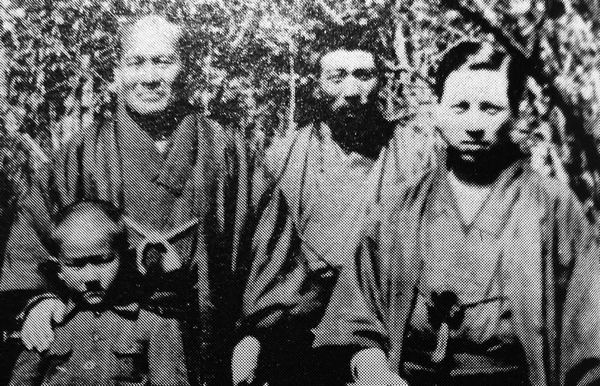
    Mr. and Mrs. Horikawa

    Muko Nishida with Mr. and Mrs. Horikawa in Hokkaido, 1973

    After commuting to Kitami for two years, he decided to relocate with his family to Hokkaido in order to further his training and received severe individual instruction in addition to the regular training at Horikawa Sensei’s dojo.

    He later established his own organization to spread the teachings of Kodo Horikawa called Hikarido (The Way of Light / 光道).

    The following article contains excerpts from “The Height of Aiki” (合気の極み), written by Nishikido Sensei and published in Japanese in 2017 by BAB Japan publishing company (BABジャパン出版局), which also publishes the popular martial arts magazine Gekkan Hiden (月刊秘伝 / “Secret Teachings Monthly”).

    Some of his emphasis on Ki, love and harmony in Daito-ryu Aiki-jujutsu may appear to be at odds with common perceptions of Daito-ryu, but it may be helpful to consider his statements in the context of similar statements from other prominent figures in the Daito-ryu world.

    • Tokimune Takeda, the son of Morihei Ueshiba’s teacher Sokaku Takeda and the Soke of Daito-ryu Aiki Budo:

    “The essential principles of Daito-ryu are Love and Harmony”

    “The goal of spreading Daito-ryu is ‘Harmony and Love’, keeping this spirit is what preserves and realizes social justice. This was Sokaku Sensei’s dying wish”

    “There is no first attack in Aiki-jujutsu. Endure as much as you should endure. Even when it becomes necessary, neutralize the opponent without causing injury through Aiki.”

    • Yukiyoshi Sagawa, one of Sokaku Takeda’s senior students and one-time successor as Soke of the art:

    “Aiki Budo is the Way of Human Development”

    “Aiki is the fitting together of Ki.
    Through this harmonious reconciliation all things under heaven and earth in the universe move peacefully without disturbance. This harmonization is Aiki.”

    • Masao Hayashima (早島正雄), who trained with both Sokaku Takeda and Sokaku Takeda’s student Toshimi Matsuda (from the first page of his book – “Taoist Aiki-jutsu – the volume of Internal Power”):

    “Aiki-jutsu is said to be the Budo of Harmony.”

    • Katsuyuki Kondo, Menkyo Kaiden in Daito-ryu Aiki-budo from Tokimune Takeda and successor to the mainline of Daito-ryu, in an interview with Aikido Journal‘s Stanley Pranin:

    What are the main differences between Daito-ryu and aikido?

    I don’t think there is any difference. In Daito-ryu, too, practice begins and ends with courtesy (rei). And its final goal is the spirit of love and harmony.
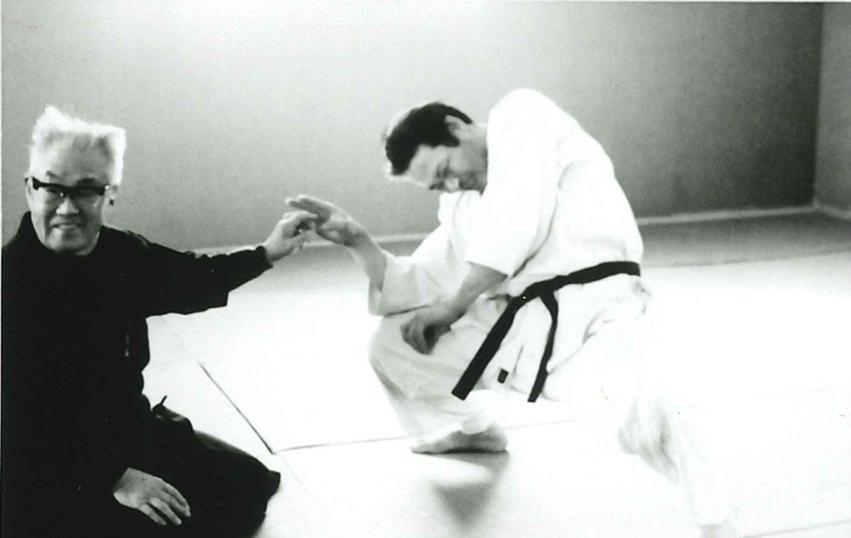
    Muko Nishikido and Kodo Horikawa

    Daito-ryu Aiki-jujutsu Kodokai Founder Kodo Horikawa
    applying Aiki to Muko Nishikido

    Ai no Bujutsu – Aiki and the Bujutsu of Love

    – Muko (Takeo) Nishikido (translation by Christopher Li)

    Daito-ryu Aiki-jujutsu is the bujutsu of “harmony” (和), as was stated by Kodo Horikawa, who established the Daito-ryu Aiki-jujutsu Kodokai, in Showa year 25 (1950) in Kitami City, Hokkaido – “Neither cut nor be cut. Neither strike nor be struck. Neither kick nor be kicked.”. It is a bujutsu that handles the opponent without causing them harm.

    In the case of the Daito-ryu Aiki-jujutsu Hikari-do, the level of harmony is gradually enhanced as training progresses from the basic techniques in Shoden to Chuden and Okuden.

    Harmony, that is, love.

    Why is that? Because it prevents contention. When one uses “Aiki” even the very impulse to counter-attack ceases to arise.

    Without harmony one cannot be led to love. The greater the harmony the deeper that love becomes. In Hikari-do we grasp this in our training through the techniques.

    At first there is no real feeling when the techniques in Aiki-jujutsu are applied to you. That is because one cannot understand how or what is being done to you.

    When Aiki was first applied to me I thought “What is this?”. The will to fight disappears. The desire to attack the opponent disappears.

    Aiki completely strips away the feeling of the opponent to fight and their strength. That can be stripped away not only for just a single person, but even when there two, three, four, five or six people.
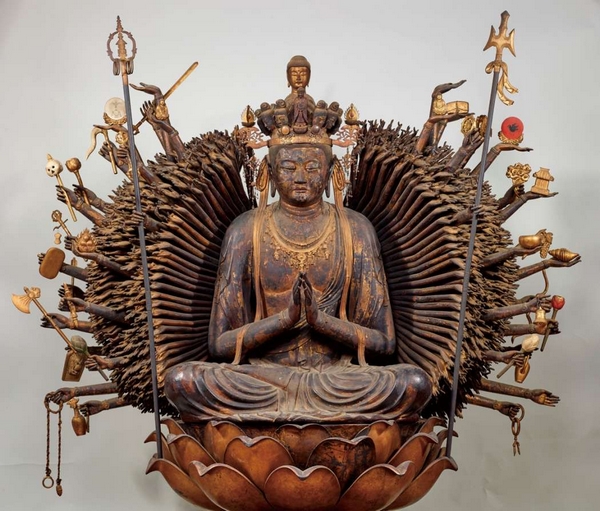
    Thousand Armed Kannon

    Seated Thousand-armed Kannon Bosatsu
    Fujiidera temple, Osaka – 8th century

    One works to create a body that that can manage situations like that in an instant. One works to create a body like the Thousand Armed Kannon (千手観音), so to speak.

    When one says “thousand”, in the past this meant a number without limit. This means that no matter where one is grabbed on their body they become able to use Aiki.
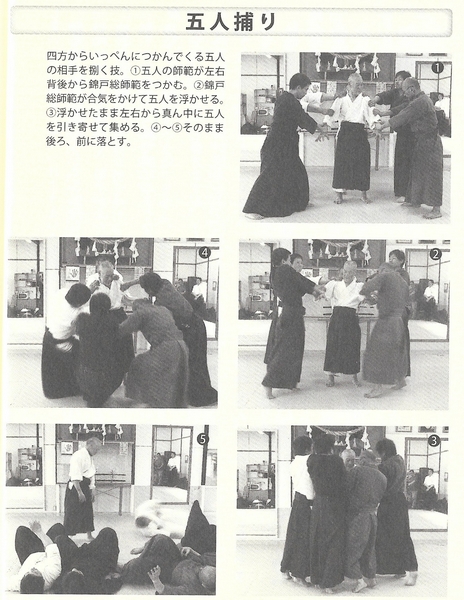
    Five person attack

    In a manner of speaking, it means that more harmony can be achieved by two people rather than one, three people rather than two, four people, five people, six people. It is the world of harmony. For that reason, contention disappears.

    I think that this is real love. One person, two people, three people, four people, five people, six people – love becomes deeper and deeper.

    Daito-ryu Aiki-jujutsu is the bujutsu of love.

    And then, as one draws closer to real training in the inner workings of Aiki, even the smallest portion of the ego becomes unable to enter. One enters into a selfless world without ego.

    This is what I have grasped to this point.
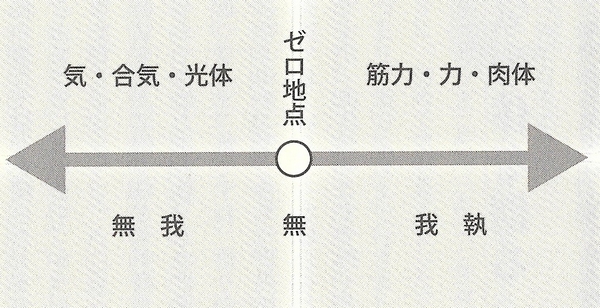
    Ego to egolessness chart

    When expressing Aiki as a chart we get something like the diagram above.

    On the right side is the world of power, the world physical strength. In terms of the spirit, it is the world of the ego. On the left side is the world of Ki, the world of Aiki. In terms of the spirit, it is the world of egolessness.

    In the center is the zero point, in other words nothingness (“Mu” / 無). One who has become enlightened to nothingness comes to this point. “Ah, it’s nothingness” is one kind of enlightenment.

    However, even if one becomes enlightened to a state of nothingness, one cannot do anything. Even a master potter will say “Nothing can be done from nothingness”. This is still the zero point. Just coming here one can still go to the right side of the world of strength, the world of the ego, or one can also go to the left side of the world of Ki, the world of Aiki.

    The right side of the world of strength, the world of the ego, is comfortable. Strength and ego can be used immediately.

    Conversely, the worlds of Ki and Aiki are severe. One cannot grasp the real thing if they compromise. If one thinks to grasp he real thing they must pass through this world of severity.

    Even when one attains enlightenment through Zen training, they come to this point of nothingness, the zero point. But if you’re satisfied there then you’ll reach a dead end. There is a much deeper world. Wherever you go, however far you go, there is a world without limits.

    The more that one uses Aiki the more that their Ki increases, their harmony increases, their spirit enters into the world without limits.

    When those people who have inhabited the world of physical strength, the world of power, the world of the ego until this time train in Aiki-jujutsu they will draw closer to the zero point. That is, nothingness. The world of enlightenment. Return to the origin. From there begins the determination of whether one will either return to the world of physical strength, power, the world of the ego again, or depart for the world of Ki, the world of Aiki.

    In Hikari-do there are many types of training done in order to return to the point of nothingness. That can be called the enlightenment of the physical body – once the body has gone that far then next one is able to enter the world of Ki, the world of Aiki.
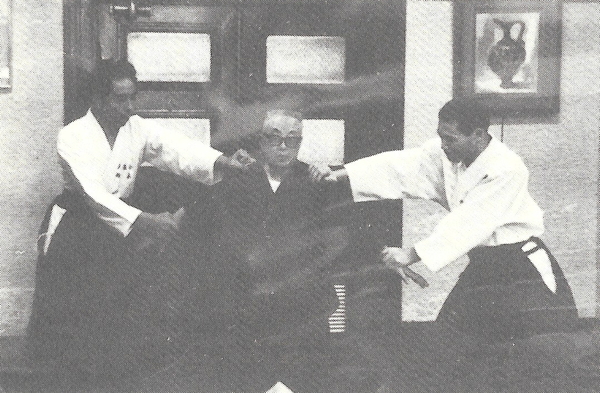
    Kodo Horikawa - Police Demonstration

    Demonstration at Police Headquarters in November 1973
    Seigo Okamoto – Kodo Horikawa – Muko Nishikido

    Building the Ki Body

    Daito-ryu Aiki-jujutsu first builds the “Ki Body” through training in the kihon (“basics”) and then enters into training in Aiki. When building the Ki Body physical strength (power) is not used. When the use of physical strength has ceased completely, there for the first time is the Ki Body.

    There was a time during my third year of receiving instruction from Kodo Horikawa Sensei in Kitami, Hokkaido that I realized that my entire body was the Ki Body. “Ah, my entire body is the Ki Body”, I realized. When I truly stopped needing physical strength, that was my first glimpse of Ki.

    In other words, I had made my way to the point of nothingness. However, I did not yet understand Aiki. If I had not been able to grasp Aiki it may be that I would have returned to the world of physical strength.

    When one trains in Aiki they experience a liberation (moksha) from the physical body. In moksha there is a liberation of the physical body and a liberation of the spirit, Aiki is a liberation of the physical body. One understands – “Ah, this is the Ki Body!”. The body of physical strength becomes the Ki Body.

    When compared with Horikawa Sensei’s sixty years of Aiki, my Aiki is still half of that at thirty years. Even if you just look at the shape of his body, Horikawa Sensei is twice as sharp as I am. I am still inexperienced.

    That Horikawa Sensei – even past eighty years old he would say “Well, Sokaku Takeda Sensei was much greater. I’m just not there yet…”.

    There are those kinds of steps in this world. It is the world of shugyo (“intense training”), so it can’t be helped. One has to build their body. Just one year, or two years of shugyo can’t hope to build the body and leap past sixty years of training.

    Hoping to get even a little bit closer to Horikawa Sensei, I thought of my own method of training. I took a heavy wooden sword and swung it five or six thousand times every morning and night. I did that for five or six hours to seven or eight hours every day, and continued for about half a year.

    Then, one day when I swung it ten-thousand times, the heavy wooden sword flew up away from me. I thought “Ah, it flew away!”.

    So then I started swinging an iron bar several times heavier than the wooden sword. Likewise, I would swing it for a few hours in the morning and the evening about 2,500 times each, 5,000 times a day. And finally the iron bar became weightless and flew up out of my hands.

    Normally I wouldn’t be able to swing it with my strength. Even with Ki I couldn’t swing it. I have swung an iron bar with Ki, but I couldn’t swing it more than a hundred times. My hands couldn’t hold it. Instead, I was better able to hold it when swinging with physical strength.

    Then I thought “OK, I’ll swing it with Aiki!”. and I swung it with Aiki – two hundred, three hundred, five hundred, six hundred, one thousand, two thousand times I swung. That was the first time that I thought “Ahh, in the end one really has to train…”. If I hadn’t swung using Aiki I would probably have gone back to my original body of physical strength.
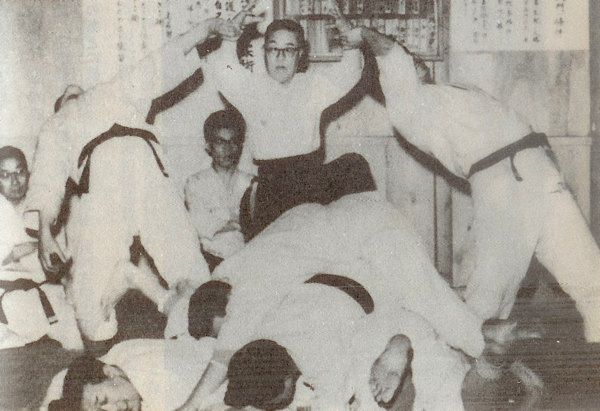
    Kodo Horikawa

    Daito-ryu Aiki-jujutsu Kodokai Founder Kodo Horikawa

    Basic Techniques and the Ki Body

    Daito-ryu Aiki-jujutsu does not require even the smallest bit of strength.

    That said, it’s not “relaxation” (脱力). I am not saying that relaxation is bad, but when one relaxes the become unable to forge themselves.

    In Hikari-do we train from the first steps of basic techniques to training to build a truly physically resilient physique. What I am teaching is training methods for the building of the Ki Body.

    I grasped this training method after meeting Horikawa Sensei. If I teach it to someone for one year their body will suddenly change. It will naturally become a physically resilient Ki Body. We have that methodology. In other bujutsu they train by learning techniques, not Ki. For that reason, they are unable to develop the Ki Body.

    In order to build the physical body, one would normally lift barbells, or other things, but if you can grasp Aiki then things like that can be done simply. Muscular strength is unnecessary. Conversely, if one uses even a little bit of physical strength then they will be unable to use Aiki.

    One must get a firm grasp on the basic techniques. This is important.

    If one cannot grasp the basic techniques properly then they will not achieve the Ki Body. They will become unable to attain the real thing. They will develop into a body that is simply composed of techniques.

    As long as one grasps the basic techniques they will quickly progress to the next level.

    One dayI asked Horikawa Sensei, “Sensei, how many years will it take to get to Aiki?”. When I did that he said, “If you grasp the basics firmly, then two or three years will be enough”.

    That’s because if one grasps the basics then they will naturally form the Ki Body. There are not that many people who think to purposely grasp the basics. Those who grasp the basics firmly progress quickly.

    But everybody, especially those who have come to learn bujutsu,  inevitably tries to throw the opponent or apply a technique and their feelings get drawn in that direction. When that happens those that could see become blind.

    Among my students were some who said, “Nishikido can’t use Ki”. But there were also those that, when they finally came to training in the Hiden Ogi techniques, said “Ahh, so there is Ki, there is Aiki!”. Also, there were those who, even when shown “This is Ki. This is Aiki.”, would think “That’s just another technique”.

    Training in Ki cannot progress well without a clear spirit of nothingness and concentration. That progress can be made is because that person’s spirit is in a state of clarity.

    The state of nothingness is not “indifference” (無関心), it is to be able to see clearly that which is not visible. The “Ki” which was invisible to that point becomes visible. One comes to see it with their spirit. They come to see it clearly.

    When one become capable of that one becomes capable of seeing Ki all of the time. To grasp this one time is simple, if one cannot grasp it then of course it is difficult. Those with idle thoughts have a difficult time grasping this.

    Even if I teach “If you do this than you will see!”, there are those who are impatient and think “It’s not this, it’s not that”.

    The basic techniques are the same, if you do that then you  will not be able to see it. It’s quick if you focus on what I am teaching, but people can’t seem to focus.

    The Resilient Aiki Body

    It is written “Aiki”, but it is read “Ki wo gassuru”. That is what Kodo Horikawa Sensei said. (*See the more detailed explanation towards the end of this article).

    In order to use Aiki, the body must become the Ki Body. The entire body becomes the Ki Body, and is used through the unification of Ki.

    To become the Ki Body means not to use physical strength. When one does correct basic training in Aiki they will naturally become the Ki Body.

    If one does not use physical strength then their strength will degenerate. When physical strength degenerates the muscles also become weaker. It’s difficult to maintain physical strength. In order to triple one’s physical strength they must really participate in a large amount of physical training. But in order to develop the Ki Body it’s acceptable to throw away that physical strength. Normally, in order to achieve the Ki Body, a normal person would take twenty to thirty years at the earliest. When one uses this with unified Ki, the Ki fills the body. As one further unifies and uses this Ki they become more and more filled with Ki. That is even further unified and utilized.

    This is Aiki training. This is Aiki conditioning. For that reason, there is no end to Aiki conditioning. And thus, it builds a resilient Ki Body.

    When one becomes able to use Aiki the Ki Body becomes even further developed. Even when training in the basic techniques of Aiki the Ki Body becomes further developed.

    There is no other bujutsu like this. From basic techniques to a training method that build the Aiki Ki Body.
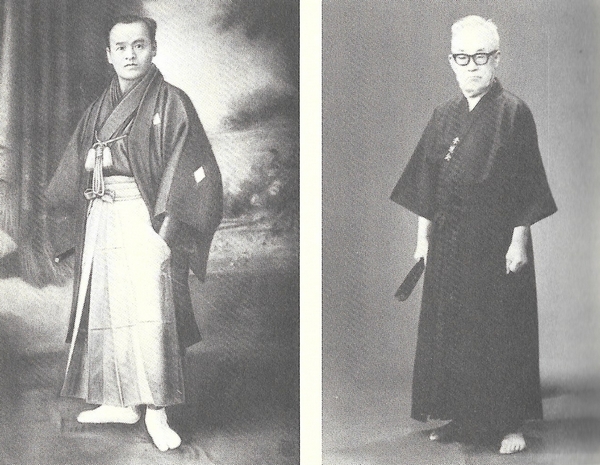
    Sokaku Takeda and Kodo Horikawa

    The Aiki bodies of Sokaku Takeda and Kodo Horikawa

    Once one becomes capable of using Aiki, then one becomes able to build the Aiki Body with Aiki. Not the Ki Body, creating the Aiki Body.

    Horikawa Sensei’s techniques were incredible, but his body was also incredible. His body was filled full with Ki. Not a soft, fluffy Ki. He was filled full with a sharp, intense Ki.

    Since Sensei was a school teacher, he had never done any kind of physical labor. I always wondered “How did he develop such an incredible body?”. He didn’t have the shape of a Ki Body, his body was in the form of an Aiki Body.
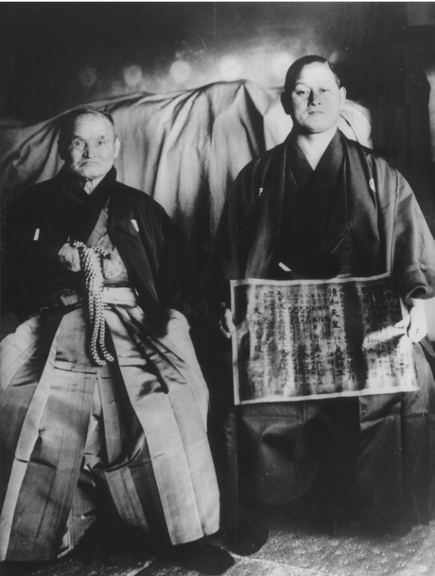
    Sokaku Takeda and Takuma Hisa

    Sokaku Takeda and Takuma Hisa
    Receiving Menkyo Kaiden in Daito-ryu Aiki-jujutsu, 1939

    Sokaku Takeda’s body was also firm and sharp. There are pictures of them together, but when compared to Sokaku Takeda’s body Takuma Hisa still looks something like a child.

    I think that Takeda Sensei must have handled Takuma Hisa Sensei like a child. Horikawa Sensei’s body was incredible, but Takeda Sensei’s was far and above even that.

    Development of the Tendons and Ligaments

    All schools of bujutsu build a resilient body through severe training. It is through that that one can become capable of using techniques such that are called “divine techniques”.

    Aiki as well was born at the end of the struggles of our ancestors devoting their entire body and souls to their training.

    There are several hundred schools of bujutsu in Japan, but the name “Aiki-jujutsu” exists only in Daito-ryu Aiki-jujutsu.

    No matter how weak one’s body is, if they truly understand Aiki and train correctly then they will develop a resilient Aiki Body.

    In Daito-ryu one first develops the Ki Body through training in basic techniques, and then begins to use Aiki. When using Ki the tendons and ligaments of the body don’t work very much. However, when one begins to use Aiki after developing the Ki Body the tendons and ligaments begin to work.

    There was a time when Horikawa Sensei was admitted to the hospital after he cut his Achilles tendon two-thirds of the way through. At that time one of the doctors in the hospital said in wonder “This person’s Achilles tendon is three times as thick as a normal person’s!”.

    Horikawa Sensei’s toes and fingers were also incredible.

    Even normally when nothing was happening they were all stretched out wide. Just the same as I when I am stretch my finger and toes out wide to their tips.

    The tendons in Horikawa Sensei’s Achilles tendon and his toes and fingers were the result of sixty years of Aiki conditioning. In other words, the tendons and ligaments throughout Horikawa Sensei’s entire body were strongly developed.

    When the tendons and ligaments throughout one’s entire body are worked through Aiki training (conditioning) the tendons and ligaments start to develop and one can build the resilient Aiki Body.

    Muscles, when one takes even a short break from muscular training, soon become weak. When one becomes of an advanced age their deterioration becomes visible. However, once tendons and ligaments are developed they do not deteriorate. Even when one reaches an advanced age that resilient body is preserved, and one can remain with a youthful appearance indefinitely.

    Horikawa Sensei told me “Even if you’re sick in bed for a week or ten days, it’s no hindrance to using Aiki”. Even if you’re sick in bed for a week or ten days, the conditioned body does not deteriorate.

    Gassuru Aiki

    This happened one day in the third year of receiving instruction from Horikawa Sensei, the first year of receiving individual instruction in Kitami.

    I asked Horikawa Sensei loudly “Sensei, Is Aiki kokyu-ho (a breathing method)?”. Horikawa Sensei was very hard of hearing.

    Sensei said “What? Kokyu-ho? Hahaha…” – he just laughed and that was the end of it.

    Then, after a few days had passed I was having tea at Sensei’s house after morning practice and an Aikido demonstration was being broadcast.

    After the demonstration was over Sensei said this – “They call it Aikido, but they aren’t using the slightest bit of Aiki!”. As one would expect, at that time I asked “Sensei, what is Aiki?”.

    When I did that Sensei stopped for a moment, took a deep breath, and said “Aiki is…”. I held my breath and watched Sensei’s face. And then this is what he said next.

    Sensei told me “Aiki is written Aiki, but the meaning is Ki wo gassuru, it is read Ki wo gassuru.”.

    “Sensei! Aiki is Ki wo gassuru?”, I said without thinking. Sensei said, nodding, “Yes, that’s right.”. I said “Thank you!” from the bottom of my heart.

    Until that time I had read a number of books about Aikido, but most of them wrote about Aiki as something like “Ki wo awaseru”.

    Translator’s Note: Horikawa Sensei appears to be distinguishing between “awaseru” (合わせる) and “gassuru” (合する). “Awaseru” is commonly used in modern Aikido in the meaning of “matching” or “harmonizing” with the opponent. “Gassuru” in this context is used in the sense of “unification” within the body, without relation to the opponent.

    Morihei Ueshiba also used this reading of the kanji for “Ai”, both in his 1933 technical manual Aikijujutsu Densho and his 1954 technical manual Aikido Maki-no-Ichi, but slightly more explicitly, as when he used the term “Inyo-gacchi” (陰陽合致) – “the unification of Yin and Yang”.

    He later (1963, from a speech at a demonstration at the Hibiya Kokkaido) stressed that this process occurs within one’s own body when he stated that “In Aikido Izanagi no Mikoto Izanami no Mikoto enter and move through this old man’s body”   (「合気道は、イザナギの尊 イザナミの尊が爺の体内に入り行っているのだ」) – Izanagi and Izanami standing in for Yin and Yang.

    He also presented this in his use of the phrase “Ten-chi-jin Aiki”, the classical Chinese model that “unifies the forces” (“Aiki”) of “heaven and earth” (“Yin and Yang”) in man (‘jin”).

    “Aikido is the way and the principle of harmonizing Heaven, Earth and Man
    (Morihei Ueshiba – from “Takemusu Aiki”, edited by Hideo Takahashi).

    This also lends some elucidation to one of the core principles of Daito-ryu – Aiki-inyo-ho, the “Aiki Yin-Yang Method”, or in this light, a “method for unifying the forces of Yin and Yang”, the classical Chinese union of opposites also cited by Morihei Ueshiba above.

    One last point – Nishikido Sensei titled his book 合気の極み, “The Height of Aiki”. But the character used for “height”, 極み, is also the character used for “polarity” in Taiji – 太極 – “supreme polarity”, the union of the opposing forces of Yin and Yang. In the classical Chinese model, Wuji – “nothingness” (無極) becomes Taiji (太極), the manifestation of Yin and Yang. This process was also described by Morihei Ueshiba in terms of the Kototama.

    For that reason, when I heard Horikawa Sensei’s explanation I thought “As i suspected, it’s different.”. When I understood that it was “Ki wo gassuru” it became clear to me.

    At that time I had already understood the basics of Aiki. I had already realized the concept of the Ki Body. For that reason, I was able to understand “Ah, so that’s what it is!”.

    If I hadn’t heard those words from Horikawa Sensei, It may be that I would not have been able to grasp Aiki. I was extremely thankful for that single sentence. Even now I can’t forget the joy that I felt at that time. “Sensei, arigatou gozaimasu!” – I thanked Sensei from the bottom of my heart.

    And so, that was how I was able to grasp the principle of Aiki.

    There was also another event. One day I was watching Aikido Founder Morihei Ueshiba’s demonstration at Horikawa Sensei’s home. I watched, thinking “Ah, incredible!”.

    I was able to see clearly how Ueshiba Sensei was moving. “Ah, I can see how Ueshiba Sensei is moving!”, I felt.

    Previously, I had not felt that way. I just thought “Ueshiba is incredible. Aikido is incredible.”.

    But I was able to see it. I saw clearly what Ueshiba Sensei was doing and how he was doing it.

    It must be that when one arrives at that level, things that they hadn’t been able to see before become visible, don’t they?
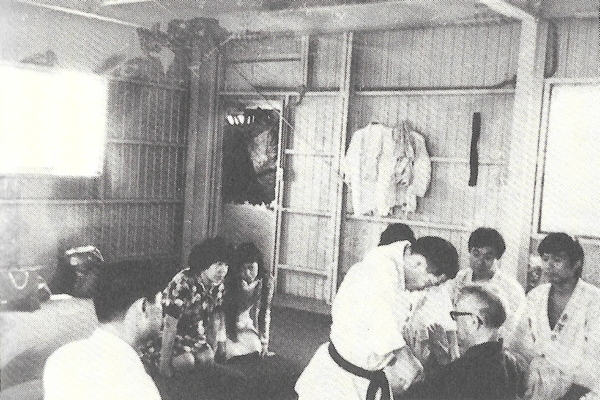
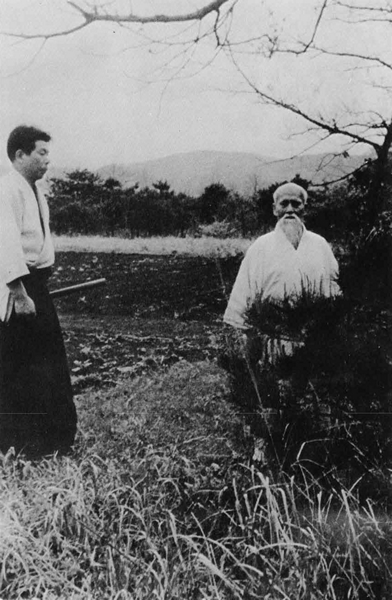
    Kodo Horikawa - Aiki-age

    Hokkaido, 1974 – Aiki-age with Kodo Horikawa


    Published by: Christopher Li – Honolulu, Hawaii
  • A Letter from Kenji Tomiki to Isamu Takeshita

    A Letter from Kenji Tomiki to Isamu Takeshita

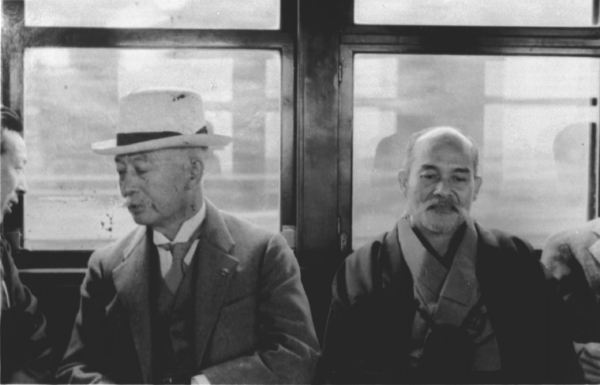
    Morihei Ueshiba and Isamu Takeshita on the trainMorihei Ueshiba and Isamu Takeshita on the train

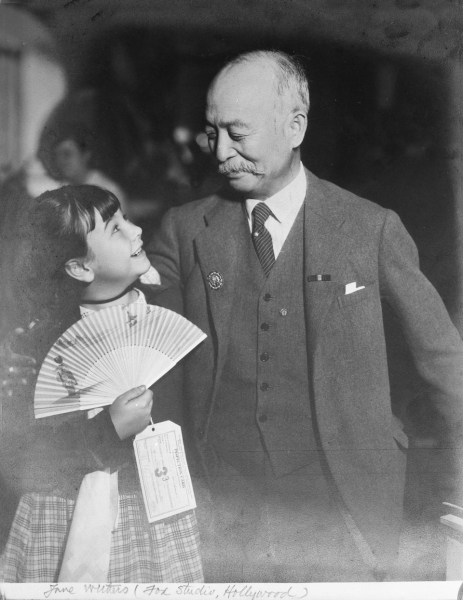
    Isamu Takeshita (竹下勇) was an Admiral in the Imperial Japanese Imperial Navy and a diplomat who helped negotiate the end of the Japanese war with Russia.

    A patron of the Japanese martial arts, he introduced President Teddy Roosevelt to his Judo instructor Yoshiaki Yamashita. A student and patron of Aikido Founder Morihei Ueshiba, he was instrumental in convincing Ueshiba to move to Tokyo and also introduced him to the inner circles of Japan’s military elite.

    Admiral Takeshita also gave what was most likely the earliest demonstrations of Sokaku Takeda and Morihei Ueshiba’s art in North America.

    Admiral Isamu Takeshita in Hollywood with child actress Jane Withers, 1935Admiral Isamu Takeshita in Hollywood with child actress Jane Withers, 1935

    During the summer of 1935, Admiral Takeshita made his fifth visit to North America. Stops included New Orleans, San Francisco, Washington DC, and Seattle. His purpose was to tell US audiences that the international press misinterpreted Japan’s role in China. The Japanese objective, he said, was not to spread the Japan’s Co-Prosperity Sphere but to stop international Communism. “No Japanese warship has ever crossed the Pacific except on a mission of peace,” he said during a radio broadcast in San Francisco. “No Japanese soldier has ever come to these shores except on a similar mission.”

    While in the United States, Takeshita demonstrated aikibudo to judoka and reporters. “I spend at least two or three hours a day with my pupils,” he said. “Ju-jitsu or kendo is an art as far as a foreigner is concerned, but it is also in character-building… Character is the most important thing from beginning to end.”

    According to Takeshita, there were 3,500 holds in his style. Rather than using force to overcome an opponent, the idea was to throw him almost without touching him. The way this was done was by using the opponent’s own energy against him. While Takeshita believed that aikibudo was a dangerous art for a young man, he thought it an excellent method for older men and women. He concluded by saying that it provided excellent training for politicians, as without it he would have become exhausted from all the handshaking Americans expected!

    In Washington DC in September 1935, US newspapermen asked Takeshita about his “jiu-jitsu”. “Flexing the muscles of his arms and grinning,” said the New York World Sun Dispatch afterward:

    The admiral offered to illustrate what he called a more effective manner of combat known in Japan as aikibudo.

    One man, allowing curiosity to overcome caution, volunteered. Like a flash the admiral had the newspaper reporter on the floor, too surprised to do more than gasp.

    ‘I was very gentle with you,’ Admiral Takeshita said. ‘You see, I could very easily have killed you instantly.’

    On his way back to Japan in October 1935, Takeshita also demonstrated aikibudo to Japanese American newspapermen in Seattle. His partner in the demonstration was Yasuyuki Kumagai, 5-dan, the head instructor of the Seattle judo club known as the Seattle Dojo. “The admiral smiled and told Kumagai to get set,” the Great Northern Daily News reported afterwards.

    Both men took the judo pose, and with a sudden movement that was faster than most of the witnesses could catch, Takeshita thrust out an open hand, fingers rigid and pointing to Kumagai’s mid-section.

    That was all, but Kumagai, who knows a little of vulnerable spots on the human body, was startled as well as convinced.

    ‘One inch more and I would have been unconscious or be writhing on the ground in pain,’ said the husky judoist. And most of the bystanders believed him.

    Aikido Comes to America: September 1935
    Journal of Combative Sport November 1999
    By Joseph R. Svinth

    Ueshiba Morihei and Kenji TomikiThe young Kenji Tomiki with Aikido Founder Morihei Ueshiba

    Kenji Tomiki (富木謙治) began training under Aikido Founder Morihei Ueshiba in Daito-ryu Aiki-jujutsu in 1926 after being encouraged to meet Morihei Ueshiba by Hidetaro Kubota (who later changed his name to Nishimura), a fellow Judo student at Waseda University.

    The first known book published by Aikido Founder Morihei Ueshiba (“Moritaka Ueshiba” at the time of publishing) was the 1933 training manual published in English under the name “Budo Training in Aikido“. This manual was initially given to his students as a kind of a teaching license (the full manual is available for free download from “Aikijujutsu Densho – AKA Budo Renshu, by Moritaka Ueshiba“). It is filled with illustrations depicting techniques taught at the Kobukan Dojo which were drawn by Takako Kunigoshi, a student at the Kobukan who began training shortly before her graduation from Japan Women’s Fine Arts University. The text portions of this work were largely compiled and edited by Kenji Tomiki.

    In 1938 he became Morihei Ueshiba’s representative at Kenkoku University in Japanese occupied Manchuria (replacing Rinjiro Shirata, who had originally been chosen, but was conscripted into the military in 1937), and would become Aikido’s first 8th Dan in 1940.

    You may also be interested in these two previous articles about Kenji Tomiki:

    In the current article, created with original materials in Japanese provided through the assistance of Josh Gold and Aikido Journal, is a letter from Kenji Tomiki to Admiral Isamu Takeshita from 1928 (there is a simpler version of this article, without some of the annotations, is also available on Aikido Journal). At this point in time Tomiki had only trained for a short time with Morihei Ueshiba before entering military service, and the letter is written close to the end of that service. He details some of his thoughts and impressions of Morihei Ueshiba’s jujutsu, and the thoughts that it raised concerning Kodokan Judo.

    This letter is actually mentioned by Isamu Takeshita in his diary:

    September 21, 1928

    Received a letter about the Aiki-Jujutsu of Mr. Tomiki, in Hirosaki [Aomori]. Comparing this with Kodokan-Judo interested me. [Note: Tomiki enlisted in the army in Hirosaki since the beginning of January, 1928]

    – from “Summary of Isamu Takeshita’s Diary”
    translation by Fumiaki Shishida

    Enjoy!


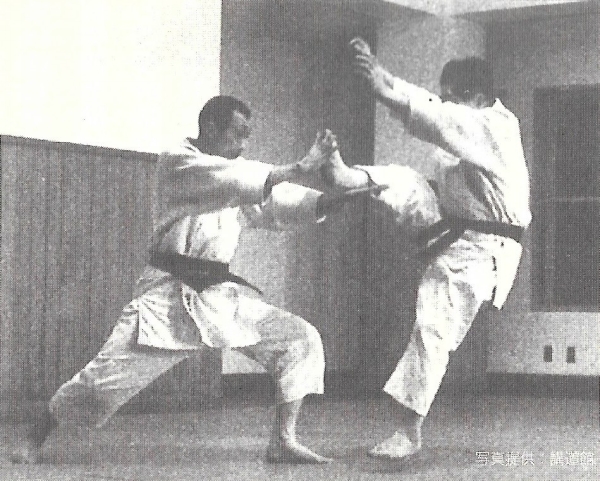
    Kenji Tomiki and Hideo OhbaKenji Tomiki defending against a front kick from Hideo Ohba in 1961

    A letter from Kenji Tomiki to Isamu Takeshita

    September 19th, Showa year 3 (1928)
    To Mr. Isamu Takeshita, 3-5 Kuruma-cho, Shiba-ku, Tokyo-to

    Sent by Kenji Tomiki, 31-5 Kachi, Hirosaki
    Accounting Department Management Cadet

    Heishin (“peaceful/ordinary news”, an honorific greeting)

    Dear sir,

    Since then I have not been able to send greetings for some time. I know that you and your wife have passed that time without difficulties, and I myself am still serving robustly in my employment by the army. The unusual heat wave that has been continuing in this area through the summer has gradually given way to autumn breezes and we can feel the chill in the mornings and evenings.

    We will be dispatched to this year’s special war games that were moved up for the state ceremony to be held in the beginning of next month nearby Morioka, and fortunately we have been granted the honor of participating. I am attached to the headquarters for the 31st Regiment, 6th Battalion, and will be departing twenty-one days from tomorrow. We will start with combined arms training near Aomori and brigade and regiment level opposition, then directly after that proceed with provisional division opponents and finish with the Shinkyo large scale maneuvers (Note: possibly in preparation for the Japanese invasion of Manchuria).

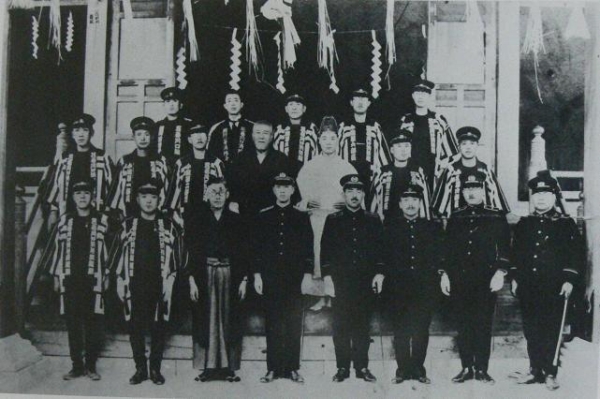
    Morioka Special War GamesPhotograph commemorating the completion of the
    Showa year 3 (1928) Morioka Special War Games

    Only a month after the war games are completed I will be separating from life in the military. After my military discharge, It seems that I will be returning to Tokyo to become a burden upon everybody once more.

    The other day I received a letter from Ueshiba Sensei. He has returned to Ayabe for a short time and will be returning to Tokyo in September. I was certainly happy to know that all of you are researching as usual, and that the number of enthusiastic practitioners grows with each passing day.

    Looking back to last spring when I first received instruction from Ueshiba Sensei, and the short period until my enlistment a few months after that, those were truly days that held great significance to me.

    In addition to an extraordinary revolution in my outlook on Judo, which I had researched for more than ten years since my elementary school days, the instruction and insight that I received into many of the questions and dissatisfactions with Judo that I had felt until that time clarified my thoughts on the current situation of Kodokan Judo.

    Of course the number of days that I have been able to learn jujutsu from my instructor were limited, and even now I am still far from being able to plumb the depths of the deeper techniques. However, and this is based on the research of a short time, here are some of the things that I have been taught up until this time, or that have been wandering through my thoughts, with the knowledge that I have much more to be taught in the future.

    Firstly, I have thought a great deal up to this point concerning what is called the Judo philosophy. I was unable to understand Judo’s place in the midst of the greater meaning of budo, but now I have come to believe that this is clearly so, that is, it is not that I was completely denying Kano Sensei’s philosophy of Judo, but that there are some questions concerning the presuppositions.

    Is the single path of Judo included in the greater meaning of budo? If that is so, then then there is no particular need for argumentation for the viewpoint of Judo. Perhaps it is not that traditional Kendo, Judo and other bujutsu formed as individual entities with individual viewpoints.

    This is what I was taught. What is called budo is a single integrated path, and this path is now expressed in an unbroken form as Kenjutsu, Sojutsu…the Bugei Juhappan (Note: the 18 traditional types of martial arts used by samurai in Tokugawa Japan, based upon earlier Chinese traditions). In past times all bujutsu was, in the end, the manifestation of a unique path of war. Therefore, both Kenjutsu and Jujutsu return in the end to a single path, and it is not necessary to divide Kendo from Judo in order to explain them. Actions of advance and retreat, body posture, breathing – they all must match with each other. However, the Judo and Kendo of the present day are virtually all in the process of becoming increasingly different from each other. Judo is not the same as something in which one holds a weapon, but both of those arts must adhere to the same basic principles. I gave myself up to the clarity of this truth through Sensei’s jujutsu.

    In the ideal budo, as one progresses along the path their technical side progresses in parallel. This varies from what occurs in sports. In comparison to sports, in which records are maintained for the few years of one’s youth in the sport, in budo there comes a gradual increase in skill that accompanies mental conditioning continuing to old age. If we are looking towards this as an ideal, then there are a plethora of questions that arise concerning current Kodokan Judo. If we instead consider the case of Kendo, there are many practitioners who have the spirit to keep striving vibrantly past their 60’s, a better match with the ideals of budo.

    These weaknesses have all been resolved by Sensei’s jujutsu.

    It can be thought that Kodokan-ryu only hopes for growth within an extremely limited area. Therefore, with the drawbacks caused by the introduction of things such as modern boxing and Tode-jutsu (Karate) it can be felt that it has reached a practical dead-end in modern times.

    If that is so, then from where do those weaknesses emerge? In the end, I think that it returns to the fact that the current Kodokan-ryu has grown based upon games for physical education rather then self-defense techniques. In that lies a great deal of the fault.

    This can be understood through research into the origins of jujutsu and the sources behind the establishment of Kano Sensei’s Kodokan Judo. In the past the general jujutsu which has divided into many different schools was all for the purpose of shinken-shobu (Note: 真剣勝負 – a match with a live blade. In other words, a fight that determines life and death). Then, from those ryu-ha various schools that focused on throwing techniques such as Kito-ryu (起倒流) and Yoshin-ryu (楊心流), or those which specialized in striking (atemi) and holds such as Tenjin Shinyo-ryu (天神真楊流) and Yoshin-ryu (楊心流) differentiated themselves. However, the long and short of it is that defense against attacks was the primary focus, so that joint techniques were the most common. Consequently, Kano Sensei removed the joint techniques from those schools, avoided striking (atemi), chose the least dangerous strategies and established a Kodokan Judo that was appropriate for modern times. Then a variety of competitive methods were established from the most interesting principles and finally we have what is thriving today. On the other hand, it ended up as being completely a sport. Ueshiba Sensei would often say “Are things like Kodokan Judo useful? That’s not real bujutsu.”, and actually the reality is just that. Looked at from the viewpoint of self defense it’s completely powerless. And then, looked at from the viewpoint of true bujutsu it’s at the point of heresy. However, if one looks at it from the point of view of a sport then I think that it functions very well. I believe that here are the current reasons for modern Judo.

    So in the end the problem must become “Which reason for Judo’s existance is most common in modern times, as self-defense or as a sport?”. Putting this problem aside for the moment, I would like to talk just a little about clarifying another side of the problem, the start and end of the controversy that engendered the Kodokan method of competition.

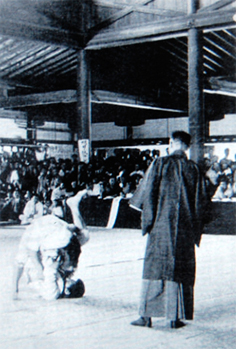
    Sankaku-jime applied at the 1920 Kosen Taikai.Kosen Judo – at the heart of the controversy over groundwork in Judo
    Sankaku-jime applied at the 1920 Kosen Taikai

    In former years there were rival Judo matches between Senior Dai-ichi High School and Senior Dai-ni High School. As a result, although Dai-ichi High School had a leading third dan and a number of black belts, Dai-ni High School, who never had more than one or two black belts, would place higher in the competitions. What it came back to is that Dai-ni High School trained thoroughly in ground techniques, so Dai-ichi High School had no space in which to attack them. Kano Sensei was extremely critical of this:

    “The foundation of Judo is shinken shobu. In times past ground techniques were used after the first opponent was fully overwhelmed in order to completely control a second opponent. In comparison to those times Dai-ni High School responds to an attack with ground techniques from the very beginning. This is not a proper thing to do for shinken shobu, extremely cowardly..”

    A great controversy grew surrounding this.

    We didn’t like ground techniques and we felt that the behavior of Dai-ni High School was underhanded. However, in terms of theory we knew that they were absolutely correct. That is, modern Kodokan Judo is sports. Therefore, as long as something does not violate the rules of the decided upon method of competition the goal is to win. Things such as shinken shobu were outside of the equation in this case. Accordingly, I believe that the use of Dai-ichi High School’s weakness in ground techniques to get the win is only reasonable. This problem of ground techniques versus standing techniques is a continuing problem, even today.

    However, just delaying to a draw by responding unconsciously with ground techniques lacks an aggressive mindset – there is a great deal there that contradicts the warrior’s “battle to the death without surrender” attitude. And further, the fact is that one can practice throwing techniques for three or four years without developing real skill. In comparison, combining ground techniques with physical strength one can achieve significant results in only six months or a year, so they are very effective when going into competitive matches. What is prized in paired sports is victory in competitive matches rather than shinken shobu, so if the same mental and physical conditioning, sacrifice and effort is necessary to achieve that then I believe that it is best for us to take the route towards ground techniques rather than throwing techniques.

    In the midst of those valued words from Kano Sensei that I mentioned before, modern Judo is gradually developing as a sport. Furthermore, I know that there is a dilemma in its gradual separation from shinken shobu (life or death attitude/intent.)

    Translator’s Note: Jigoro Kano himself apparently had misgivings about Judo as a sport, expressed here to Gunji Koizumi in 1936:

    I have been asked by people of various sections as to the wisdom and possibility of Judo being introduced with other games and sports at the Olympic Games. My view on the matter, at present, is rather passive. If it be the desire of other member countries I have no objection. But I do not feel inclined to take any initiative. For one thing, Judo, in reality, is not a mere sport or game. I regard it as a principle of life, art and science. In fact it is a means for personal cultural attainment. Only one of the forms of Judo training, so-called Randori or free practice, can be classed as a form of sport. Certainly, to some extent, the same may be said of boxing and fencing, but today they are practised and conducted as sports. Then, the Olympic Games are so strongly flavoured with Nationalism that it is possible to be influenced by it and to develop ‘Contest Judo,’ a retrograde form as Ju Jutsu was before Kodokwan Judo was founded.

    Fulfilling His Duty as a Member: Jigoro Kano and the Japanese Bid for the 1940 Olympics
    By Joseph R. Svinth

    The benefits that come from Kodokan Judo are usually explained by the following four points:

    1. Methods of physical education. (“taiiku-ho” / 体育法)
    2. Methods of cultivating the spirit. (“shushin-ho” / 修心法)
    3. Methods of consoling the spirit. (“ishin-ho” / 慰心法)
    4. Methods of self defense. (“goshin-ho” / 護身法)

    Shusaku Kiryu, University of TsukubaShusaku Kiryu, University of Tsukuba Judo Team

    The purpose of this study is to clarify the background and intent of Kano Jigoro when he introduced the concept of ishinho (method to console the spirit) as one of the objectives of judo. Kano initially described the purposes of judo as taiiku (physical education), shobu (martial arts), and shushin (to master one’s spirit). Later, Kano add ishinho as an additional objective, but the reason he did so is unknown. Upon examining Kano’s writings and the aspects of judo popularized during this period, I was able to clarify the following:

    1. After 1883, judo penetrated schools as an extracurricular activity. Later, many judo clubs were established and they began holding inter-school matches.
    2. Kano showed that people who trained in the discipline of judo reaped the benefits of judo- taiiku, shobu, and shushin.
    3. In 1911 , judo became a standard subject in Japanese high schools. Later, Kano announced the inclusion of ishinho as an objective of judo, and added additional, factors (including the pleasure of exercise; the enjoyment of watching randori, competitions, and kata; and kata as an art form) to judo.
    4. Kano generated a new concept of ishinho against the background of his knowledge of dissatisfaction with normal gymnastics, the various benefits of judo, and the merit of athletic sports. With increasing inter-school matches, ishinho disappeared from Kano’s works, and students became involved in many scandals. Instead of ihsinho, Kano appealed to all people to improve this situation, whether they practiced judo or not.

    The Introduction of the Concept of “Ishinho” to Judo
    and the Thoughts of Kano Jigoro
    – Shusaku Kiryu, University of Tsukuba

    When I attempt to compare Ueshiba Sensei’s jujutsu to these points the following thoughts arise:

    1. There is certainly a danger of harm when elementary and junior high school students train normally for competition. If the instructor exercises appropriate caution then it can be suitable even for those who might be considered unsuitable for Kodokan-ryu such as the elderly and women. Therefore, I believe that on that point, or as concerns Judo as exercise, that it is by no means inferior.
    2. As a budo with a goal towards cultivating the spirit its goals are the some, so in the end it returns to a problem of the instructor, but I believe it to be far superior in terms of its great emphasis on spirituality.
    3. As for “Methods of Consoling the Spirit”, it is said that Kodokan-ryu appeals to feelings for the fine arts, but conversely, these things can also be seen in this jujutsu. As an example of a refined and elegant kata in Kodokan-ryu there is “Itsutsu no Kata” (五つの型), which expresses the feelings of the rushing of the waves, but in this jujutsu this is expressed, not in kata, but in the course of normal practice. Further, it is the same for “Ju no Kata” (柔の型), there are many points in this jujutsu that are extremely similar. However, in “Ju no Kata” the Kokyu is completely missing, making it end up spineless. It is the same for the movement postures – it is thought that when those are mastered by the women in Kodokan-ryu that they are able to able to attain a beautiful posture. However, the kamae of the legs and hips in this jujutsu and the movement of the body matches precisely to Noh dance, so I think that on this point it is actually ideal.
    4. Needless to say, as method of self-defense there is a remarkable difference. Firstly, as a conditioning method (鍛練法), and I was taught an enormous amount about this point. As a conditioning method there are two different methods. That is, one method favors randori over kata, and one method favors kata over randori. In addition to Kodokan Judo, modern Kendo also makes use of the former method, and this point can be thought to reveal a weakness of current-day bujutsu. In the end, this can be thought to be a consequence of the development of bujutsu that focuses on competition.

    The harm of a focus on randori is that one tends towards the few techniques that one is skilled at and strays from the path, degenerating into simple physical strength. Although that is fine in terms of physical education, in order to grasp the true spirit of bujutsu I believe that clearly maturing the meaning of that bujutsu through kata before entering into randori is the way to eliminate mistakes. In this jujutsu the focus is on kata, but what seems to be a rather roundabout way to understand the meaning of that bujutsu is conversely a shortcut, and can be thought to eliminate mistakes. However, what I think is even more superior here is that although it is called kata it is not the same as the fixed fifteen throwing kata or the joint locking kata limited to so many techniques of Kodokan-ryu. They are flexible and freely adaptable to whatever situation arises – they are kata that are themselves randori.

    When actually observing Kodokan-ryu and others and researching into their historical origins I was able to clearly ascertain the points of superiority of this jujutsu. Thus, the desire to understand the value of this jujutsu from the wider perspective of Nihon Bujutsu has been continuously on my mind.

    As I said before, I have trained in Judo for many years, but in the end I never took it a single step past the point of view as a sport, and accordingly I researched it as a superior method of physical exercise, but when I emerged from my academic studies limits on my time, stamina, and location made me think that Judo was something that I would have to distance myself from. However, through an unexpected chance I was able to observe Sensei’s technique, and found a place for the Judo that I had thought to abandon and came to believe that here was something that I could continue to practice and improve forever as another form of exercise and a training interest. I enlisted just as I graduated last spring and leaving my classroom and my home behind then had the time to devote myself to Sensei’s instruction.

    I would like to return to Tokyo after my military discharge and find some employment there, but I am also hoping to be able to spend a long time on research into everybody’s instruction in jujutsu, if it pleases you.

    Chinkon KishinChinkon Kishin Training at the Omoto compound in Ayabe, 1921

    Finally, there is the issue of Sensei’s faith, I felt some uncertainty just as I visited Sensei in Ayabe last summer. My uncle and Mr. Kubota are examples, but there was not much support for my trip to Ayabe. However, I believe that Omoto-kyo and bujutsu are completely separate. While I was staying in Ayabe I always heard talk of faith from Sensei and other people, and perhaps due to my sceptical nature and the many subjects that I could not fully comprehend I was unable to understand this Omoto-kyo that is filled with miracles that surpass modern science. However, I have great admiration for Sensei’s faith and Sensei’s humble attitude towards the Gods. and I have thus deeply considered many points concerning Sensei’s techniques and his faith. It is not necessarily limited to Omoto-kyo, but it may be that it is with faith that bujutsu first reaches that level, that I may be been taught at a visceral level that bujutsu shugyo is something that in the end returns to faith.

    Day by day the weather is becoming colder, I am praying for all of your health. Finally, thank you for taking the time to consider my ramblings.

    September 19th

    Respectfully,

    Kenji Tomiki to the honorable Mr. Isamu Takeshita

    Postscript: Please give my best regards to Mr. Shimoji and Mr. Yamamoto.

    1. This letter was transcribed by Professor of Intellectual History of the Japanese Martial Arts at Waseda University and Aikido Shihan of the Japan Aikido Association Fumiaki Shishida, from a copy received from Daito-ryu Aiki-jujutsu Hombu-cho Katsuyuki Kondo. Kenji Tomiki’s handwriting was deciphered with the assistance of Mr. Seiichi Saito, who studied under Kenji Tomiki during his time at Kenkoku University in Manchuria, but there were a few places that were unclear and I hope for clarification at a later date. There may have been mistakes and imperfections in the copy, but it goes without saying that the wording of the text is the responsibility of the editor. With deep gratitude towards Kondo Sensei and Saito Sensei, Shishida Fumiaki – January 18th 1991.
    2. The original materials in Japanese were provided with the assistance of Josh Gold and Aikido Journal.

    Published by: Christopher Li – Honolulu, Hawaii
  • Budoka no Kotae – Talking to Kisshomaru Ueshiba Sensei

    Budoka no Kotae – Talking to Kisshomaru Ueshiba Sensei

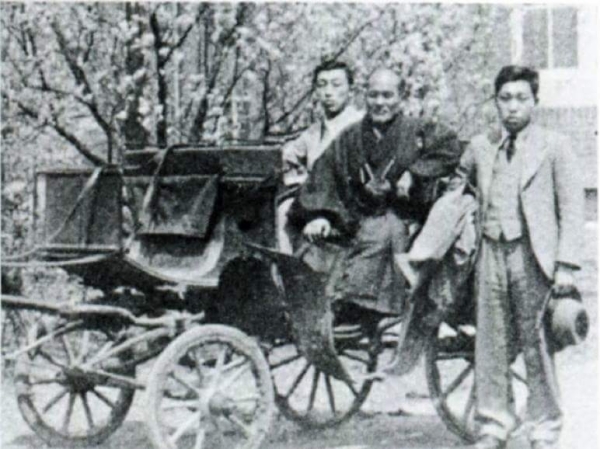
    Morihei Ueshiba 1925Kisshomaru Ueshiba with his father Morihei Ueshiba
    at Ueshiba Juku in Ayabe around 1925

    Kisshomaru Ueshiba was born on June 27, 1921 at the Omoto-kyo compound in Ayabe, where his father Morihei Ueshiba opened his first dojo, the Ueshiba Juku.

    In 1927 he and his family moved to Tokyo, where his father would open the Kobukan Dojo – which would eventually become Aikikai Hombu Dojo.

    In 1942 Morihei Ueshiba told his son to “Defend the dojo with your life!”, and retired to the countryside in Iwama.

    After the passing of Morihei Ueshiba on April 26 1969 he became (after some disputes involving his brother-in-law Koichi Tohei) the second Doshu of the Aikikai organization. Until his death on January 4th 1999, Kisshomaru Ueshiba would be the primary presence and director of the post-war Aikikai organization.

    Kisshomaru Ueshiba has appeared in a number of previous articles:

    The current article is the English translation of an interview that originally appeared in “Answers from Budoka” (“Budoka no Kotae” / 武道家の答え), published by BAB Japan in 2006.

    In this interview Kisshomaru Ueshiba Doshu discusses his effort to change and adapt his father Morihei’s art for a modern world.

    Aikikai Aikido Shimbun - January 1999Aikikai Hombu Dojo Aikido Shimbun – January 1999
    “To the spirit of the past Doshu”
    by San-Dai Doshu Moriteru Ueshiba

    “The techniques and way of Aikido that the founder O-Sensei left us, was not always easily understood by everyone. Doshu, my father, changed these so they would be easily understood, and he gave all of his life to spread this. For that reason he left behind many books that he had written. I grew up watching Doshu return from keiko to study and write for long hours and even with my child’s eyes I could see the importance of this work”

    The fruits of those efforts have spread Kisshomaru Ueshiba’s version of the art across the world, but have left his son, San-Dai Doshu Moriteru Ueshiba, with challenges of his own.

    Peter Goldsbury, 7th Dan Aikikai and chairman of the International Aikido Federation (IAF) from 1998 to 2016, made some interesting comments on the current state of this situation on Aikiweb, in a discussion on the course of Aikido going forward into the future (extracted from two separate comments):

    I had a private conversation with H Isoyama a few months ago. Isoyama began training in Iwama at the age of 12 and grew up under Saito’s tutelage. Kisshomaru was also there and the Hombu was actually in Iwama at the time. He noted that a recurring problem in Iwama and in Tokyo was “what to do about the old man,” up on the floating bridge with his deities, whereas Kisshomaru was concerned with trying to fashion aikido into an art that could actually survive in postwar Japan and that meant making some important compromises.


    I think you can see Doshu’s dilemma (*the current Doshu, Moriteru Ueshiba). He has to continue to teach the ‘essence’ of the art, but without knowing very much about what his grandfather actually did. He is a few years younger than I am and all he knows has been filtered via Kisshomaru and those deshi of Kisshomaru’s generation. Doshu’s son Mitsuteru will have an even bigger problem.

    Apart from a few exceptions like Tomiki and Tohei, Kisshomaru allowed the old deshi like Tada, Yamaguchi, Arikawa to get on and teach what they had learned from Morihei Ueshiba directly, in so far as they understood this. The variety was allowed to flourish, but with the passage of time there has been an inevitable dumbing down and an increasingly frantic insistence that what the Hombu is doing is the only means of aikido salvation. I think if the Aikikai could make the eight basic waza into sacraments, they would leap at the chance.


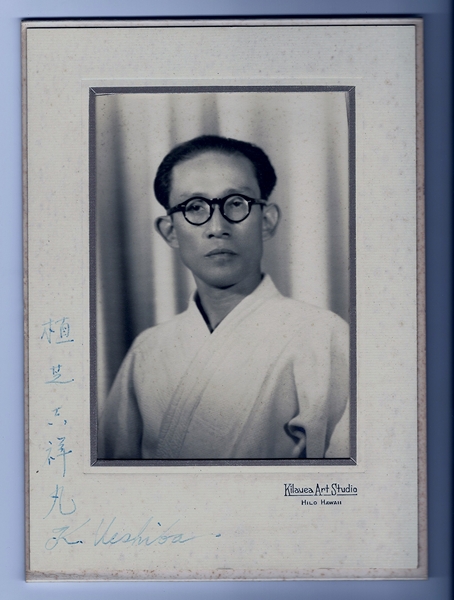
    Kisshomaru Ueshiba 1963, taken at Kilauea Art Studio in HiloKisshomaru Ueshiba in 1963
    taken at Kilauea Art Studio in Hilo, Hawaii

    Budoka no Kotae – Talking to Kisshomaru Ueshiba Sensei

    From “Stopping the Spear” to a “Great Strategy”

    Q: First I would like to ask you, what are the current goals for your Budo training?

    A: As to the current goals of my Budo training, I am not thinking at all of things such as becoming strong through Budo, or striking and throwing an opponent. I am thinking of it as a method of lifetime training through the Way of Budo. It is improving the human spirit and pursuing a leap of the psyche – training with like minded people and extending the influence of those people into society, not only in Japan, but also overseas to build a worthwhile and peaceful society. It is because the way to society is through this path that the International Aikido Federation (IAF) was formed – and happily, Aikido has recently experienced widespread growth overseas.

    Q: What is the current condition of Aikido overseas?

    A: Of the Japanese Budo that are popular overseas, the present state of affairs is that Aikido follows after Judo and Karate. For example, if I speak of the case of France, which has not hesitated to accept the influences of Japanese culture, there are about 378,000 people doing Judo followed by about 78,000 people doing Karate. Aikido is said to have about 40,000 people, and I have heard that is followed by Kendo with a few hundred people. So there’s that much of a gap between them. Since becoming the world’s Judo and raising their flag at the Olympics the societal awareness of Judo has become much greater. Karate is not only Japan, Chinese and Korean Karate have also become much larger.

    Karate is a fierce Budo that focuses on striking and kicking, and is popular with young people. I think that it is excellent for training the minds and bodies of young people. However, I think that there are some things in Aikido that are a little different. That is, from the past Aikido has forged techniques through typical methods of Budo conditioning, and that there are no shiai (試合 / “contests”). Because when one competes one becomes caught up with thoughts of winning or fear of failure. In the midst of the movements of Aikido’s techniques, in natural movement, we pursue the unification of body and mind (心身統一 / “shin-shin toitsu”) – it is where we fulfill that to the greatest degree that we refine our humanity.

    Kisshomaru Ueshiba in HawaiiKisshomaru Ueshiba in Hawaii

    Q: Do have some special method of training?

    A; The thought of a special method of training has never crossed my mind. I believe that the most important factor in the value of modern Budo is that anybody can practice it comfortably in any location. That is an absolute requirement, because it will then become a positive force for society. Nowadays, one cannot go up into the mountains to train like a warrior from the Sengoku Period or feudal times and then do something like declare “I have become strong” and make your appearance as a master… I suppose that there will be some people who will approve of that, but it doesn’t match the flow of today’s society. There should be a Budo that is cultivated from the midst of present times. If it is not a Budo that can live in modern times then there is no societal value.

    Q: It is said that Aikido is a Budo that pursues spiritual values, in what form does it appear overseas?

    A: As regards overseas, there are those who have an interest in Zen or eastern culture such as Chado (tea ceremony). It is a particular characteristic of Aikido that there are many intellectuals who have an interest in it.

    Previously I brought up the case of France, where there are 378.000 people practicing Judo, but in contrast to Judo and Karate it is a particular characteristic of Aikido that the number of children practicing is very small. So when one is older, even elderly people can practice.

    In Aikido my father used the training methods of many of the Kobudo (“ancient martial arts”) – these, driven by spiritual philosophical principles for today’s world, are Aikido.

    When I went to New York in Showa year 38 (1963) a professor from New York University said “Even someone my age can do Aikido. I practice Zen, but Aikido can be interpreted as moving Zen, can’t it?”. Then I said “There are those people who say that Aikido is moving Zen”. After I said that there – before I knew it the mass media and others such as Buddhist priests started telling me that Aikido was moving Zen.

    Q: What are the essential points at which Aikido differs from other Budo?

    A: There are nine groups registered with the Budokan as Japanese Budo. Including the Budokan there are ten groups that make up the Budokyogikai (武道協議会). Judo, Kendo, Karate, Shorinji, Naginata, Sumo, Kyudo, Jukenjutsu and then Aikido, but Aikido is the only one of these that does not have a competitive form. I would be happy if you could be aware of the fact that it is in this area that Aikido has a different perspective than other of the standard Budo.

    Q: Does that mean that Aikido is not a type of Kobudo?

    A: Depending upon the person there are those who say that Aikido may enter the category of Kobudo, There is certainly no mistaking that the fact that Aikido originated from Kobudo, and in Aikido my father used the training methods of many of the Kobudo – these, driven by spiritual philosophical principles for today’s world, are Aikido. For that reason I always say that Aikido is a question of the spirit. Please think of it in this way.

    Kisshomaru Ueshiba's WeddingKisshomaru Ueshiba’s wedding in Iwama
    Morihei Ueshiba seated between the newlyweds

    Morihei Ueshiba was a Budoka who established a Way of the Spirit

    Q: Who are the Budoka that you most respect?

    A: As one training in Aikido I respect my father (Morihei Ueshiba). Although there are many others that I would bow my head to…

    Q: Can I take that to mean that this is because Morihei Sensei had his eyes on the same goals as you do?

    A: There are those who say that my father was strong. That may also have been part of it. But that kind of thing is no reason for respect. It is only because he established a new Way of the Spirit called Aikido that he is worthy of respect. My father was a man of the old school, so it may be that there are some things about me that he was not satisfied with. However, things were left to me because I was his child, so I did my best to develop this Way into a modern Way.

    There are no incredible “secret teachings”

    Q: Saying that, if I were to ask you what the secret teachings (極意 / “gokui”) of Budo are you might call that something like nonsense?

    A: I’m glad that you said that. Around the beginning of Showa (1926-1989) , when a person asked my father “Sensei, what are the secret teachings? Please show us the secret teachings.” he replied “Isn’t everybody doing the secrets? I show the secrets from the beginning. There’s no this is secret, that is secret, there’s nothing incredible. That’s why if you look at the scrolls you won’t understand anything. There’s no this is secret, that is secret, that’s just magic tricks. It’s nonsense to even discuss it.”. I believe this as well.

    The secret teachings of the past would just come naturally through practicing wholeheartedly. It was a matter of the spirit, one would just suddenly say “Ah, I see!”. Among Kobudo people there are really those who talk about ridiculous things like this is secret or that is secret, but from my point of view that’s not acceptable.

    My father said “Isn’t everybody doing the secrets? I show the secrets from the beginning.”

    The strength of Japanese culture

    Q: What motivated you to pursue Budo?

    A: In the past my father said “I am not planning for you to succeed me in Budo”. However, after the war there wasn’t any particular work available. At that time I spoke to some people who had come back home after studying abroad. With the end of the war the local Japanese students felt as if they were suffering from things like dementia or castration, and were dealing with it by running away secretly from place to place. I truly felt miserable as I listened to them.

    I thought “Japan fought against the rest of the world, that’s how much strength the Japanese people possess. What can I do?”. So then I asked my father if there wasn’t something, if there wasn’t something from the traditions of Japan.

    As I was pondering that, I found that there was something. Aikido. I thought that in Aikido – the end of my father’s religious training – was a really wonderful expression of the Japanese and Asian people’s culture. Then I worked to move  Mac Arthur’s command division and the Ministry of Education, and the Kobukai that had existed up until that time was re-recognized in February of Showa year 23 (1948) as the national organization of the Aikikai Foundation. My father at the Ibaraki Dojo said “I am focused on my Budo training, so you do it! You can more or less handle things.”, so I went ahead and started things in Tokyo.

    O-Sensei and KisshomaruMorihei Ueshiba and Kisshomaru Ueshiba
    in front of Aikikai Hombu Dojo

    Up until that time at the Ibaraki Dojo one could not become a student without an introduction, so there were many distinguished personages, these certainly weren’t regular people. It was through the cooperation of such people that the Aikikai was able to spread nationally. To speak of that, the Tokyo dojo until that time was a wooden structure that leaked when it rained. Moreover, there had been a number of fires, which we extinguished each time with buckets of water.

    Also, there were many war refugees in the dojo. It took until around Showa year 30 (1955) to move all of those people out.

    When the older students gathered to train we started to say “Let’s set our sights overseas”, and we turned our eyes to enthusiastic young people to transmit the virtues of Aikido. So it was that the with the expansion overseas we followed Judo and Karate in their development.

    Furthermore, around Showa year 30 (1955) I left my company in order to give my undivided attention to Aikido and create a student based organization – I sent shihan to around 150 schools to develop the organization. There we go back to what we discussed at the beginning, My feelings that grew after the war when I first thought to devote myself to Aikido. However far the Japanese people may fall, they possess something that is peculiar to the Japanese people. Everybody knows that Einstein is a famous scientist. His exceptional brilliance was the foundation of what is called his insight. To express things differently, as in the example of a spinning top, the pursuit of that “perfectly clear state of mind”  (澄み切りの境地 / “sumi-kiri no kyouchi”) is the goal of Aikido.

    I think that the prosperity of Japan is the result of drawing on the wisdom of the people in each of their fields. However, the prosperity of today’s Japan is not enough, I think that spiritually there is also an aspect of that prosperity that is very negative. I believe and desire with all my heart that the Aikido that I have explained to you can be something that can, at the very least, compensate for some of those negative aspects.

    Q: Thank you for taking to time out of your busy schedule to cooperate with us.

    Kisshomaru Ueshiba at Aikikai Hombu Dojo in 1967Kisshomaru Ueshiba at the old Aikikai Hombu Dojo

    Published by: Christopher Li – Honolulu, HI

  • Budoka no Kotae – Talking to Morihiro Saito Sensei, Part 3

    Budoka no Kotae – Talking to Morihiro Saito Sensei, Part 3

    Morihiro Saito and Morihei Ueshiba in IwamaMorihiro Saito and Morihei Ueshiba in Iwama
    “Traditional Aikido – volume 2”

    While he was working for the former Japan National Railways, Morihiro Saito Sensei lived in the Iwama Dojo compound, taking care of O Sensei and the Aiki Shrine and teaching in the Iwama Dojo. Sensei was devoted to O Sensei and for this I respect him. I often met Saito Sensei when I accompanied O Sensei to Iwama and during preparations for the Aiki festival. O Sensei was always there, so I don’t have any memories of taking any of Saito Sensei’s classes.

    O Sensei was more than 75, so his techniques and movements had fully matured. Kisshomaru Sensei wasn’t around, and the techniques and movements changed. In one direction, Saito Sensei absorbed completely the movements and techniques that O Sensei had taught when he was healthy and strong. Since O Sensei lived in Iwama which had the Aiki Shrine as well, I think in that context it is proper to speak of “preserving the traditional Aikido of Iwama.” The Iwama Dojo was located in a large garden-like compound which was needed to practice ken and jo. O Sensei would teach ken and jo however he felt inclined, and then the next day would do something completely different. It was owing to the genius of Saito Sensei that an easy to understand system of teaching jo and ken was established. My dojo’s Igarashi Sensei cooperated with Saito Sensei’s publication of his book on jo and ken. When I was shown the first edition of the book, I noticed there was no photograph of O Sensei. I said something about this to Saito Sensei and he replied that he had no good photographs of O Sensei. Good photographic equipment wasn’t so readily available in those days. In the second edition appears photographs of O Sensei which I gave to Saito Sensei.

    With this kind of connection, Aikido Kobayashi Dojos have incorporated regular ken and jo practice. Saito Sensei highly praised us for this. Today, in overseas seminars, everyone has their own jo and ken; this is Saito Sensei’s legacy.
    Yasuo Kobayashi talking about Morihiro Saito in “Aikido, My Way“

    Morihiro Saito Sensei was born on March 31st, 1928 and passed away on May 13th, 2002. For more than twenty years during that time he trained directly under Aikido Founder Morihei Ueshiba, one of his closest and longest serving students.

    Morihiro Saito acted as the guardian of the Aiki Shrine until his passing in 2002. He is famous for his dedication to preserving the exact form of Morihei Ueshiba’s techniques as he was taught them during his training under him in Iwama.

    This is the third  section of the English translation of a three part interview that originally appeared in “Answers from Budoka” (“Budoka no Kotae” / 武道家の答え), published by BAB Japan in 2006. You may wish to read Part 1 and Part 2 before reading this section.

    Morihiro Saito - "Traditional Aikido - volume 2"Morihiro Saito – “Traditional Aikido – volume 2”
    Budoka no Kotae – Talking to Morihiro Saito Sensei, Part 3

    Q: Was it possible that he had some goal in mind?

    A: No, that’s not it. He was angry. Because even though he would tell them to practice precisely and sharply they would only do flowing training. It annoyed them when the Founder said that and scolded them, so they would call and say “Saito-san, tell him that something came up and call him (the Founder) home”. When O-Sensei was there they’d say “That annoying old man is here”. So the Founder’s feelings finally snapped and he stopped teaching there.

    Q: Something like “Respect from a safe distance” (敬して遠ざける)?

    A: That’s right. For that reason, when he returned here he would stamp his feet and yell. Things like “Unacceptable!” (なっとらん!).

    Kisshomaru Ueshiba at Aikikai Hombu DojoNi-Dai Doshu Kisshomaru Ueshiba at Aikikai Hombu Dojo
    The establishment of Hombu style

    Q: How did things get that way?

    A: I believe that it was caused by the sudden emergence of Aikido into the world after the end of the war. Because those demonstrations showed it in a really beautiful manner. For that reason people flocked to Aikido, and since they showed those people flowing movement everybody was happy. So because of that people said that Aikido is an enjoyable Budo, it’s beautiful, it’s smooth and attractive.

    So Hombu Dojo, for that reason, had a temporary golden age. During that time people who were second or third dan scattered across the world. They said that they wanted to make a name for themselves. That is the Hombu Style that foreigners talk about. I followed another path of static training without doing that, so people around the world call that Iwama Style. They became international terms. A division that came about inside the same Aikido.

    “Iwama Style” is first known overseas

    Q: Is Iwama Style something special?

    A: Some people don’t like it, you know, those from Tokyo. Or even from the country areas. So there are a lot of enemies. Even though when one speaks of Iwama Style one is speaking of the Founder’s style…

    Q: Was it the same overseas?

    A: However, I was rescued by the discovery of that book by the Founder. That book…that researcher into the history of Aiki from America, he found it in the countryside. That book proved that what I am doing is correct.

    Morihiro Saito teaching from the 1938 technical manual "Budo"Morihiro Saito teaching from the 1938 technical manual “Budo“

    Q: You must have been happy?

    A: I was ecstatic! That’s why i carry that copy, and wherever I go I show it to people and say “There you are! Look at this, this is how I am teaching you”. When you compare the training, in the end it slaps them in the face. Aikido began from this Founder, and when you explain this clearly everybody is happy. There was someone from Switzerland who came the other day, tomorrow someone from Canada, they’re throwing away the techniques that they’ve been learning for fifteen years and starting over again from the beginning. I really have to give them credit.

    Q: It’s significant that they even had the strength to make that realization, isn’t it? How about the Japanese instructors?

    A: As you might expect, one issue is that without financial strength, making the changeover is difficult. Other than that, there are doctors, people running companies, and people who have their own jobs who are realizing that this is different from the Aikido that they have done previously and are devoting themselves to making a changeover. For that reason, I take precisely what I was taught by the Founder, make it easy to understand, and have them study it.

    Q: Will you publish a book about that some day?

    A: I’m thinking about it.

    Q: Who is this? (pointing to the Founder’s book)

    A: The Founder used that name at times. He’d use the name Tsunemori (常盛) or Moritaka (守高), but the name that appears in his family register is Morihei (盛平).

    Q: Is this the original?

    A: No, it’s a copy.

    Q: I see, the reproduction is very good. Is there an original copy someplace else?

    A: This name here is the name of the person to whom it was given. This was not made public in Tokyo. Perhaps the Ueshiba family has it.

    This book is proof that I have been practicing honestly, Ha-ha-ha, it really helped me out. From that time I carry it with me whenever I go out in the world, Because from here this has changed again. I can explain the changes.

    Morihiro Saito - "Traditional Aikido - volume 3"Morihiro Saito – “Traditional Aikido – volume 3”
    Tales of experiences with Aikido (武勇伝)

    “Train sincerely in the basics – the power found in them is kokyu-ryoku, Ki is there, Ki is extended, this will be the result.”

    Q: By the way, this is a lower level question, but this book is targeted at a general readership who will be happy even with a casual discussion, so may I ask you some of those types of questions?

    A: Even now we use these training methods, so in the end I think that I would like people to enjoy what they are reading.

    Q: Yes, that’s right, isn’t it? For example, if you will excuse me, if you have some stories of a time that you were caught up in a fight related to Aikido, or a “tale of heroism” (武勇伝), or a story of a spiritual experience, then I would like to ask you about them.

    Stanley Pranin and Morihiro SaitoAikido Journal Editor Stanley Pranin translating for Morihiro Saito
    A: I don’t know what you mean by spiritual, but Aikido training has conditioning in breath power (“kokyu-ryoku”), this is an extremely logical method of expressing power.

    One night at Chichibu Station there was a fireworks display. About twenty people missed their chance to ride the last train and were in the station’s waiting room.

    At that time someone who looked like a yakuza grabbed a young man wearing a business suit by the lapels and started pushing him around. So I said “Hey you, stop that!”, but he wouldn’t stop! Then when I grabbed the arm of the person who looked like a yakuza he let go of the other person and started grappling with me. So I took a step back, put my hand slightly under his chin and went to throw him. When I swept him with my right leg he flew straight backwards and hit his head on the concrete – he lost consciousness. The railway police came right away, so I passed him over to them.

    That kind of kokyu-ryoku is what people talk about when they say things like “extend Ki”, but in the end Ki isn’t something special. Train sincerely in the basics – the power found in them is kokyu-ryoku, Ki is there, Ki is extended, this will be the result. When entering through theory without doing the actual techniques one cannot really realize this.

    Q: If that is done, when a person surpasses a certain level will they be able to flip an opponent’s body over lightly just by touching them?

    A: That’s if one is following the principles strictly, and if the situation at the time allows for it.

    People who can match that skillfully with whatever technique is being used are skillful at Aikido. The person who takes the angle rationally is a strong person.

    Morihiro Saito and Morihei Ueshiba - 1954Morihiro Saito and Morihei Ueshiba – 1954
    Q: When the opponent is an older person, or someone who’s body is stiff, no matter how skillful one is their way of falling will be unnatural – don’t they ever get injured?

    A: There are often people who take pride in injuring others during Aikido training, but if one does it carefully they can become skillful without causing injury. The Founder almost never injured anybody! He taught us like beginners until our ukemi gradually became skillful and then skillfully led us into the bigger throws. When people like children fell he would put his hand under their head as he threw – it was really tender behavior.

    As to other stories… Aikido begins with hanmi. If one steps forward, if one steps backward, if one opens or moves forward. I had in experience related to this.

    At one time I was employed by the Japan National Railway. The tracks have inbound lines, center lines and outbound lines. On that day, I went out for a task at an engine that had stopped on the center line. At that time the steam engine was puffing steam, and since it was the middle of winter I couldn’t see anything at all. I was standing just at the point of the inbound line. Then, and I don’t really understand this myself, I suddenly jumped out of the way and landed in left-hanmi. You see, I had moved my body out of the way of the train. In that instant, an express train from Aomori passed by on the inbound line.

    Q: Wow!

    A: The crewmen knew that I was out there, so they thought that I had already been run over. But I was just standing there calmly, so both the crewmen and the people standing on the platform were astonished. I still don’t understand how or why I jumped out of the way or how I sensed that the train was coming. Once the express train passed my knees started knocking. How many years ago was that…it was in my twenties. There are times when human being’s knees actually knock, aren’t there? I was the one who was most surprised.

    Q: That was a at a time when you had not yet mastered Aikido, right?

    A: But that jumping tai-sabaki matches Aikido methods. I really don’t understand. What did I sense, it was just a short instant of time – conversely, if I had sensed that something was coming I think that might have become unable to move! It must be because I didn’t understand what was happening that I was able to move out of the way.

    Q: Did you gain a deeper understanding of the principles of Aikido from that time?

    A: Well, it’s something that could have happened to anybody…

    Q: Or it may be that it was one of those spiritual experiences that we spoke about previously, don’t you think?

    A: I think so. If I had put that tai-sabaki into practice after I became skillful then it wouldn’t have been anything. There was one time that I happened to get caught up in an odd situation.

    Q: When was that?

    A: Well, about thirty years ago, I think. One day I was drinking with a friend, and we were walking down the street bar hopping when there was a fellow making noise about how his motorcycle wouldn’t start. So, we thought we’d take a look at it, but when we touched the motorcycle all of a sudden we were surrounded. They were from some Kumi (Note: a yakuza group) from some construction site in Asakusa, it seemed that they had been in a fight with some local young people, beat them up and were chasing after them. The motorcycle belonged to their group, and they thought that I had come to get even with them. Hey! Hey! They came at us. Well, we had to protect ourselves (Note: “You have to sweep off the falling sparks” – in other words, protect yourself from possible dangers).

    Q: How many of them were there?

    A: Coming directly at us there were two people, but we were pretty drunk. I don’t remember a thing, but it seems that I threw them quite a distance while hardly touching them at all. When you are throwing, there are ways to throw so that they can take ukemi, or so that they can’t take ukemi. Because the others were just regular people who had started a fight….

    With regards to sempai who force a throw even in training, it would be rude not to take ukemi so one forces themselves to take the ukemi, and then they get injured. I think that those people who injure others have no room in their hearts. Those people who have room in their hearts have feelings of consideration in the midst of their severity and will not cause injuries. People who cause injuries are practicing in an overbearing manner, and in that manner there is a contradiction with the principles, so I think that I would like them to study that area more. I’m not very good at speaking, so I can’t express it well…

    Morihiro Saito reading "Budo"Morihiro Saito reading “Budo“

    The basic training of Aikido is static training

    Q: Well, this has been really interesting. By the way, when I watch skillful people training together in Aikido they get thrown quite a distance. Or is it that they are purposefully trying to show something?

    A: Do you see training like that? Well, people who train while taking that big ukemi are all weak.

    When training in the real basics we don’t allow them to take big ukemi. I throw without allowing them to take big ukemi and then after they fall we hold them down. Some throw partway through. Then the person throwing is already done with their task, and the person being thrown is released there. But in the basics one holds them down until the very end, one does not release their Ki until the very end. It’s there that there is a difference in the degree of conditioning. Here (the Founder’s book, mentioned previously) it is too, in this technique everybody takes the big ukemi but even in this throw he is holding them down. This is basic in Aikido.

    Q: Thank you for such a valuable discussion. I hope that many Budo shugyosha will find it a helpful reference.


    Published by: Christopher Li – Honolulu, HI


  • Budoka no Kotae – Talking to Morihiro Saito Sensei, Part 2

    Budoka no Kotae – Talking to Morihiro Saito Sensei, Part 2

    Morihiro Saito - Traditional Aikido Volume 4Morihiro Saito – Traditional Aikido Volume 4

    When O-Sensei was not in Iwama, I was in charge of the teaching. I do not know who taught in Hombu dojo when O-Sensei was not there for obvious reasons, I was in Iwama. I rarely went to Hombu dojo. During 1960-61 O-Sensei was very vital. He then sometimes went to Tokyo to teach Aikido, though not many days would pass before students of the Hombu Dojo called me asking me to take O-Sensei home! O-Sensei was giving them a hard time, scolding them for not practising the correct way. In Iwama O-Sensei used to do his own practise in the mornings and then I was the only student to take part. In return for his special teaching I worked in O-Sensei’s farm.

    Interview with Morihiro Saito Sensei by Mats Alexandersson

    Morihiro Saito Sensei was born on March 31, 1928 in a farming village near the Iwama dojo where he would spend more than twenty years training directly with Aikido Founder Morihei Ueshiba. Due to his 24-hour on and 24-hour off working shift with the Japanese National Railroad he was able to spend long periods of time alone with Morihei Ueshiba as his student and training partner – particularly as the Founder formulated his post-war system of weapons training. Early morning classes were devoted to prayer at the Aiki Shrine followed by weapons practice, the study of Aiki-Ken and Aiki-Jo and their relationship to empty-handed techniques.

    Morihiro Saito acted as the guardian of the Aiki Shrine until his passing in 2002. He is famous for his dedication to preserving the exact form of Morihei Ueshiba’s techniques as he was taught them during his training under him in Iwama.

    This is the second  section of the English translation of a three part interview that originally appeared in “Answers from Budoka” (“Budoka no Kotae” / 武道家の答え), published by BAB Japan in 2006. You may wish to read Part 1 before reading this section.

    Morihiro Saito and Morihei Ueshiba - Tanren Uchi in 1955Morihiro Saito and Morihei Ueshiba
    Tanren Uchi (“forge cutting”) in Iwama, 1955

    Budoka no Kotae – Talking to Morihiro Saito Sensei, Part 2

    Q: Is that everyday?

    A: Yes. Mondays and holidays are off, but there are no days off for the uchi-deshi. They have training in the morning, for the first half of the day. In the evening, together with the sumi-komi (live-in) students, about thirty of forty students gather together.

    Q: The dojo must get full, doesn’t it?

    A: Right now there are ten people with just the sumi-komi students alone. They take their meals here, and they just reimburse us for the actual costs. But when they cook together a lot of problems come up! They come from different countries, there are people who don’t eat meat, or people who don’t eat fish.

    Q: Especially with religious considerations, foreigners who are looking into things like Zen often don’t eat meat or fish, right?

    A: That’s why I make it a condition of entrance that they not bring religion or politics with them. There are places in foreign countries that fight wars over religious differences, but here we function with absolutely no relation to that. The Kami-sama are enshrined in the dojo, but those Kami-sama have a connection to Budo that is not religious. They have been worshipped by warriors since ancient times, so there is no religious atmosphere. Everybody faces the front without reluctance, bows and claps their hands before starting practice.

    Q: What about you? Is there some religion like Soto Zen Buddhism that has been passed down to you from your ancestors?

    Morihei Ueshiba's grave in Kozanji Aikido Founder Morihei Ueshiba’s grave in Kozanji
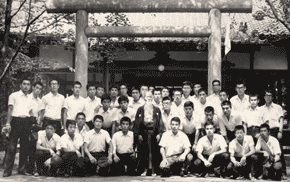
    A: I was born into Shingon Buddhism, but there was no cemetery at that temple. A Soto Zen Buddhist temple nearby made a nice cemetery, so after I moved there I became a Soto Zen Buddhist. The Founder is now buried in a Shingon Buddhist temple in Tanabe, Wakayama called Kozanji (高山寺). One of his last wishes was “make me a grave here”, but for some reason Ni-Dai (Kisshomaru Ueshiba) had a grave in Wakayama Prefecture. That’s why people can’t take a day trip to visit the grave. It’s really pretty tough to get all the way to Wakayama.

    In my case, since this was the Founder’s dojo, I believed that it is my responsibility to transmit what I was taught by the Founder. At one time a lot of things were said, but opinions have changed, and the number of requests to come here have greatly increased.

    We first built a foundation of static training (個体稽古). Then the method built in stages into flowing techniques and then throwing without touching.

    Q: Both here and Hombu Dojo must each have their own good points, this is is a wonderful place, isn’t it?

    A: Any path is the same, but in those days the method of teaching was differentiated depending upon the dojo.

    Q: Differentiated in what way?

    A: Rather than saying that it was differentiated, it may be that the teaching became differentiated. In the end, in a place where one teaches for four days, or a place where one teaches for one week, or a place where one teaches 365 days a year the method of teaching changes.

    Q: How was the teaching done here?

    A: As you might expect, we first built a foundation of static training (個体稽古). Then the method built in stages into flowing techniques and then throwing without touching. Flowing techniques were from third-dan, so in the beginning we were only allowed to do static training, but now flowing training is the primary focus in Tokyo.

    When one uses strength in Tokyo they get scolded. That’s the difference. We were taught to hold on strongly, to hold firmly in grabbing techniques.

    Further, the Founder always emphasized strongly in his teaching that the sword, the staff and empty hand techniques are one thing. We are doing it that way, but in Tokyo the sword and the staff are not taught at all.

    Q: Not at all?

    A: They don’t teach it at all. For that reason, the fact of the matter is that high ranking students in Tokyo go to Iaido to learn the sword, or Muso-ryu (Shinto Muso-ryu Jodo) to learn the staff. The Founder did not teach either the sword or the staff in Tokyo. Here he taught everything from the basics on up…. We’re in the middle of student camps right now, students from Osaka Prefecture University were here and tonight students from Tokushima University will be coming. We’ll continue with the camps until the beginning of April.

    Meiji University GasshukuAikido Founder Morihei Ueshiba with students from Meiji University in Iwama
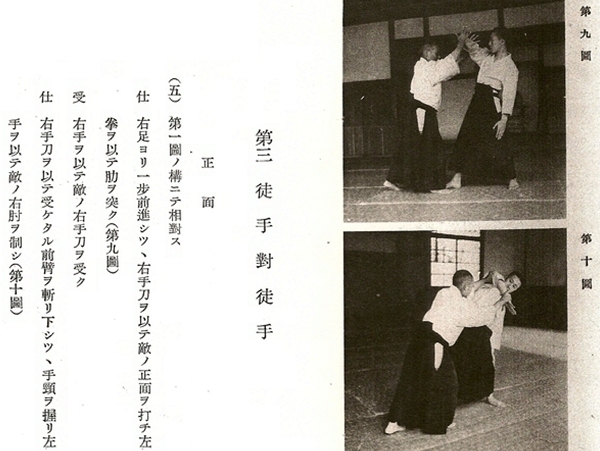
    Yasuo Kobayashi – front, second from right

    Q: How many people come from each university?

    A: If too many come then we can’t accommodate them, so we limit it to about twenty people. Ibaraki University, Japan University, MIyagi University of Education, Tohoku University, Iwate University, Hirosaki University, the other day the students from Osaka Prefecture University went home, tonight Tokushima University comes, and when they’re finished Kanagawa University and Aichi University will come and then we’ll finally be done.

    Three or four nights, or at the most five nights. We have all of the necessities for preparing meals, so the students go shopping and cook their own food.

    Q: And they are normally each taught by the shihan in their area?

    A: Yes, that’s right.

    Q: Are those shihan very junior to you?

    A: Yes, there aren’t very many people senior to me.

    Q: It must be very exciting for them to come here, isn’t it?

    A: Of course, since this was the dojo where the Founder performed his shugyo. But was that Tanabe? Some place inconvenient. Ha-ha-ha, in the morning they train outside swinging the sword and the staff. In the evening they train with the regular students. So there are more than sixty people and nobody can move! Ha-ha-ha-ha.

    Q: Is that so?

    A: Previously we had thirty-six mats (Note: tatami mats, about three feet by six feet each), but when the students began to come, the Founder in his later years said to expand that and we expanded the mat space. This is sixy mats, and I’m feeling that it would be good to have at least a hundred. But there are methods of training, no matter how tight the space is.

    “The basic principle of Aikido is just to attack.”

    Q: Is exchanging techniques with the ordinary students helpful to you?

    A: For that reason, they go home happy.

    Q: How does that work? In terms of level.

    A: Depending upon the school it can be very different. Also, the teachers who bring students here are very broad minded! Because there are also many shihan who tell their students not to come here. Many of those are in Hombu in Tokyo – “Don’t go to Iwama!”, they say. A shihan at one of the universities is also an instructor at Hombu, but he says “Don’t go to Iwama!” and doesn’t allow his students to come here. Because we do static training here. When they learn and then go home it’s difficult to train with them.

    Q: Subtle differences emerge?

    A: Yes, they do. It’s a little embarrassing to talk about, but all paths tend to split in multiple directions…

    Q: Looking at things in the long term, are there clear differences and destinations depending upon whether one does static practice or soft practice?

    A: A clear result emerges! Oh yes, during combined training, it can be clearly seen there. It’s not even worth arguing about.

    Shomenuchi - Budo 1938Morihei Ueshiba initiates with an attack
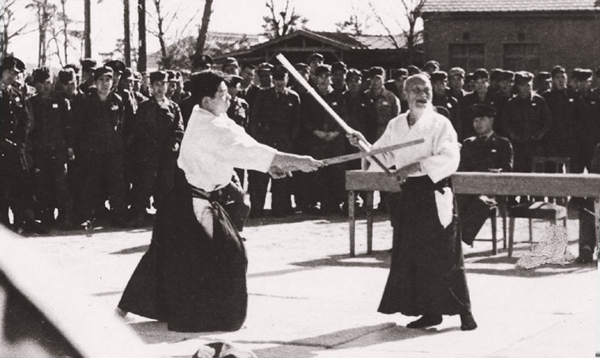
    Budo – Moritaka Ueshiba’s 1938 Technical Manual

    The Budo in which one attacks first

    Q: By the way, many people say “in the Budo called Aikido there are no attacking techniques.”?

    A: No, that’s ridiculous, the basic principle of Aikido is just to attack. Rather than talking about striking, by “attack” we mean that the basic principle is to strike the opponent and draw them out. It’s not a crushing blow, one enters in flash and when the opponent moves to counter they must extend their hand. To trap that hand is a basic principle.

    Q: That makes sense, doesn’t it?

    A: There are many places that don’t know this and practice by just waiting for the other person to come strike. The basic principle is different. Shomenuchi, you know, all starts with with an attack from my side. Like the example in this book, one strikes and moves forward, then grabs their chest.

    Q: I see, One strikes from their side and then makes them receive the attack…this is a precondition.

    A: Also right here in the Founder’s book it says “Move forward from your side and attack”. Recently people from that other school all said there are no attacks in Aikido, but that is mistaken. The basic principle is to attack… It is said “There is no defense that surpasses an attack” (攻撃に勝る防御なし) – at least in the case of shomenuchi, that is an attack.

    Q: Is what you’re calling an attack different than what you’d see in the case of combat sports?

    A: It’s different. It’s a matter of drawing out the opponent’s Ki, or absorbing their feelings, or matching with them, or connecting with them, and then controlling them.

    Self Defense Forces Demonstration 1955Demonstration for the Jieitai (“Self Defense Forces)
    Morihiro Saito and Morihei Ueshiba, 1955

    Aikido is bodywork like swordwork
    (and swordwork like bodywork)

    Q: When you do that, is it also possible to explain that in the context of the so-called combat arts?

    A: Yes, when one really moves in accordance to the principles, the movement of one against many is connected to the handling of the sword, and connected to the movements of the staff. For that reason, in Aikido one must also train in sword and staff that is specifically for Aikido. Whichever one you omit, your Aikido will not be complete.

    It may be annoying for me to repeat this, but that group in Tokyo, perhaps because they have too much pride, don’t come here to learn. They learn the sword through Iaido and the staff through Muso-ryu. In Iaido it’s like the sword is put against the waist. In Aikido we do it while twisting the hips. It’s the opposite! In Iai one thrusts the hips forward and then draws them back in a flash, but in the sword of Aikido we twist the hips and pull.

    Iaido is a wonderful Budo, but in the case of Aikido the meaning and the goals are different, so they are incompatible. Further, in the end the method of using the staff in Aikido and Muso-ryu is different. Because in Aikido the unified principles of bodywork like swordwork and swordwork like bodywork are one.

    Q: Here everything is like that?

    A: That’s how we are doing it. This may be the only place in the world. However, the Founder taught everything from these kinds of basics here, he didn’t teach them in Tokyo.

    Continued in Part 3…


    Published by: Christopher Li – Honolulu, HI