Category: Translation

  • Budoka no Kotae – Talking to Morihiro Saito Sensei, Part 1

    Budoka no Kotae – Talking to Morihiro Saito Sensei, Part 1

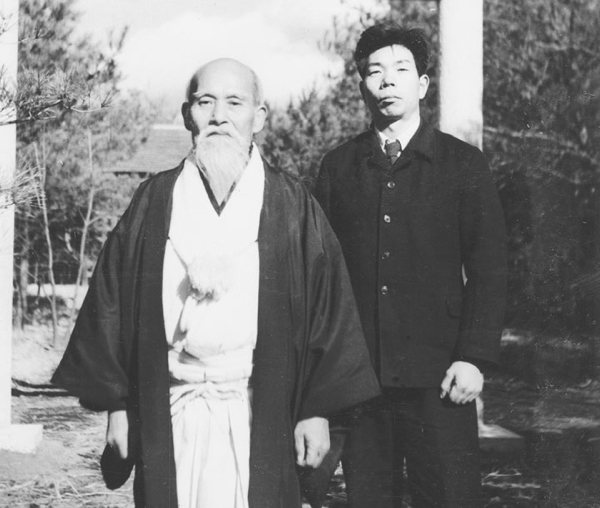
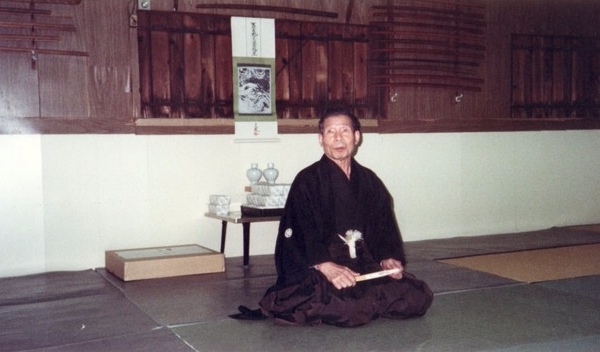
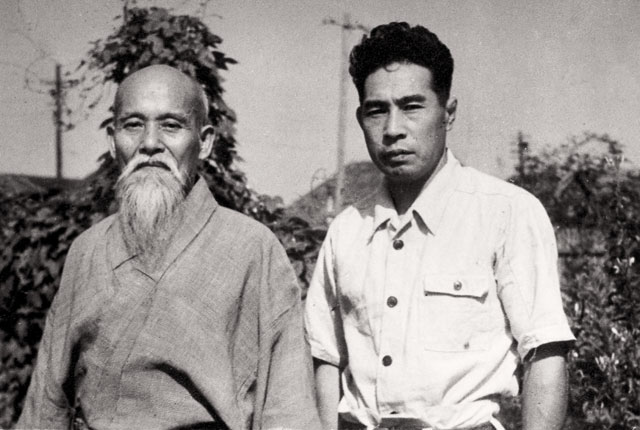
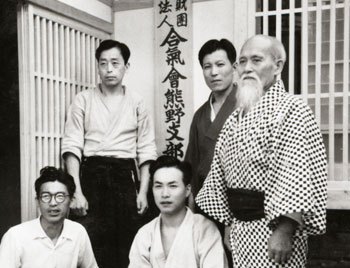
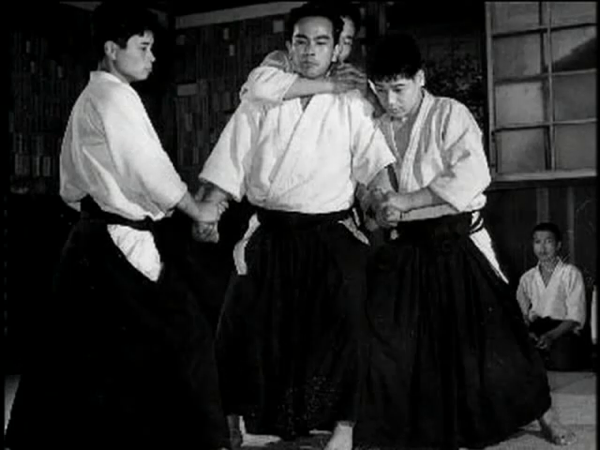
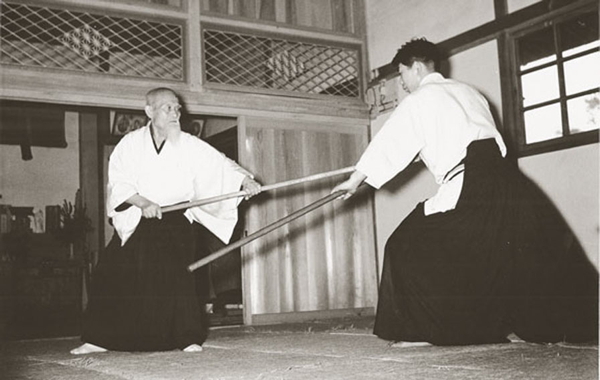
    Morihiro Saito in Iwama, 1955

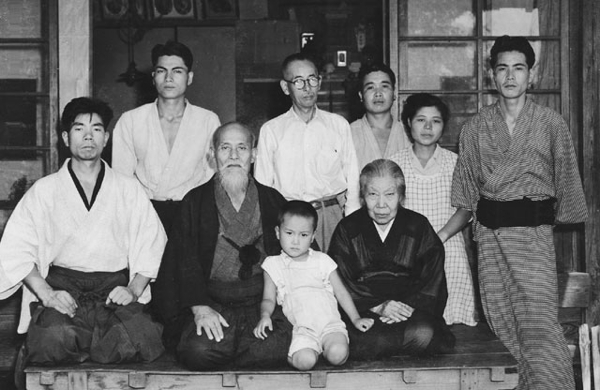
    Morihiro Saito (left) with Aikido Founder Morihei Ueshiba and his wife Hatsu
    Iwama – 1955, San-dai Doshu Moriteru Ueshiba (4 years old) seated middle

    「バカモノ! まだ技をかけてないのに勝手に転びやがって!ここは本部ではない!開祖の合気道は、相手の協力なんかなくても倒れるように出来ているんだ!勝手に転ぶのではなく、倒されないように最後まで抵抗して掴め!開祖の合気道は武道なんだ!」

    “Idiot! Falling down by yourself even though the technique hasn’t been applied yet! This isn’t Hombu! The Founder’s Aikido is made so that you can throw without the cooperation of the opponent! Don’t just fall down on your own, hold on and resist being thrown until the end! The Founder’s Aikido is Budo!”

    One person’s experience upon meeting Morihiro Saito.

    Morihiro Saito was born in Ibaraki Prefecture in 1928. Hearing tales of an “old man doing strange techniques up on the mountain near Iwama”, he became a student of Aikido Founder Morihei Ueshiba in 1946, at the age of eighteen and would train under him for the next twenty-three years.

    His work schedule at the Japan National Railway allowed him long shifts working followed by long shifts off, allowing him to spend extensive periods training and acting as a training partner for Morihei Ueshiba as he refined his weapons curriculum. He eventually received a plot of land on Morihei Ueshiba’s property and where he built his house and lived with his wife and children. He and his wife cared for the Ueshiba’s through the last years of their lives.

    Morihiro Saito acted as the guardian of the Aiki Shrine until his passing in 2002. He is famous for his dedication to preserving the exact form of Morihei Ueshiba’s techniques as he was taught them during his training under him in Iwama.

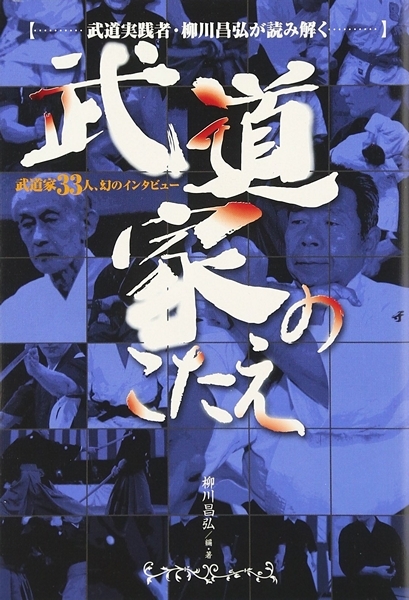
    Budoka no Kotae - BAB Japan, 2006Budoka no Kotae – BAB Japan, 2006

    This is the first section of the English translation of a three part interview that originally appeared in “Answers from Budoka” (“Budoka no Kotae” / 武道家の答え), published by BAB Japan in 2006.

    Morihiro Saito and Morihei Ueshiba - 1955Morihiro Saito with Aikido Founder Morihei Ueshiba
    in front of the Aiki Shrine, 1955

    Budoka no Kotae – Talking to Morihiro Saito Sensei, Part 1

    Aikido is formed after the war by Morihei Ueshiba

    Q: In this book we are asking those training in budo for their cooperation in giving us their opinions on their budo training, but it may take a number of months before we are ready for publication.

    A: Oh, is that right? It must be quite a lot of work, how many sections will there be?

    Q: We will divide it into four main sections. Aikido, Judo, Karate-do and Kendo. There will also be a little related to Shorinji Kempo and kobudo.

    A: Kobudo, that’s good. Kobudo is wonderful. Because it was since kobudo existed that Aikido was first born.

    Q: And it’s likely that those arts like Judo or Kendo that are called gendai budo today would not have been born without kobudo either.

    A: Yes, that’s right. Previously, the foreigner from Aiki News – it was Stanley Pranin who, when searching for the roots of Aikido, gathered together authorities from many of the arts that the Founder practiced, such as Daito-ryu , Kashima Shinto-ryu and Yagyu Shingan-ryu for a Friendship Demonstration.

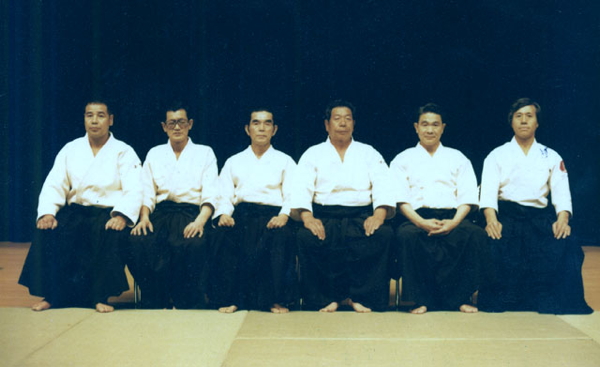
    First Aikido Friendship DemonstrationAikido Instructors at the 1st Aikido Friendship Demonstration in 1985
    Left to right: Yasuo Kobayashi, Yoshio Kuroiwa, Kanshu Sunadomari,
    Morihiro Saito, Shoji Nishio, Mitsugi Saotome

    Q: Was that at the Budokan?

    A: No, that was at the Yomiuri Hall in Yurakucho. It’s a small place. It wasn’t anything that was on a scale to hold at the Budokan.

    Q: I see. It would be a much bigger event at the Budokan, wouldn’t it?

    A: Yes, although in Aikido we hold something there once a year in May.

    Q: During that time in the Yomiuri Hall was that person (Mr. Stanley Pranin) able to gather information relating to the roots of Aikido?

    A: How about that… He is an Aikido historian – that is to say, he is investigating deeply into the history of Aikido.

    Q: Is that right? When was there a book about the roots of Aikido that he published?

    A: He published several times that year.

    Q: Such as the Aiki News magazine?

    A: That’s right. Concerning the Founder, in the Founder’s last years he went to Tokyo permanently, but of course after the war he was in Iwama continuously. Because after the war Budo was suppressed.

    Q: For a period of time, right?

    A: Yes. But in Showa year 23 (1948), when the Aikikai was reconfirmed under the law, an undersecretary named Tamura came here and secretly asked that at least a seed of Budo would be served from destruction. That really put the Founder in high spirits. The Founder was really serious about the training that started from that time. During the war he was ordered by the military to teach “Itto Issatsu” (“一刀一殺” / “One Cut One Kill”), and he went to the Army and Naval academies and the Toyama Military Academy, so it seemed that he wasn’t able to instruct in the way that he desired.

    Q: Ahh, was there a period like that?

    A: Yes, there was. He also instructed at the Nakano Spy School.

    Q: Is that right? So for Morihei Sensei the defeat in the war was rather a kind of an opportunity?

    A: That’s right. He could finally turn towards his original goals, and here in Iwama he was able to put aside the time for the establishment of Aikido. Because he was also, as you know, a student of religion. From Showa year 13 (1938) he became exceedingly vigorous in his activities. Here is a copy of a book from that time, haven’t you seen it before? (holding out a book)

    Gozo Shioda, Budo - 1938Yoshinkan Aikido Founder Gozo Shioda in “Budo”, 1938
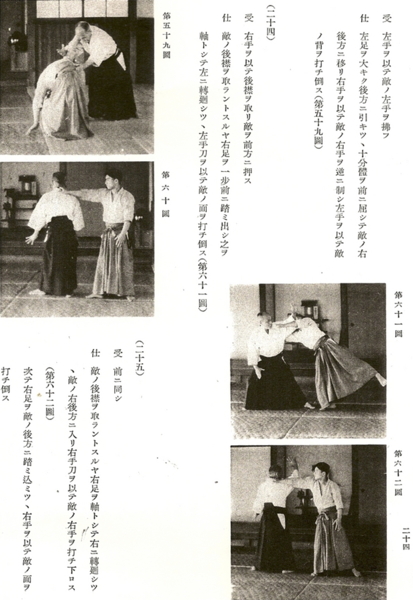
    See “Budo – Moritaka Ueshiba’s 1938 Technical Manual“

    Q: No, this is…?

    A: Is that so? They don’t publicize things like this very much in Tokyo, do they? Mr. Pranin from Aiki News discovered this in the countryside and gave me a copy, it was created in Showa year 13 (1938) or thereabouts.

    Q: So this is a book published in 1938? This is an important book, isn’t it?

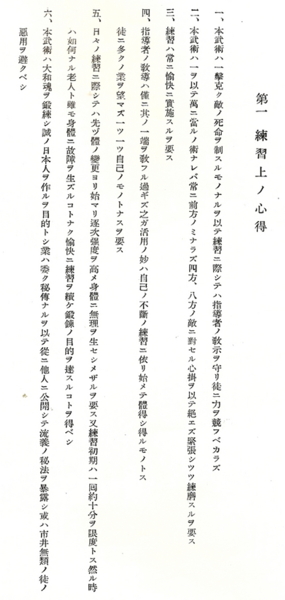
    Rules for Training 1938Morihei Ueshiba’s “Rules for Training”
    from the technical manual “Budo” – 1938

    1. This bujutsu decides life and death in a single strike, so students must carefully follow the instructor’s teaching and not compete to see who is the strongest.
    2. This bujutsu is the way that teaches how one can deal with several enemies. Students must train themselves to be alert not just to the front, but to all sides and the back.
    3. Training should always be conducted in a pleasant and joyful atmosphere.
    4. The instructor teaches only one small aspect of the art. Its versatile applications must be discovered by each student through incessant practice and training.
    5. In daily practice first begin by changing your body (“tai no henko”) and then progress to more intensive practice. Never force anything unnaturally or unreasonably. If this rule is followed, then even elderly people will not hurt themselves and they can train in a pleasant and joyful atmosphere.
    6. The purpose of this bujutsu is to train mind and body and to produce sincere, earnest people. Since all the techniques are to be transmitted person-to-person, do not randomly reveal them to others, for this might lead to their being used by hoodlums.

    *Translator’s Note: these rules were published after the war in Kisshomaru Ueshiba’s books, but with the word “Aikido” inserted in place of “this bujutsu”.

    A: Here he writes some guidelines for training, such as “Training should always be conducted in a pleasant and joyful atmosphere.”. In any case, this was written during the war.

    Q: By the way, of the people who trained directly with Morihei Sensei, there are very few left today, isn’t that true?

    “Because it is my task to receive the actual techniques of the Founder and then pass them on directly and simply just as they are.” – Morihiro Saito

    A: Even so, there many still remaining. Around 1952 or 1953 he started taking trips to the outside – he’d go to Kansai for a week, or travel around for about a month. Sometimes he’d also go to stay in Tokyo like this. So there were many people who were able to take the Founder’s hand directly and receive instruction.

    However, in my case it was a matter of time. There was land, but there was no rice being distributed. So if we didn’t grow it ourselves we wouldn’t be able to eat! So when I was able to be there physically I would help with the farming from morning to night, and after I married my wife also helped with the farming full time. We also did all the other regular household chores. Many other people came, but there were a lot of things going on, and they didn’t last very long. In the end, I was the only one left.

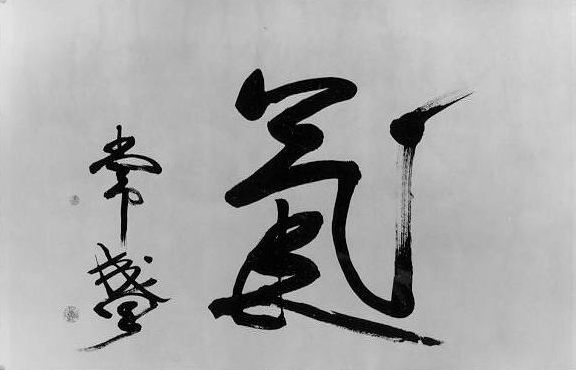
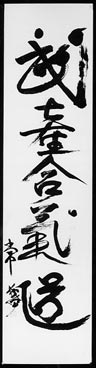
    Calligraphy for "Ki" by Morihei Ueshiba

    Calligraphy for “Ki” by Morihei Ueshiba (signed “Tsunemori”)

    What is “Ki”?

    Q: Recently the word “Ki” has become widespread in a variety of forms, hasn’t it?

    A: Yes, that’s right.

    Q: Just what exactly is that “Ki”? Depending upon who’s speaking Ki means a great variety of things – what they call “aura” in Western terminology, or others explain it in Eastern philosophical terms such as “prajna” in Yoga. But is this something that can be seen with the eyes?

    A: Well, O-Sensei was also particularly strict about what “Ki” was…. The Founder tended towards religious speech, and the students would study how to express the Founder’s speeches in modern terminology. They each express themselves from their own particular positions. I’m not very good at that kind of thing… Just actual techniques. Because it is my task to receive the actual techniques of the Founder and then pass them on directly and simply just as they are.

    Q: Is that so?

    A: The way that people do Aikido now changes quite a bit depending upon the instructor. There are people doing the complete opposite of what other people are doing.

    Q: For example, in what way?

    A: In our Aikikai organization, and outside of it, there are many students of the Founder. There are those who have formed separate organizations – for example Gozo Shioda-san of the Yoshinkan, or Koichi Tohei-san of the Ki Society, each of those were founded by people who came here to study after the war. Shioda-san came here surprisingly often. Tohei-san made that thing called “Ki” his foundation to spread Aikido.

    Q: Tohei Sensei seems to be doing Aikido in a separate form, with “Ki” as the foundation.

    A: Yes, that’s right. The core of it is in lectures, but he has created a separate Ryu and is working hard at it. He’s an Aikido 10th Dan, and people wanting to learn Aikido join the “Ki Society”, but since most of it is lectures the training is neglected. The Budo world is quite a difficult place!

    Q: I see. Is the training here very strict?

    A: Because technique is something that you can understand if you see it. People understand before they train, so they are happy, and they get the feeling that it is extremely logical.

    Q: Even now do you take their hands and teach them directly?

    A: Yes, all of them. The Founder also took the hands of the regular students here and taught them continuously until he passed away. Especially me, since I was assisting with the farming, in the morning he would teach me sword and staff privately.

    Q: There are many foreigners also training here, what about them?

    A: They are shugyosha.

    Q: Is that right? Where do they live?

    A: Here, or in apartments nearby.

    Q: That’s long term, isn’t it.

    A: There are those who are here for an extended period. That woman is here for the third time, she has been here since June last year. Americans, Germans, Australians – during the busy times there are people here from as many as ten countries. Well…right now we have about six countries.

    Q: When they come, as they don’t understand Japanese over there, do they learn a bit before they come?

    A: There are people like that, and then there are people who don’t understand any at all…I can’t speak any other languages.

    Q: When that’s the case, we’re talking about a heart to heart transmission (以心伝心) between people aspiring to the same Budo?

    A: One way or another, with a lot of gestures…however, it is very difficult with the French. They must not use much English. Normally, if they speak English than they can somehow communicate between each other, but somehow we have a difficult time when the French come. Also the Italians. But the young people who come from Scandinavia use English so we’re able to get by.

    Q: Now Aikido has mostly moved overseas, so most of the people who come must be those who have seen and heard of Aikido over there and then come to the home of Aikido to master it?

    A: This year it is nineteen years (at the time of the interview, 1988) since the Founder passed away, but I haven’t traveled anywhere so I have only taught those foreigners who have come here. It began with those who were introduced to Aikido after the Founder passed away. Most of the Europeans would enter Hombu Dojo and wouldn’t come here very often, but while that was happening people began to come, bit by bit.

    When the Founder was alive here, one could not become a student without an introduction. That was true even for the local people. For that reason, the people here were a very select group. From there one person became two, two people became four, and then we couldn’t cut off the flow. However, we couldn’t accommodate them all…well, it’s good that people are coming.

    Q: How many people are here now?

    A: During training…? The evening classes have about thirty or forty people.

    Continued in Part 2…


    Published by: Christopher Li – Honolulu, HI

  • Aikido Shihan Sadao Takaoka – Meeting O-Sensei

    Aikido Shihan Sadao Takaoka – Meeting O-Sensei

    Sadato TakaokaSadao Takaoka Sensei (1916-2002) in 1993

    Sadao Takaoka was one of the lesser known direct students of Aikido Founder Morihei Ueshiba. He began training in O-Sensei’s home town of Wakayama in 1939, but he did not actually meet the Founder until well after the war, in 1951. And although he enjoyed a personal relationship with the Founder and often participated in the annual All Japan Aikido Demonstrations held in Tokyo, he remained on the outskirts of the Aikido world and is largely unknown today.

    He was one of the few people that had the opportunity to act a a training partner for Morihei Ueshiba when he was refining his weapons system after the war, as mentioned by Shigenobu Okumura Sensei:

    Q: In a previous interview you said that you had seen such things as Sho-chiku-bai Sword (松竹梅の剣 / “Pine-bamboo-plum Sword”) and Gogyo Sword (五行の剣 / “Five Elements Sword”)…

    A: I think that those things were still going through a period of trial and error. So Saito-san from Iwama and Sadao Takaoka-san (高岡貞夫) from Wakayama were used as practice partners during that process of trial and error.

    – Interview with Aikido Shihan Shigenobu Okumura, Part 2

    He was also Yoshinkan Aikido instructor Tsuneo Ando’s first Aikido teacher (see “Talking to Tsuneo Ando Part 1 – the Gozo Shioda that Nobody Knew“).

    In this essay Sadao Takaoka discusses his early experiences with Aikido before, during and after World War II, and his experiences in meeting Aikido Founder Morihei Ueshiba. There is also an Appendix in which Takaoka Sensei discusses some of O-Sensei’s teachings.

    Sadao Takaoka DemonstrationSadao Takaoka Sensei at a demonstration in 1993

    Aikido Shihan Sadao Takaoka – Meeting O-Sensei

    by Sadao Takaoka

    The Birth of Aikido in Wakayama

    The birth cry of Aikido in Wakayama came in Showa year 14 (1939) when I met a student of Aikido, Hiroyuki Nozawa Sensei. I’d like to talk a little bit about my history prior to meeting Nozawa Sensei.

    My uncle was a circuit priest. We would set up an image of the Buddha in our house twice a month on the first and the fifteenth, and many of the faithful would come to pray. There were also believers in Kii Tanabe, so my uncle would often go there as well. In Showa year 8 (1933) I was seventeen years old. When I spoke to my uncle about wanting to learn Judo he told me that there was an instructor teaching a “mental” budo (“seishin budo” / 精神武道), but when we went to see my uncle’s friend Mr. Egawa we found out that the instructor had moved to Tokyo. That instructor in Kii Tanabe was Ueshiba O-Sensei. I often heard stories about Ueshiba O-Sensei from my uncle.

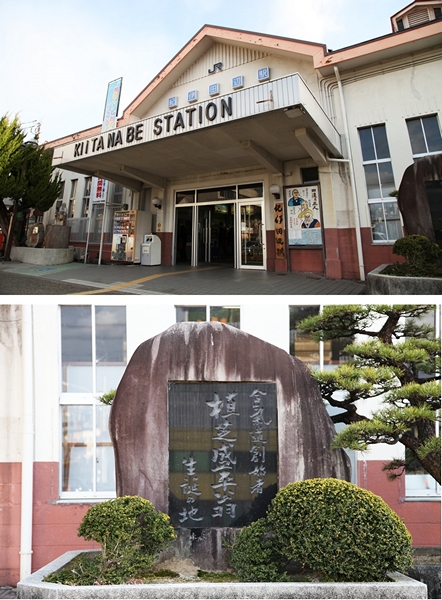
    Kii-Tanabe StationKii-Tanabe train station and the memorial to
    Aikido Founder Morihei Ueshiba

    So there I was. I wanted to learn some kind of budo, so I learned koryu Takenouchi-ryu grappling. I learned from a teacher named Kusutarou Mizutani (水谷楠太郎), and there were a lot of anecdotes about him. One of those was the happening at the Wakayama-shi train station. The baggage handlers for the train station and the baggage handlers for a shipping company got into a fight, but they became angry when Sensei attempted to intercede – “this is none of your business!”. “Well then, I’ll take all of you on – come at me!”, he said and beat all of them about the platform. An Osaka police officer who saw this suggested that Sensei become a detective, and he did that work for a while but it didn’t suit him so he soon resigned. He established a dojo and began teaching, and I heard that as rumors of the incident at the train station spread he began to attract large numbers of students.

    Mr. Tsuda, who was one of Mizutani Sensei’s senior students, took responsibility for my instruction, and thanks to being the youngest student there he would tell me many of the secret methods by oral transmission (“kuden” / 口伝). He would also guide my education in budo with tales of Itto Ittosai‘s (伊藤一刀斎) students Ono Zenki (小野善鬼) and Mikogami Tenzen (神子上典膳).

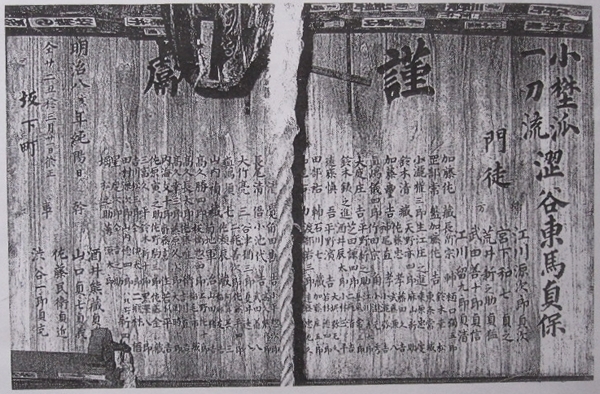
    Toma Dojo EnzojiThe name board for Shibuya Toma’s Ono-ha Itto-ryu Dojo at Enzoji Temple
    Ono-ha Itto-ryu is the oldest of the Itto-ryu branches founded by Itto Ittosai
    The 18 year old Sokaku Takeda’s name appears seven from the right in the center

    About three years after I started training in Takenouchi-ryu grappling my uncle told me to go with him during his shugyo and we went up to Gongendo (権現堂) in the mountains to do zazen and misogi under the waterfalls. My uncle showed me and taught me many mysterious things. For about five years I would participate in his shugyo once or twice a month.

    In Showa year 13 (1938), I started training in my home, training with about ten people. From December 25th of that year my youth group began the year-end night patrols, and I was responsible for the last day of the year until dawn on New Year’s Day.

    The gathering place for the night patrol was at a movie theater called Denki-kan in Motoderumachi, Mr. Hiroyuki Nozawa had been sent from Kyoto and assigned to that location.

    Wakayama DenkikanAt the Wakayama Denki-kan – by Kyokichi Tanaka, 1910

    All of a sudden he said, “Are you Takaoka-san? I hear that you teach budo.”. I said “no”, and then he said “someone from yesterday said your name”, with a suspicious look on his face, so I said “I’m just fooling around”. “What rank are you?”, he asked, and I replied, “It’s a koryu, so I receive sections of the curriculum”. When he said, “Do you know what Aikido is?” and I said “That’s Ueshiba Sensei from Kii Tanabe, isn’t it?”, he said, “So you’ve heard of it?”. I told him, “It was Ueshiba Sensei that I went to call on in Showa year 8 (1933) , when I thought about learning budo.”.  Then he invited me, “That’s great, shall we try touching hands?”.

    When we trained together the form of the techniques was the same, so Nozawa Sensei and I started teaching Aikido together in my dojo. After training for a while we received a request from the police, and when the two of us went to teach them the Military Police approached Nozawa Sensei with an order to  “teach Aikido to the army personnel”, so we went to teach at the command center. A short time after that, the two Aikido Shihan Yukawa Tsutomu (湯川 勉) and Tetsuo Hoshi (星 哲臣) showed up and I was taught as well. Both of the Shihan had very powerful (hard) technique.

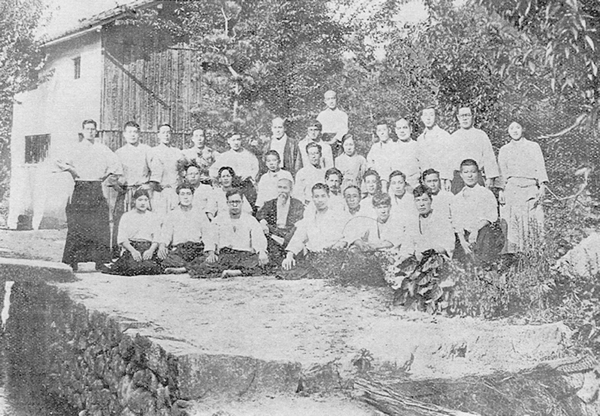
    Summer Training Camp 19341934 Summer Training – front row from left:
    Kiyoshi Nakakura (standing), Rinjiro Shirata (seated), Tsutomu Yukawa (seated)
    From the Kobukan Dojo newsletter “Kobu” (皇武)

    Translator’s Note: Tsutomu Yukawa was one of Morihei Ueshiba’s favorite students (he was actually married to Morihei Ueshiba’s niece), and was famous for his great strength. He died in a knife fight in Osaka in 1942. Tetsuo Hoshi was a  Judo sixth dan who returned his rank to the Kodokan after meeting Morihei Ueshiba. He was later executed as a WWII war criminal for torturing prisoners of war with his martial arts techniques (from “The Way of Judo: A Portrait of Jigoro Kano and His Students“, by John Stevens).

    Nozawa Sensei had also studied Kurama-ryu (鞍馬流) before doing Aikido, so he also practiced a lot of striking techniques. Nozawa Sensei used to say that at the time that he studied at the Aikido Kansai-shibu Takeda Dojo that all of the students who came to train held certificates in other ryu-ha (“schools”).

    After that, I began teaching Aikido to the general population in Showa year 18 (1943). In order to avoid provoking the command center I made up another name for Aikido – changing the “Takenouchi” in “Takenouchi-ryu” from 竹内 to 武内, I called it “Takenouchi-ryu Tessen-jutsu” (武内流鉄扇術) when I taught.

    Memories of my military service

    During my training in budo with Mizutani Sensei I learned methods of healing through bonesetting and shiatsu, and being asked by my students I would sometimes give them healing treatments.

    In Showa year 18 (1943) , during basic training a few days after I enlisted, I was called into the petty officer’s room by the squad leader – “You said that you didn’t have a girlfriend, but who is this!?”, he said, and showed me a letter. It was a pink envelope. The squad letter opened the envelope and read the letter, but it was a thank you letter from one of the people that I given healing treatments to before I enlisted.

    I was asked, “You do budo?”, so I gave him an explanation of Aikido. The training officer, who had been listening, said, “Come teach me before lights out”. In this way, I was able to avoid the usual hazing from the troops before lights out.

    I completed my three months of basic training without incident and returned home. When I reached foreign soil as part of the third call up for Showa year 20 (1945) I was soon called to the medical office, where the army medic said “I gave this man two shots of the anaesthetic but the pain won’t stop. You try treating them.”. After treating him for around twenty minutes the pain went away, and the army medic said that he would tell general headquarters that I was to work in the medical office starting the next day, and that was how I came to work there.

    Soon after that it came to the end of the war, and about a week before I thought that I would be able to return home an order was issued for personnel at the aviation factory in Gwangju (Korea) and I was unable to return home. At the time I was treating the adjutant to the battalion commander, and when I went to tell him that I would be unable to treat him from the next day he said that would be a problem and told general headquarters that I was essential personnel and that he wanted them to change my assignment.

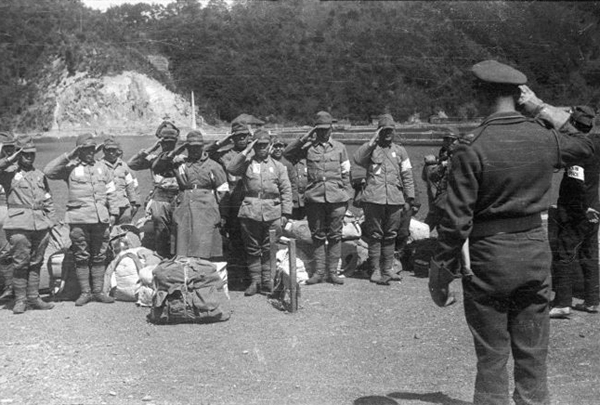
    Repatriation at Senzaki Port Repatriation operations at the port of Senzaki, Japan

    Original caption reads: “NZEF in Japan. Repatriated Japanese soldiers salute a New Zealander, Major L W Wright, as he approaches. Orders have been issued that all occupation force troops must return salutes given by Japanese. These Japanese are passing through the port of Senzaki, where New Zealanders are in control of repatriation operations.” Photograph taken ca 1946 by a New Zealand Army photographer.

    On October 15th of Showa year 20 (1945) I arrived at Senzaki Port to the nostalgic mountain skyline of Japan, boarded the train for the demobilization returnees, and when I opened my eyes was arriving at Tennoji Station in Osaka.

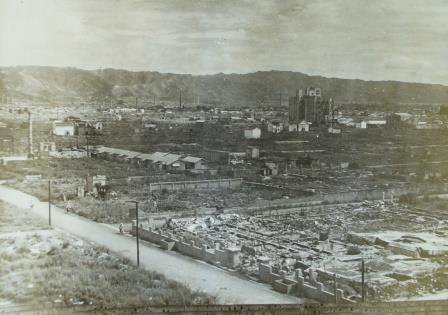
    I got on the Nankai Electric Railway, but when I arrived at my long forgotten Wakayama City it was a burnt out ruin. I thought to go and see the burnt remnants of our home, and all that was left of that terrible tragedy were the burnt and crusted remains of our metal utensils.

    Wakayama BombingThe remains of Wakayama City after the 1945 air raids

    I immediately became concerned for my family, but when I went to call on my uncle in the country my family were all unharmed,

    In retrospect, I am grateful that I was able to return home quickly and unharmed thanks to budo.

    Morihei Ueshiba and Minoru MochizukiMorihei Ueshiba and Minoru Mochizuki around 1951

    Meeting Morihei Ueshiba O-Sensei

    After the demobilization I was teaching Aikido to the young people in the rural evacuation areas when one day a young person that I had never seen before came to me and said “I’d like to train with you”. Although I said “today is a day off” he insisted, so I said “well then, right here” and I showed him two or three techniques in that six tatami room (about 9.18 square meters, or 98.8 square feet), but when I said “that’s it for today” he showed no signs of leaving. I asked him “is there something that you want?” he said “actually, I’m a student of Judo and I’ve never seen techniques like these”, and when I told him “nobody knows these techniques, so I’m teaching them in gratitude for the help they gave me in demobilizing” he said “thank you” and left.

    The next day when I was talking to the students they said “Did he show up? He said that he was going to toss that guy with the strange techniques around.”, so I said “Is that right? I’m glad that I didn’t get thrown then.” while laughing, and everybody exploded with laughter. It’s a good memory of the evacuation area.

    In January of Showa year 22 (1947) I moved from the evacuation area to Nakanoshima in Wakayama City.

    In Showa year 23 (1948) the president of the Nakanoshima Community Association, Mr. Youzou Shima, said that he wanted to help those pure youths who had lost their hope and were falling into the depths of depression, and asked me to teach them Aikido.

    We turned the workshop at the Shima home into a dojo, and trained there day and night as Nakanoshima Dojo.

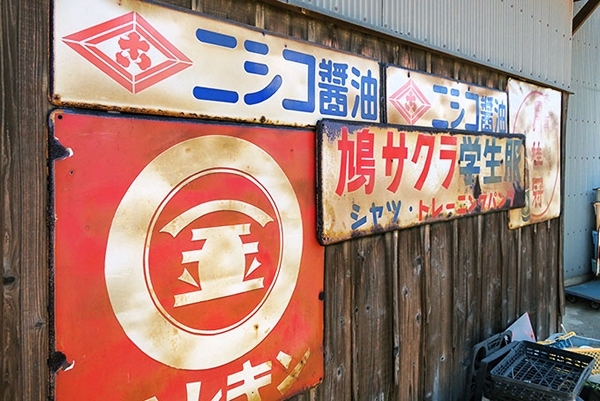
    Nikko ShoyuOld Nikko Shoyu (now Daisho) signs in Osaka

    In Showa year 26 (1951) I was fortunate to learn that Aikido Founder Morihei Ueshiba O-Sensei would be returning for the first time in fifty years. At the request of Mr. Nishimoto (西幸醤油 / Nikko Shoyu) from the public safety committee he was to teach the members of the Wakayama police department.

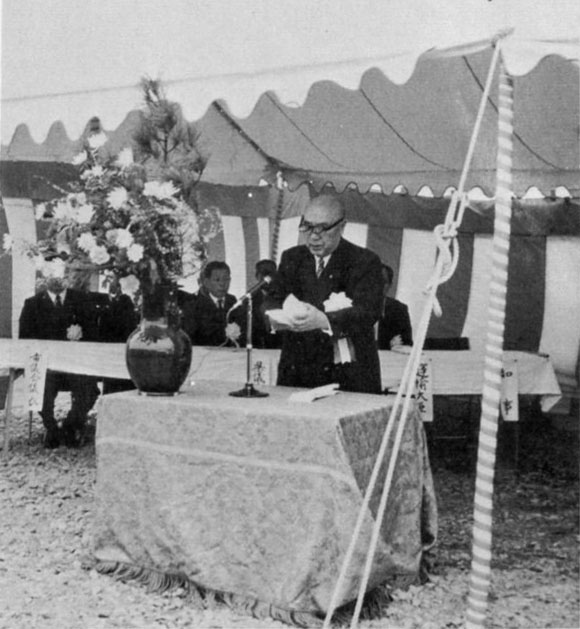
    Shinji OnoWakayama Prefecture Governor Shinji Ono

    Through an introduction from Nozawa Sensei I was able to receive instruction along with the police officers, and for the mornings and evenings on Tuesdays, Thursdays and Saturdays at the Wakayama Prefectural Workers Community Hall with Governor Shinji Ono (小野真次) we would recieve instruction in Karate, which was born in Okinawa, from the instructors Otsuka, Tomoyose and Yamashiro, and then on Mondays, Wednesdays and Fridays O-Sensei would come to Nakanoshima Dojo with his high-ranking student Koichi Tohei (now head of the Ki Society).

    Thanks to this that the dojo was overflowing with energy, and the number of students suddenly jumped to more than one hundred. In Showa year 28 (1953) I was promoted to third dan in Aikido and registered with the headquarters as an Aikido instructor.

    After training, when I would say “Shall I give you shiatsu?”, he would say “In the past my students gave me shiatsu, but now there’s nobody who trains in shiatsu anymore. Maybe just once?” and lie down on his side.

    As I was giving him shiatsu he said “You belong to this path. Have you thought about trying the Nishi Health System?”. When I told him that I wanted to learn his techniques first he said “Is that right? Well then, let me teach you my healing method.”, and then he taught me his palm healing method.

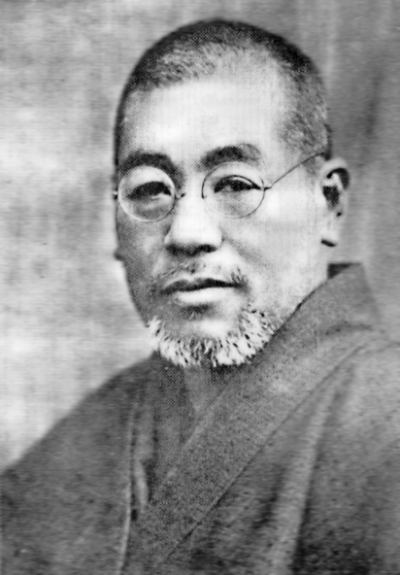
    Mikao UsuiReiki Founder Mikao Usui 1865-1926

    Translator’s Note: “Palm healing” is a kind of hands on healing that was often practiced in Japan as an element of Buddhism. It is commonly used as a technique in Reiki, founded by Mikao Usui in 1922. Both Morihei Ueshiba and Onisaburo Deguchi were said to have been acquainted with Mikao Usui.

    When I mentioned to O-Sensei that his ribs were quite thick he said “My ribs are all one sheet. One time in the old days an instructor at the Toyama Academy stabbed me with a wooden bayonet. I did some reckless things back then.”.

    Let me talk about some of the various anecdotes that the Founder told me.

    The Founder was returning from harvesting when when he heard a voice saying “hey, hey”. When he put down his bale of wheat and looked around the village headman and the constable had been knocked down in the field . They scolded him because his bale was too wide to pass through.

    He told me that in Ayabe, even when he returned from the main shrine late at night his wife would leave the door unlocked for him “I’ll tell you this because it’s you, but I don’t tell everybody.” he said. Then I asked him about a story that I had read in a book about the beam in the ceiling of the main shrine at the Omoto compound in Ayabe. “When I looked at the logs my body grew warm and the log looked like a small chopstick. It moved when I rocked it so I picked it up.” he said.

    I heard this one from one of his students – “The Founder is strong, after practice he puts water in a basin and cools his hands,”.

    When I trained with him he was so soft that I asked him if I would be able to produce as much power as he had before the war if I did this training. O-Sensei replied “Before the war I trained with strength without understanding. Now that strength is not necessary. This is Takemusu Aiki!”. Then he explained the reasons to me.

    In the year that the war ended I became ill and my spirit became weak. As I thought of going to heaven an angel came to fan my flames. When I tried to leave even then a lone priest appeared and told me to return. He explained that it was too soon to see his face, that I was not yet cultivated enough.

    After that I recovered from my illness. When I thought to go to offer prayers at the Aiki-jinja I saw a white man on the front path. Looking closely I saw that another Ueshiba holding a wooden sword standing in kamae, and when I went to strike him I was struck. When I struck again I was struck again. When I took a stance the next time he vanished suddenly. From that time my techniques became soft. The is Sho-chiku-bai Kenpo (“the Pine-bamboo-plum method of the sword”).

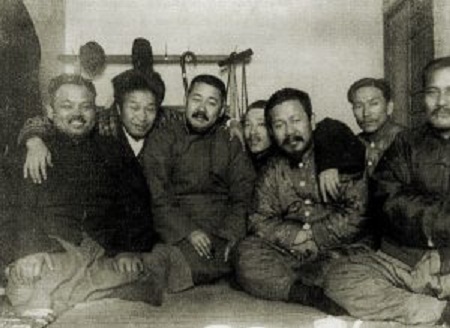
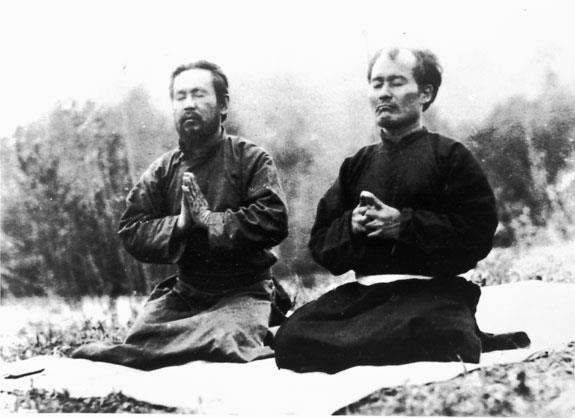
    Morihei Ueshiba MongoliaPilgrimage to Mongolia in 1924
    Onisaburo Deguchi, second from left
    Morihei (Moritaka at the time) Ueshiba on the far right

    He often spoke to me of the time that he went to Mongolia, and when he spoke of falling in the lake he warned me “Takaoka, you are the only one who can protect yourself.”.

    The memories of those conversations with the Founder left a deep impression on my heart.

    A short time later the instructors Katsuki and Arikawa came from Hombu to teach.

    In Showa year 30 (1955) a dojo just for instruction from O-Sensei was born in Masago-cho (真砂町), so the Nakanoshima Dojo members also started to go there to train.

    Soon it was time for O-Sensei to return to the capitol, and I was told to come every morning at five o’clock so that he could give me shihan training in Tokyo.  Every day for a week I learned the teachings (法則) while shivering in the light from O-Sensei’s eyes. On the last day he said:

    I have given you my treasure. I could take back an object, but I can never take away the principles that I have taught you up until today. If you can understand what you have been taught then it is alright to tell others, but while you still don’t understand you must not. Train as long as you have life.

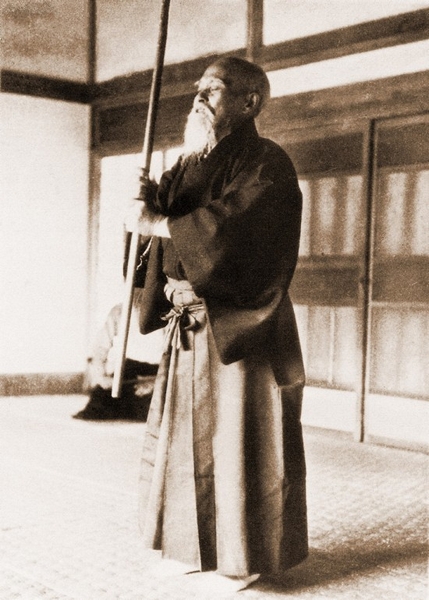
    Translator’s Note: The 1955 shihan  training sessions in Tokyo began with O-Sensei wielding a Jo in “Kagura Mai” (神楽舞 / “Dance of the Gods”). When questioned about technique during the training sessions O-Sensei would just repeat the “Kagura Mai” without saying a word.

    Yasuo Kobayashi Sensei said this about that seminar: “In the spring of 1955, a special practice was held for yudansha from all over Japan at Hombu Dojo. The various instructors from Hombu joined with Sunadomari Sensei from Kyushu, Tanaka Sensei of Osaka, Hikitsuchi Sensei of Wakayama and from Tohoku, Shirata and Otake Senseis and others along with us deshi for a week of practice sessions. The last day there was a party which was attended by Shioda Sensei of the Yoshinkan, Katori-Shintoryu’s Sugano Sensei, Ninjutsu’s Fujita Sensei, Matsuo Sensei of Iaido and many other noted martial artists. Sensei representing the various schools of Aikido were also invited along with the old officer class of the Navy; everyone had a pleasant interchange.”

    Morihei Ueshiba Kagura MaeAikido Founder Morihei Ueshiba
    Kagura Mai – the Dance of the Gods

    Appendix:
    Dobun (instructive principles) by Morihei Ueshiba.

    As taught by Sadao Takaoka Shihan, Wakayama Aikikai dojo
    (originally appeared on The Aikido F.A.Q.)

    Original translation by: Haruko Kado
    Recompiled in English by: K.C. Brodbeck
    Parts taken from Aikido Newsletter 2/10/1974

    One spirit
    Four souls
    Three elements
    Eight powers

    Mototsumitama (literally translated as the Great Basic Metaphysical Substance of being) of the one spirit, four souls, three elements, and eight powers, make up the Great God. The Great God is the living infinite mother who has spread spiritual and physical prosperity throughout space.

    Space was once empty, with no Heaven and no Earth. Suddenly a pinhole opened up in this empty space. This pinhole was the very origin of existence. From this hole, Ki of the Great God, which was finer than steam, smoke or mist, gradually came forth to form a circle which surrounded the pinhole and gave birth to the Kotodama of Suu. This birth was not only the birth of the physical world, but of the spiritual world as well.

    The universe then began its natural respiration taking a deep breath of expansion, and as it expanded sound flowed from it. This original sound was the kotodama Suu. Suu then continued expanding in four directions and formed a pulsating circle. When Suu has developed it turns into U. The constant work of Suu produced the kotodama U.

    The kotodama U, which is the origin of spirit as well as substance, divides into two and works as opposing forces which function independently. Each of these two functions has its own Mitama (spirit). One of these forces flows up and generates the kotodama A, while the other function falls to Earth and creates the kotodama O. With A going up and O going down an opposing force is created, and held together by Ki, an attraction is formed.

    Takamagahara ( high planes of heaven ) represents the universe. It teaches us what the law and order of the universe should be and how the gods reside within it. Everyone s family represents Takamagahara and each individual has Takamagahara within him\herself. All the elements of this universe constantly breathe and flux and live every moment of our lives. In other words, Takamagahara is the great celestial globe which has successfully accomplished its formation and wishes. It is the very origin of creation of heaven and earth. To come to understand the wishes of Takamagahara and pursue the tasks of the gods to satisfy their will is Aikido.

    Clarify the Ki of space, the Ki of the self-curdling island (Onogorojima), the Ki of the universe, and all the ways which mitama come into your body. Make all the breathings of the universe match your own. Use these lines as the law, and make them accomplish the mission of the universal heaven. The basic principle to pursue in each direction is called Aikido.

    Aikido should be the doctrine endowed by god to clarify the workings of the universe. The past, the present, and the future are the routes which the universe should follow. This includes the human body, as it has the universe within it. Purify the universe and harmonize it with the three worlds of the manifest, the spiritual, and that of the gods. Following this continually is Aikido.

    The core of the universal dynamism consists of 75 sounds. Each one of these sounds obeys three rules: triangle (Iku-musubi), circle (Taru-musubi), and square (Tamatsume-musubi).

    The kotodama, A, O, U, E, I, manifesting the mind of the Founding god ( Kuni no Katachi no Kami), interacting with the neutral god (Toyokumo no Kami), the functions of the Five gods came into being.

    When the eight powers interact with each other, the light, pure ones went up to the heavens, and the heavier, impure ones fell to the Earth. Each time the heavens and the Earth interacted, some functions fell to Earth, expanding it. This was done by the god of Tamatsume-musubi. With the three elements, Iku-musubi, Taru-musubi, and Tamatsume-musubi, influencing the process, the universe grew and continues to grow today. Aiki is this interaction and use of kotodama. It is the one spirit, four souls, three elements, and the eight powers.

    One, two, three, four, five, six, seven, eight, nine, ten, one hundred, one thousand, one million, and the great Mitama of all These words represent the one spirit, four souls, three elements, and the eight powers. Ueshiba Sensei never failed to recite these words in his prayer before and after Aikido practice in order to teach us to assimilate ourselves within the universe. By doing so, we can produce techniques which make the three elements visible in the manifest world. Wishing for world peace, Ueshiba Sensei always preached that human beings are also a part of the universe.

    The Three Elements

    Ueshiba Sensei told us in his Dobun that the Three Elements are gas, liquid, and solid. After studying this for a long period of time, I came up with my interpretation for this. I think that these three elements are three stages. When O Sensei said gas, he wanted to tell you to match your breath with that of your opponent. Liquid indicates that you should absorb your opponent s strength. Solid implies that you should use your breath and perform the technique. In other words, in the gas stage we should lead our opponents with our Ki. In the liquid stage we should assimilate ourselves with our opponent. In the solid stage we gradually apply ourselves in the desired directions to complete the technique.

    The Four Souls

    Historically in Japan four separate aspects of functions of mitama have been recognized. The first is Kushimitama, or the heavens, which give light to all things in order to purify their KI. The second is Sachimitama, or the Earth, which lavishly provides and never expects anything in return. The active and valiant Aramitama, or fire, is indispensable for any type of development. The harmonious Nigimitama is the water that can flow anywhere and rules the Earth.

    The Eight Powers

    The eight powers are always contrastive to each other. Moving force and stopping force, dissolving force and curdling force, pulling force and releasing force, joining force and separating force, work actively in the universe to sustain life and the Earth. This is also true within ourselves, as we are part of the universe and have a universe within our bodies. I draw an analogy from the Ken-zen-ichi-jyo sword tactics which were written in the twelfth century. In Ken-zen-ichi-jyo we learn that if an opponent gives you his full 100% attack, you should receive the attack with zero. If he gives you 90% then you receive it with 10. 80-20 70-30 60-40 40-60 30-70 20-80 10- 90 0-100. I believe this is much easier to understand than the definitions given by O Sensei If we meet 100% with 100% we end up with a 50-50 connection and we cannot proceed with the desired function.

    Fire and water are two basic examples of the opposing powers. Fire naturally flows vertically, while water flows horizontally. Water puts out fire, and fire evaporates water.

    Many people ask about Aikido with relation to religion. I don t believe in religions because I know that history has seen a lot of conflicts among religions which have caused many great battles. Instead I believe in the god of fire and the god of water. It is such a simple concept that I wish people all over the world could come to support the idea.

    The final set of contrastive powers is positive and negative. When explaining these two forces I use the terms plus and minus.

    Correct breathing is critical to using these forces effectively. Take a breath as you pronounce A, O, U, E, I. Try to let your body learn to breathe the kotodama, and not your brain. In doing so you will not need commands from your brain to move as quickly as possible.

    In Aikido, zero (or nothingness) is necessary most of the time. Kokoro (heart and mind) is one thing while Ki is something else. Many people believe that they are identical, but it they are not. Heart and mind remain innocent for your entire life, while Ki is always fluctuating. You must purify yourself to become nothing. What you do in Aikido never fails to reflect the state of your Ki. If your Ki is clouded, you cannot accept or lead your opponent. I really hope that everyone can learn to master the Aikido that Ueshiba Sensei taught and lived.


    Published by: Christopher Li – Honolulu, HI

  • Aikido Shihan Seiseki Abe – Meeting Morihei Ueshiba O-Sensei

    Aikido Shihan Seiseki Abe – Meeting Morihei Ueshiba O-Sensei

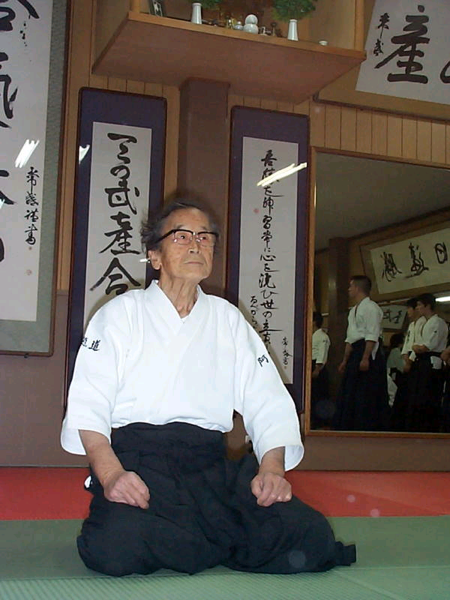
    Seiseki Abe

    Seiseki Abe (阿部醒石), 1915- 2011
    Amenotakemusu Juku Aikido Dojo (天之武産塾合気道道場)

    Seiseki Abe was born in Osaka, Japan.  A teacher of Japanese calligraphy, he was also a student of Misogi under Dr. Kenzo Futaki, who had trained under Aikido Founder Morihei Ueshiba. He began training in Aikido after encountering the Founder in Osaka in 1952 and then began teaching him calligraphy a few years later, thereby occupying a unique position as both a student and a teacher of Morihei Ueshiba. He was one of a small number of people to be awarded tenth dan directly by O-Sensei, although the Aikikai only officially recognizes him as an eighth dan.

    In this short essay, published in the Rikuryo Alumni Association “Visiting our Teachers” series in 1988, Abe Sensei recalls his first encounter with Aikido Founder Morihei Ueshiba.

    Seiseki Abe with Morihei Ueshiba

    Seiseki Abe, standing far left, with Morihei Ueshiba
    Kumano Juku, 1954

    Meeting Morihei Ueshiba O-Sensei

    by Seiseki Abe

    In Showa year 27 (1952), when I had just started working in Kitano, Bansen Tanaka-san (田中万川 – first chairman of the Osaka Aikikai, passed away in 1988) established his dojo, saying “I want to spread Aikido in Osaka”. I knew nothing about that, but the day after the opening I happened to be passing by the front of the dojo and noticed a nameplate saying “Morihei Ueshiba”.

    When I opened the entranceway and asked “Is Ueshiba Sensei here?” Bansen-san was there and said “Yes, we had the dojo opening yesterday”. I knew Tanaka-san, but I didn’t know that he did Aikido.

    After a short time O-Sensei came out and we met for the first time. He said “You’re a student of Futaki Sensei (*1)”, and then right away he said “come in, come in”. The things that O-Sensei talked about at that time were difficult to understand. He spoke of things far and above “Chinkon Kishin” (*2). I listened to what he said respectfully…and then he said “You, come starting tomorrow!”.

    (*1) Translator’s note  (Kenzo Futaki): Dr. Kenzo Futaki was a medical doctor and a pre-war student of Aikido Founder Morihei Ueshiba, an advocate of a diet of unrefined brown rice, and the founder of the Misogi Renseikei (禊の練成会 – Misogi Training Society) whose practices would influence Morihei Ueshiba’s own training.

    Dr. Kenzo Futaki’s Ten more and Ten Less Rules for Health

    1. Eat less, chew more.
    2. Right less, walk more.
    3. Wear less, wash more.
    4. Worry less, work more.
    5. Idle less, learn more.
    6. Speak less, listen more.
    7. Get angry less, laugh more.
    8. Say less, do more.
    9. Take less, give more.
    10. Blame less, praise more.

    二木謙三博士の十少十多の健康訓

    1. 食うこと少なくして、噛むことを多くせよ。
    2. 乗ること少なくして、歩くことを多くせよ。
    3. 着ること少なくして、浴びることを多くせよ。
    4. 悶ゆること少なくして、働くことを多くせよ。
    5. 怠けること少なくして、学ぶことを多くせよ。
    6. 語ること少なくして、聞くことを多くせよ。
    7. 怒ること少なくして、笑うことを多くせよ。
    8. 言うこと少なくして、行うことを多くせよ。
    9. 取ること少なくして、与えることを多くせよ。
    10. 責めること少なくして、誉めることを多くせよ。

    Dr. Kenzo FutakiDr. Kenzo Futaki

    (*2) Translator’s note (“Chinkon Kishin”):  鎮魂帰神 – “calm the spirit and return to the source”, a kind of ritual spirit possession practiced by Morihei Ueshiba.

    From Transmission, Inheritance, Emulation 25, by Peter Goldsbury

    Onisaburo Deguchi’s Kamigakari:

    From Chinkon [鎮魂] and Kishin [帰神] to Chinkon Kishin [鎮魂帰神]

    As stated above, Kamigakari is usually translated as spirit possession, possession by a tsukimono [憑き物], which need not necessarily be a deity. However, Deguchi Onisaburo never used this term, preferring instead expressions like yuusai [幽斎] and, especially, chinkon kishin. Onisaburo Deguchi almost certainly borrowed the practice of chinkon kishin from his teachers, Honda Chikaatsu and Nagasawa Katsutate. Honda regarded chinkon and kishin as two distinct activities, but Onisaburo Deguchi combined them into one practice. We need to discuss the provenance of chinkon and kishin in some detail and the following account is based on Birgit Staemmler’s detailed analysis in her doctoral research. A clear advantage of considering Staemmler’s account is that she has no discussion either of Morihei Ueshiba or of aikido and so there is no trace of the ‘washback’ thinking that tends to occur in biographies of Ueshiba. Her only reference to Morihei Ueshiba is to state that he, too, practiced chinkon kishin, along with members of the armed forces and intellectuals, when he moved to Ayabe in 1920.

    Matsumura and Ueshiba - Chinkon KishinOmoto Priest Masumi Matsumura and Morihei Ueshiba
    Chinkon Kishin practice in Mongolia, 1924

    I was really in a bind. I was a student of Futaki Sensei, and Ueshiba O-Sensei, who I should say was the Founder of Aikido, had given me permission to become a student. In those days one was not able to become a student in multiple schools. And this was a person who wouldn’t teach you unless you had two introductions! (laughing)

    During the war Ueshiba Sensei taught Aikido at the Military Police School (the Rikugun Nakano Gakko) and couldn’t come out of it as a civilian. I don’t know if he was Class A or Class B, but he was named as a war criminal after the war was lost and the M.P.’s came in a jeep to arrest him.

    *Translator’s Note: the Military Police (Kempeitai / 憲兵隊) were the secret police for the Imperial Japanese Army, the Japanese equivalent of the German Gestapo. The Rikugun Nakano Gakko (陸軍中野学校), the “Nakano Spy School” was the primary training center for the Imperial Japanese Army’s intelligence division.

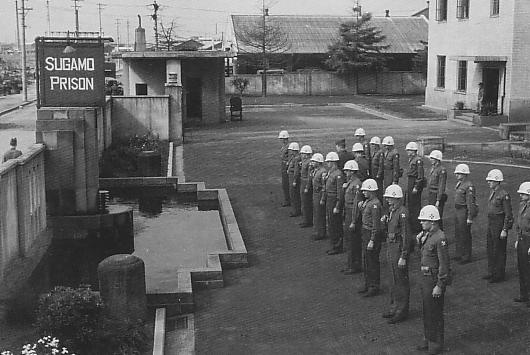
    It happened that at the time Ueshiba Sensei had a high fever and was in bed sleeping…but the foreigners were wonderful – instead of taking the stance “no matter what, he will be taken into custody immediately” they said “well, he’s sick and I guess that there’s no way that he can run away”, and they started with a search of the house (if it had been the Japanese army…no matter how sick he was I think that they would have taken him off to Sugamo Prison).

    Sugamo PrisonGuards at attention at Sugamo Prison, 1948

    When they did that, all of his writings turned out to be on pacifism (平和主義). Whatever writings they looked at they were all about advocating for peace. Then they understood “certainly he was employed as a budo instructor by the military, but Ueshiba is the very epitome of a pacifist”…and there he became the first of the war criminals to be released. In the end, he was never put into Sugamo Prison and was able to live life as a farmer.

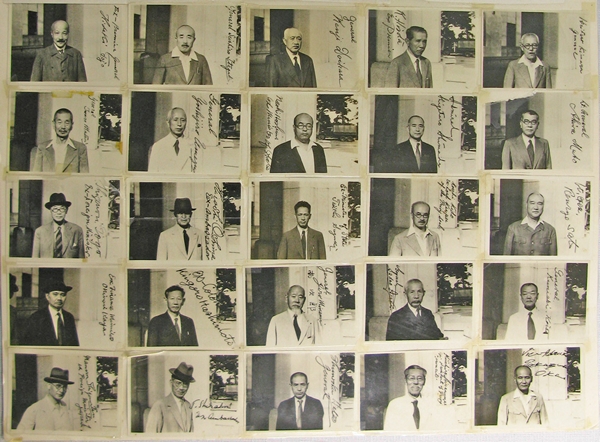
    Sugamo PrisonersSigned photographs taken at Sugamo Prison 
    this group includes a number of the Morihei Ueshiba’s associates
    Morihei Ueshiba’s close friend Shumei Okawa declined to be photographed

    (top row, left to right): “Ex-Premier General Hideki Tojo” (hanged 1948), “General Seishiro Itagaki” (hanged 1948), “General Kenji Doihara” (hanged 1948), “Ex-Premier K. Hirota” (hanged 1948), “General Heitaro Kimura” (hanged 1948), (2nd row) “General Iwane Matsui” (hanged 1948), “General Yoshijiro Umezu” (life; died in prison 1949), “Ex Minister of State Naoki Hoshino” (life; paroled 1958), “Admiral Shigetaro Shimada” (life; paroled 1955), “Lt. General Akira Muto” (hanged 1948), (3rd row) “Ex-Foreign Minister Shigenori Togo” (20 years, died in prison 1950), “Ex-Ambassador Hiroshi Oshima” (life; paroled 1955), “Ex-Minister of State Teiichi Suzuki” (life; paroled 1955), “Ex-Lord Keeper of the Privy Seal Koichi Kido” (life; paroled 1953), “Lt. Gen. Kenryo Sato” (life; paroled 1956), (4th row) “Ex-Finance Minister Okinori Kaya” (20 years; paroled 1955), “Ex-Colonel Kingoro Hashimoto” (life; paroled 1955), “General Jiro Minami [also signed in Japanese]” (life; paroled 1954), “General Sadao Araki” (life; paroled 1955), “General Kuniaki Koiso” (life; died in prison 1950), (bottom row) “Ex-Foreign Minister of Japan Mamoru Shigemitsu” (sentenced to seven years; paroled 1950), “Ex-Ambassador T. Shiratori” (sentenced to life; died in prison 1949), “General Shunroku Hata” (life; paroled 1955), “Ex-President of Privy Council Kiichiro Hiranuma (life; paroled 1952), and “Vice Admiral Takazumi Oka” (life; paroled 1954).

    *Translator’s Note – on Morihei Ueshiba and war crimes:

    from Transmission, Inheritance, Emulation 6, by Peter Goldsbury

    O Sensei as a War Criminal

    The principal evidence for this from the world of aikido is to be found in Aikido Jinsei by Gozo Shioda. The statement appears on p. 166, in a section recounting his meeting with O Sensei in Iwama in Showa 21 (1946). For those who can read Japanese, here is the text:

    Sensei wa touji Ibaragi-ken no Iwama ni insei shi, moppara noukou ni shitashinde oraremashita. Senji-chuu Sensei wa Kyoto no Butokukai no koumon wo sarete ita kankei ue, MacArthur no jirei ni yori G-go wo tekiyou sarete, koushoku tsuihou ni nari, Zaidan Houjin Aikikai mo kaisan no ukime atte oraremashita. Sono tame Aiki-en to iu namae no nouen wo hiraite mainichi noukou wo sareru katawara, doukou no mono wo atsume aikidou wo shidou sarete imashita.

    A similar statement can be found in an interview with Gozo Shioda conducted by Stanley Pranin. The latest version of this interview can be found on pp. 185-186 of Vol I of Morihei Ueshiba to Aikido, published in 2006. Here is an English translation:

    Pranin: After the war O Sensei also had a very difficult time.

    Shioda: The fact that Ueshiba Sensei was an adviser to the Butokukai in Kyoto was not good. Sensei was implicated in Class G war crimes / as a Class G war criminal. Ueshiba Sensei’s foundation was cancelled and his activities were forbidden. Thus Sensei confined himself in Iwama and since he could no longer practice budo, he created the Aiki-Farm and engaged in farming. It was a precarious existence.

    There has been some discussion on the Internet about such war crimes and questions raised about the truth of Shioda’s statements. First, a description of Class G ‘war crimes’ is in order.

    The source is SCAPIN (Supreme Commander Allied Powers Index) 550, of January 4, 1946, which ordered the removal and exclusion from public office of Japan’s wartime leaders. Broad categories delineated those who were to be purged. (A) Indicted war criminals; (B) All career military officers; (C) Leaders of the Imperial Rule Assistance Association and affiliated organizations; (D) Leaders and influential members of ultranationalist, secret and terrorist organizations; (E) Executives of companies involved in Japanese expansion; (F) Governors of occupied territories; (G) Initially broadly based and unspecified “additional militarists and ultranationalists”.

    The above classification can be found in Hans Baerwald’s “The Occupation of Japan as an Exercise in ‘Regime Change’: Reflections after Fifty Years by a Participant”, JPRI (Japan Policy Research Institute) Occasional Papers 29, p. 3. Baerwold adds the rueful comment that:

    Moreover, all SCAP staff sections had to rely on their counterparts in the Japanese bureaucracy for basic data and assistance in drafting reforms. This necessity allowed the Japanese officials to protect themselves and promote their own agenda by influencing SCAP officials. It was an early variant of using gaiatsu (foreign pressure) to their own advantage. I was an unwitting participant in the game while drafting purge criteria involving members of the Dai Nippon Butokukai, the Great Japan Military Virtue Society.

    It is interesting that Baerwold was involved in drafting purge criteria for the Dai Nippon Butokukai, which included aikido from 1942 onwards. The categories listed in SCAPIN 550 need to be read in conjunction with SCAPIN 548, which added the Dai Nippon Butokukai, with all its affiliated organizations, to the list of organizations proscribed by SCAP.

    Shioda’s allegations are strongly denied by Kisshomaru Ueshiba on pp. 83-84 of Aikido Ichiro. Kisshomaru also quotes the relevant passage from Aikido Jinsei (quoted in Japanese above) and rebuts the allegations one by one. Thus, O Sensei was not an adviser to the Butokukai during the war; he was not subject to any banning order from SCAP; and the Aikikai was never proscribed.

    I have not found any evidence outside aikido to support Gozo Shioda’s statements, but it is possible that Ueshiba is listed somewhere in the SCAP archives. However, the SCAP order issued in January 1946 initiated a search process that took a year to complete and the actual purge orders were not issued until 1947, when Shioda had already visited O Sensei in Iwama (in July 1946: see the interview, above). Nevertheless, given the influential people he knew, including a number of ultranationalist military officers who also trained at the Kobukan Dojo in the 1930s, it is possible that Shioda had such information and that O Sensei also knew he was under suspicion. However, even if he had come to the attention of SCAP, the only content of O Sensei’s ‘criminal’ activity is that he practiced a Japanese martial art. This might explain why he kept quiet in Iwama at least until around 1950, when the purge orders were lifted. SCAP had already turned its attention to the Korean War and liberated all the war criminals. Moreover, it was as early as 1948 that the Zaidan Houjin Aikikai, with its headquarters in Iwama, was approved by the Japanese education ministry as the postwar version of the Zaidan Houjin Kobukai. This appears to have been done by Kisshomaru Ueshiba, with the support of people like Kinya Fujita and Katsuzo Nishi, but appears to have been done very quietly, to avoid annoying SCAP.

    (NOTE. I have benefited very much by a recent discussion about Class G war criminals on the Aikido Journal website and from private correspondence with some of the participants in this discussion.)

    Takemusu Aikido Calligraphy

    Ueshiba Sensei’s calligraphy will remain in perpetuity,
    forever a shining treasure of the world.

    From Showa year 30 until he passed away in Showa year 44 (1955-1969), this Ueshiba Sensei stayed in my home for one week to ten days of each month. That is to say, the relationship between master and student was joined. The severe bushido type teacher student relationship of past times. This strictness was not forced upon me, it was the “way” of an uchi-deshi serving their master…that was how I regarded it. Without going that far one cannot grasp the essence of their master. Twenty-four hours per day, every day, under the same roof, what I learned was not just technique, it was that person’s way of living…that is “kokyu-ho”.

    By his side for twenty-four hours per day training my Ki. O-sensei’s moods, they were all communicated through his living. That is to say, I was connected to O-Sensei’s life. This was incredible.

    For example, when I made tea, I would have to judge how thirsty Sensei was and adjust the temperature accordingly, and when I heated his bath I would have to check the water temperature by scooping water out of the bathtub with a dipper rather than putting my hand directly into the water. If I were to put my hand directly in the water then a small amount of the oils on my hand would spread into the water. Sensei would know that. That’s why they say “The way of the disciple is harsh”.

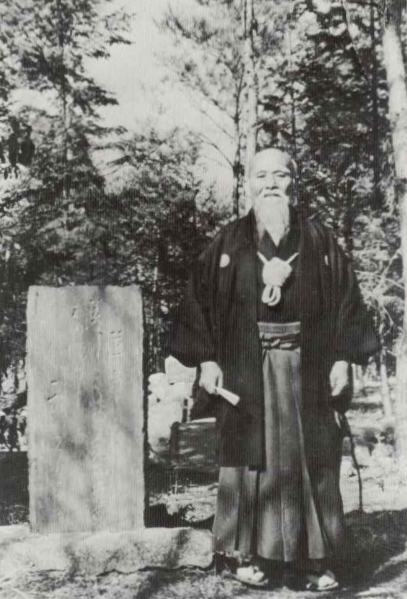
    Morihei Ueshiba in Iwama next to one of his Doka

    Stone monument at the Aiki Jinja in Iwama
    The inscribed Doka is by Aikido Founder Morihei Ueshiba
    calligraphy by Seiseki Abe
    (more in “Three Doka and the Aiki O-Kami“)

    「美しき
    この天地の御姿は
    主の作りし
    一家なりけり」

    “So beautiful,
    the form of this Heaven and Earth
    created by Su-
    to be a member of the one family”

    And then I trained that thing called “Ki”. That “kokyu” is shared exactly with calligraphy,

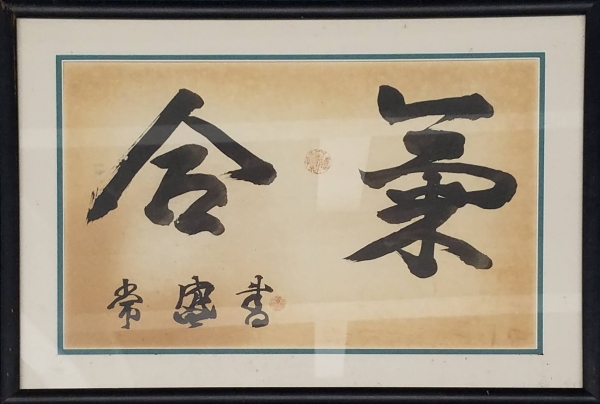
    One day Ueshiba Sensei said “That looks interesting, I’ll try it too.” and started drawing calligraphy. I’m sure that he wrote “Aiki”. From that day the comical reverse drama of “the disciple teaches the master…” began. Normally, something like this would be unthinkable…it made me extremely nervous.

    "Aiki" - calligraphy by Aikido Founder Morihei Ueshiba“Aiki” calligraphy by Morihei Ueshiba
    from the Waialae Avenue dojo in Honolulu, Hawaii

    First, without giving him a pattern, I would draw an example and show it to him. Sensei would stare at it and then say something like “so that’s how you draw it”, and then draw it himself.

    Intently…concentrating the entirety of himself in the tip of the brush, “Ki” would enter through the ink. For that reason, one can feel an incredible amount of “Ki” in Ueshiba Sensei’s works. Just turning one’s face to the calligraphy and putting palms together, the “Ki” leaps off at you. Foreigners who can’t read the characters seem to be even better at directly receiving that Ki.

    And then, when he drew he would draw in a single burst. He would not think of things like his breathing. For that reason, the most difficult thing was for him to write his name on the work at the end…clearly marking that place and position. There was only one place, pointing to that place…there is a place in the “Ki” of this single moment that leads to the “Ki” in Aiki, that is where the Ki of A-un (阿吽) exists.

    *Translator’s Note: “A-un” is the Japanese transliteration of the first and last letters of the sanskrit alphabet and represent, in Japanese Shingon Mikkyo, the beginning and end of the universe, Yin and Yang.

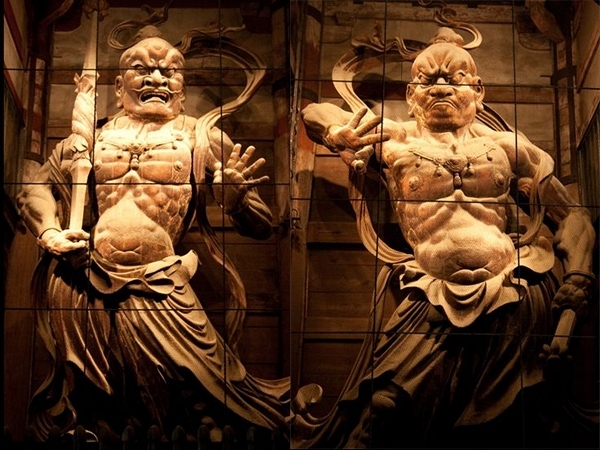
    A-un statues at Todaiji

    The A-un statues at Todaiji in Nara, Japan
    More in “Aiki, Iki, Kokyu, Heng-Ha and Aun” – Part 1  | Part 2

    From the Rikuryo Alumni Association “Visiting our Teachers” series, 1998


    Published by: Christopher Li – Honolulu, HI
  • Interview with Aikido Shihan Yasuo Kobayashi – Part 2

    Interview with Aikido Shihan Yasuo Kobayashi – Part 2

    Yasuo Kobayashi in HawaiiYasuo Kobayashi in Hawaii in 2008
    the late Robert Kubo – Aikikai 8th Dan, Aikido Hawaii International, on the left

    “At that point in time, I was caught up in some of the political nonsense amongst various teachers residing in the States, and held forth on this one drunken night at one of the regular parties the dojo had, and Kobayashi sensei said, “X-sensei is my friend, Y-sensei is my friend, Z-sensei is my friend. It all seems simple to me.” In his happy air, in his unpretentious practice and refusal to mystify aikido as either the ultimate combat or a means of establishing world peace, it would have been easy to regard him as an unexceptional man, one who simply liked pleasure, be it jovial laughter, enough beers to make him wobble when he bicycled home, and a regular routine of thumping his students and being thumped in turn. Rather, he always seemed to me to be a man of sublime common sense. As theoretical physicists strive for elegance and simplicity in their equations, Kobayashi sensei appeared to me to do with his life. Such simplicity is far from easy, and all too rare.”

    It Had to Be Felt #30: Kobayashi Yasuo – A Living Axle, by Ellis Amdur

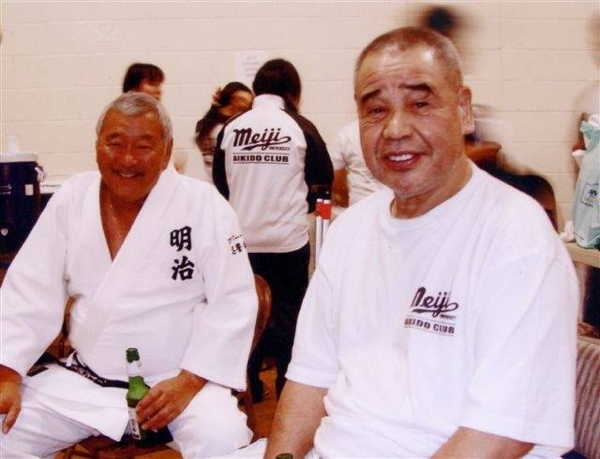
    Yasuo Kobayashi was born in Tokyo in 1936 and started training in Judo in his fifth year of elementary school. He enrolled at Aikido Hombu Dojo in 1954, the same year that he entered Meiji University, becoming one of the early post-war students of Aikido Founder Morihei Ueshiba. Now an eighth dan, he is the head of Aikido Kobayashi Dojo, which has more than 120 affiliated dojo around the world

    A round table discussion with Kobayashi Sensei appeared previously on the Aikido Sangenkai blog as “Yasuo Kobayashi and Fumiko Nakayama – Living Aikido” (Part 1 | Part 2 | Part 3).

    The current interview is the second part of a two part interview with Kobayashi Sensei that originally appeared in the May 2005 issue of Gekkan Hiden (月刊秘伝 / “Secret Teachings Monthly”), a well known martial arts magazine in Japan. You may wish to read Part 1 of the interview before reading this section.

    This interview was also published in a collection of interviews with students of the Founder published in Japanese as 開祖の横顔 (“Profiles of the Founder”) in 2009. There was a short introduction to this work in the article “Morihei Ueshiba – Profiles of the Founder“. A number of English translations of interviews from that collection appeared have appeared previously – Nobuyoshi Tamura Sensei (Part 1 | Part 2), Hiroshi Isoyama Sensei (Part 1 | Part 2), Shigenobu Okumura Sensei (Part 1 | Part 2), Nobuyuki Watanabe Sensei (Part 1 | Part 2), Masatake Fujita Sensei (Part 1 | Part 2) , Yoshimitsu Yamada Sensei (Part 1 | Part 2), Kanshu Sunadomari Sensei (Part 1 | Part 2), Hiroshi Kato Sensei (Part 1 | Part 2), Yoshio Kuroiwa Sensei (Part 1 | Part 2), Morito Suganuma (Part 1 | Part 2) and Kenji Shimizu (Part 1 | Part 2).

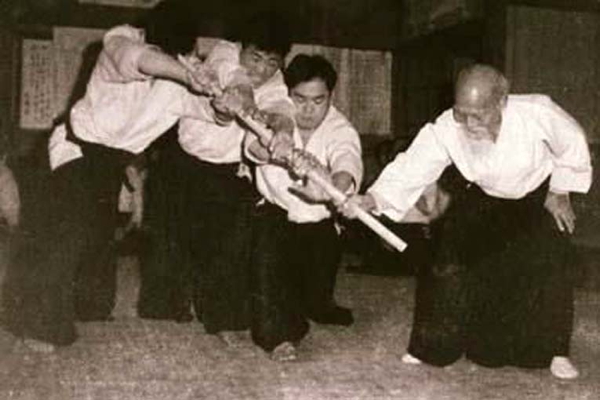
    Yasuo Kobayashi and Morihei Ueshiba“However hard we pushed the staff would not move.” – Yasuo Kobayashi

    Interview with Aikido Shihan Yasuo Kobayashi – Part 2

    Q: I see. Do the jiyu-waza (“freee-style techniques”) that are often seen at demonstrations date from that time?

    A: No, that began to be done after a system of examinations was established. After the number of members began to increase a system of Dan and Kyu examinations was established, and the uchi-deshi took ukemi at the time. However, there were only about five uchi-deshi then, so they weren’t able to partner with everybody as the numbers increased and so it came to be that those taking examinations would alternate taking ukemi for each other. It was then that jiyu-waza was added as an item on the examinations. Demonstrations began to be held from the time that I enrolled, but kihon-waza (“basic techniques”) alone weren’t interesting, so as the result of much thought it was decided to show kokyu-nage. Until that time kokyu-nage was not really done in the dojo.

    Q: Why was that?

    A: O-Sensei wasn’t very fond of kokyu-nage. Because “It’s just impossible to throw somebody flying that simply!” was his thinking. However, it’s excellent for conditioning so it was introduced into the curriculum. Something similar happened with aiki-nage, against the same background that accompanied the beginning of jiyu-waza. Speaking of that, as far as I know koshi-nage was not practiced at first either, it was after Shoji Nishio Sensei and Yoshio Kuroiwa Sensei researched it themselves that it became popular with other instructors.

    Yasuo Kobayashi student uniforms“When we went to Hawaii for a seminar wearing our student uniforms
    the customs officer asked me if we were in the army.”

    Great individuality among the Shihan

    Q: Did you often go to Iwama?

    A: When there was something happening, like the Aiki Taisai, I was often called there. But it might be better to say that I was dispatched there rather than called. Sometimes a phone call would come from O-Sensei “I’m sick!”, but when I hurried to Iwama he would be doing farmwork in good health. (laughing) I understood later that when O-Sensei became lonely he would use illness as an excuse to summon the young students. Certainly, they didn’t have training every day in Iwama, and since Morihiro Saito Sensei was employed by the National Railway there were times that nobody was there and he must have suddenly become lonely. When that happened I would be made to go and be someone for him to talk with. I would work the farm with him in Iwama, and we would eat together. Normally he was very mild-mannered and even if he only had a single steamed bun there were times that he would divide it with the students. However, when it came to taking care of him he was like a normal selfish old grandfather. (laughing) In any case, his mood would make 180 degree changes very quickly, often going this way and that. For that reason, if one could look ahead and begin to read his habits then one would gradually begin to understand what O-Sensei wanted, but if one couldn’t do that they would have a really difficult time working as an uchi-deshi. There were more than a few people who, although having ability as Budoka, failed through a lack of this kind of sensitivity. However, the experiences from that time were useful later when opening a dojo, so I think that the shugyo of the uchi-deshi was by no means wasted.

    Yasuo Kobayashi, Koichi Tohei and Nobuyoshi TamuraNobuyoshi Tamura (left), Koichi Tohei (center), Yasuo Kobayashi (right)

    Q: I’ve heard that you interacted with Morihiro Saito Sensei, Sadateru Arikawa Sensei and Shoji Nishio Sensei, what were your impressions of them?

    A: I think that Saito Sensei was attempting to faithfully hand down the techniques that O-Sensei taught in his sixties. As O-Sensei moved from his sixties to his seventies and eighties he inevitably lost physical strength, which caused the movements of his techniques to become softer and more circular. Kisshomaru Sensei changed the techniques at Hombu in accordance with that, but to the last Saito Sensei was fixed on what had been transmitted to him. I think that Gozo Shioda Sensei’s Yoshinkan was the same. On the other hand, since Kisshomaru Sensei mostly didn’t interfere with the details of other’s techniques each of the Shihan at Hombu dojo were a little bit different. Depending upon the instructor, the impression left by even the same technique could be completely different. However, it could be said that it is this depth and breadth that created today’s Aikikai.

    Q: Certainly, when one watches Aikikai demonstrations there is a lot of variation. You had many chances to be taught directly by Arikawa Sensei and Tada Sensei, what were your impressions of them?

    A: Arikawa Sensei came from Karate, and his training was intense. For that reason, there were a relatively large number of young people among those who followed Arikawa Sensei, even among the regular students, and he would mainly specialize in teaching at universities. Perhaps because of that he did not teach very much outside of Hombu Dojo, and he himself rarely spoke to people of personal matters, so although he was very popular not very many people know much about him in detail. Tada Sensei was a person who never neglected his personal training, so he accumulated an unusual amount of damage from techniques. Depending upon the shihan there were some cases in which they could not apply techniques unless the uke followed them, but that was absolutely never the case when it came to Tada Sensei.

    Aikido Founder Morihei Ueshiba

    Q: Is there an instructor who influenced you the most?

    A: I started with O-Sensei and then attended training with a variety of instructors at Hombu, but each of their techniques were different and I would adjust to each of them, so it felt as if I built my own style from there. Apart from O-Sensei, I was influenced by Kisshomaru Sensei. He had the fewest idiosyncrasies, and felt the most straightforward.

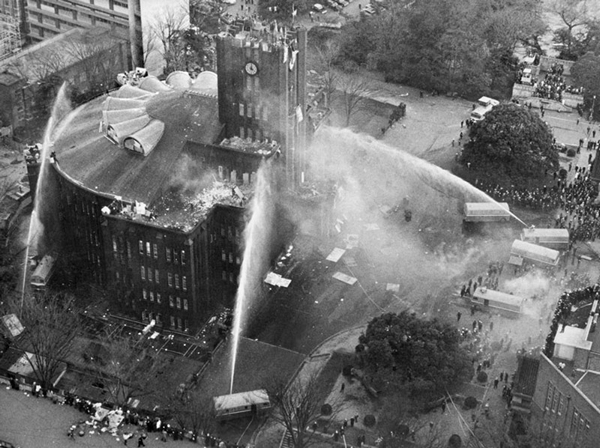
    Tokyo University ProtestsSuppressing protesters at Tokyo University – January 1969

    Moving among the common people, I spread Aikido

    Q: When did you open the current Kobayashi Dojo?

    A: April of Showa year 44 (1969). That was right in the middle of the university protests – universities had been locked out across the board and studies had been halted. Many of the students had fallen into a lifestyle of self-indulgent drinking and massages. It was then that I thought that there may be something that I could do. Well, the only thing that I was capable of was teaching Aikido, but even so I wasn’t able to just go ahead and use Hombu Dojo for my own purposes, so I thought about establishing my own dojo. I didn’t have any money, so I tore down the parking lot next to my house and build a hand-made eighteen tatami mat dojo (*Translator’s note: each tatami mat is approximately three feet wide and six feet long), and I would teach there when I didn’t have to teach at Hombu.

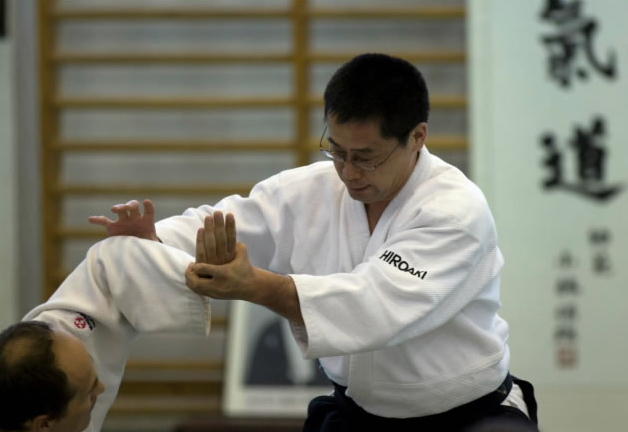
    Hiroaki KobayashiHiroaki Kobayashi Sensei, now a professional instructor

    Q: In other words, you built a dojo for the sake of the students?

    A: That’s right. In any case, students don’t eat and drink in small amounts, so those expenses were a real burden. Therefore, when I began recruiting new members I had to make the monthly fees fit their budgets. When my son Hiroaki was three years old, passersby would see me teaching students and my son and ask me “Please teach my children too”, so the number of members began to increase gradually.

    Morihei Ueshiba and Morihiro Saito

    Aikido Founder Morihei Ueshiba and Morihiro Saito in Iwama

    Q: It seems that you place importance on sword and staff at your dojo?

    A: The sword and staff that I teach is that which was organized by Saito Sensei. O-Sensei would do something different every day, so Saito Sensei, who was taught in Iwama for many years, organized them so that they would be easy to understand and that it would be easy to understand the extension of the technical principles of the sword and staff into the body arts. I think that collecting O-Sensei’s techniques like this was a great achievement. During a day of training in my dojo we always practice with both the sword and the staff, the thirteen step jo kata, the twenty-two step jo kata, the thirty-one step jo kata, we practice them just like that. I also place importance on training in the sword and the staff when I am overseas.

    Q: What are your thoughts concerning Aikido as a budo?

    A: Truthfully, this is a problem. There are some who criticize Aikido practice as being watered down, and even I don’t deny that. However, if we put that aside, I think that the fact that it has been able to attract those who had no previous interest in budo is an achievement. I myself trained intensely when I was young, so I understand that the evaluation of a budo is connected to its power to handle the strength of a budo’s attacks, but I feel that perhaps we should turn our eyes to the achievement of “the budo that was opened to 10,000 people – Aikido”.

    Q: When I hear you speak this way I understand that the narrow and inaccessible path of Aikido has become the broad path that it is today through the efforts of many teachers. So, what are your objectives for the future?

    A: I love Aikido and have trained hard for many years so that now I have opened a dojo and am teaching, and I would like to continue in the same way to, as it were, move among the common people and spread Aikido. For that reason, even now I take ukemi for the beginners! In the end, I like to move around when I teach. (laughing) Also, if the locations and the teachers are available then I would like to move forward with opening more dojos. I have more than one-hundred students raised in my dojo that have opened up their own dojos around the country, and I would like to continue to develop capable people.

    Aikido Founder Morihei Ueshiba

    Gekkan Hiden – May, 2005


    Published by: Christopher Li – Honolulu, HI
  • Interview with Aikido Shihan Yasuo Kobayashi – Part 1

    Interview with Aikido Shihan Yasuo Kobayashi – Part 1

    Yasuo KobayashiYasuo Kobayashi (小林保雄) Sensei – what a happy guy! 

    Yasuo Kobayashi was born in Tokyo in 1936 and started training in Judo in his fifth year of elementary school. He enrolled at Aikido Hombu Dojo in 1954, the same year that he entered Meiji University, becoming one of the early post-war students of Aikido Founder Morihei Ueshiba. Now an eighth dan, he is the head of Aikido Kobayashi Dojo, which has more than 120 affiliated dojo around the world.

    Aikido Journal editor Stanley Pranin called him a “man of honor” – when put under pressure to withdraw from Aikido Journal’s 1st Friendship Demonstration in 1985 he simply said “I promised to attend and therefore I will do so.”. His refusal to succumb to outside pressure was the leverage that allowed that demonstration to proceed successfully.

    A round table discussion with Kobayashi Sensei appeared previously on the Aikido Sangenkai blog as “Yasuo Kobayashi and Fumiko Nakayama – Living Aikido” (Part 1 | Part 2 | Part 3).

    The current interview is the first part of a two part interview with Kobayashi Sensei that originally appeared in the May 2005 issue of Gekkan Hiden (月刊秘伝 / “Secret Teachings Monthly”), a well known martial arts magazine in Japan.

    This interview was also published in a collection of interviews with students of the Founder published in Japanese as 開祖の横顔 (“Profiles of the Founder”) in 2009. There was a short introduction to this work in the article “Morihei Ueshiba – Profiles of the Founder“. A number of English translations of interviews from that collection appeared have appeared previously – Nobuyoshi Tamura Sensei (Part 1 | Part 2), Hiroshi Isoyama Sensei (Part 1 | Part 2), Shigenobu Okumura Sensei (Part 1 | Part 2), Nobuyuki Watanabe Sensei (Part 1 | Part 2), Masatake Fujita Sensei (Part 1 | Part 2) , Yoshimitsu Yamada Sensei (Part 1 | Part 2), Kanshu Sunadomari Sensei (Part 1 | Part 2), Hiroshi Kato Sensei (Part 1 | Part 2), Yoshio Kuroiwa Sensei (Part 1 | Part 2), Morito Suganuma (Part 1 | Part 2) and Kenji Shimizu (Part 1 | Part 2).

    Yasuo Kobayashi in Old Hombu DojoAikido Founder Morihei Ueshiba in old Hombu Dojo
    Yasuo Kobayashi Sensei entering from the right

    Interview with Aikido Shihan Yasuo Kobayashi – Part 1

    From Judo to Aikido

    Q: What motivated you to begin Aikido?

    A: I had practiced Judo from the time that I was a child. When I entered high school I was friends with the son of Tomoaki Danzaki (檀崎 友彰) Sensei from the Iaido Renmei and he invited me – “There’s a kind of Budo called Aikido, don’t you want to go see it?”. So we went to Hombu Dojo and for the first time I actually saw Aikido with my own eyes. That was the fall of my third year in high school. That was the height of Rikidozan’s popularity, and pro-wrestling was incredibly popular. However, when one spoke of Budo there was absolutely no talk of anything other than Judo, Kendo or Karate, it was a time when something like Aikido or koryu jujutsu would never fall from one’s lips.

    Tomoaki DanzakiTomoaki Danzaki, 1906-2003, of the Muso Shinden Ryu
    He was a student of Morihei Ueshiba’s close friend Hakudo Nakayama

    Q: What was your first impression upon seeing Aikido? I think that it must have been something of a completely different nature from Judo.

    A: Yes, that’s right. It had a completely different image from the budo that I had seen previously. Conversely, that was one of the things that fascinated me. It wasn’t like Judo, in which one paired up and applied techniques – applying techniques to each other after establishing a distance felt new to me. When we went to visit there was no explanation, they would just apply techniques to each other in silence. I was just told “If you want to do it then come at me!”. The person who was teaching at that time was Hiroshi Tada Sensei.

    Q: Did you turn towards Aikido right away?

    A: No, I was studying for the university entrance examinations at the time, so I enrolled after I entered the university. I also continued Judo separately through my second year at the university. The Kodokan in Suidobashi, the Aikikai in Ushigome, both of them were close enough to walk to from my home. However, I gradually began to feel that there was a limit to my Judo. That is to say, since I don’t have anything close to a large build, no matter what I did I couldn’t win against large opponents. That was a time when they didn’t have the weight classes that they have today, which made me think that all the more.

    Q: I see.

    A: Further, as opposed to Judo, in which most of one’s opponents are young, there are a wide range of ages in Aikido. There are young people, but there are also older people. Then, there were those who had resolved to come from the countryside to learn. It was a time in Aikido when both those learning and those teaching were young, so there was a kind of enthusiasm. For those reasons I gradually began to fall towards Aikido rather than Judo, and I came to learn Aikido exclusively from my second year at the university.

    Yasuo Kobayashi and Koichi ToheiYasuo Kobayashi taking ukemi for Koichi Tohei
    Akasaka Palace (State Guest House)

    Q: That was a time when Aikido was young. What was it like back then?

    A: O-Sensei was living in Iwama and Kisshomaru Sensei was a company employee, so instruction was centered around Tada Sensei. Even if one calls it Hombu Dojo, there were only around ten students. Unlike now, it was a wooden building, and there were two or so war refugee families living there – the space was partitioned for their use. The tatami was tattered and the roof was falling in – light was provided by a naked light bulb swinging from the ceiling. (laughing)

    Q: That’s quite different from the way it is now, isn’t it?

    A: Yes, it is. At the time I would attend the morning training at 6:30 a.m., and Kisshomaru Sensei was teaching that class. There were some five students living in the dojo, and although there were those who aspired to become professional Aikido instructors, there were also those who commuted to school or work from the dojo. Those people all had a sense of purpose, so they were all interesting human beings – there were many areas in which I was inexperienced, so there were many things that I was able to to learn from them.

    Q: Did you become an uchi-deshi?

    A: I was living the the Kudan district and I was close enough to walk to the Hombu Dojo in Ushigome, so I commuted. However, although I only attended the morning training at first, as time went on I became interested in the training being done by the uchi-deshi. I would go to the dojo early in the morning, and except for when I was in school I would spend all of my time living with the uchi-deshi, just returning to my home late at night. So, it seems that everybody thought that I was an uchi-deshi. (laughing) I also took care of O-Sensei, so I was treated almost the same as an uchi-deshi.

    “When one was thrown by O-Sensei power would be added to the center of their body.”

    Q: Who were the uchi-deshi that were living in the dojo at that time?

    A: Tada Sensei wasn’t living there, the uchi-deshi that were living there were Sadateru Arikawa (有川定輝) Sensei, Masamichi Noro (野呂昌道) Sensei and Nobuyoshi Tamura (田村信喜) Sensei, who later went to spread Aikido in France.

    Aikido Hombu Dojo InstructorsFront row second from left: Tadashi Abe (阿部正)
    Front row right: Nobuyoshi Tamura (田村信喜)
    Front row center: the “King of Mounted Bandits” Kohinata Hakuro (小日向白朗)
    Second row right: Kazuo Chiba, Yasuo Kobayashi, 

    Q: In your book (“Aikido, My Way: the Story of Kobayashi Dojos”) you also wrote about Tadashi Abe (阿部正) Sensei and Koichi Tohei (藤平光一) Sensei…

    A: Yes. Tohei Sensei was good at teaching, so I think that there were many people who were influenced by him. Abe Sensei once came to the dojo unexpectedly and shouted at me “Is Tohei here!?!”. I had never met him, but I thought “Is this the Abe Sempai that I’ve heard so much about?”. While this was happening Tohei Sensei came in, and as I was showing Abe Sensei in he said “Bring me some water”. As I rushed to bring him the water he said “No matter what I do I’m no match for this guy, so you throw the water on him!”. (laughing) Of course, it was an impossible situation since there was no way that I could do that, but as I paused in confusion he suddenly snatched up the cup himself and threw the water on Tohei Sensei’s face. As you might expect, Tohei Sensei just gave a strained laugh.

    Q: What an incredible scene! (laughing) When did you become an instructor at Hombu?

    A: At the same time that I graduated from the university. Work was difficult to find at the time, and without an introduction from the education department or the employment office it was difficult to find employment, but I carelessly stood up an interview that I had been recommended for by the employment office. (laughing) They scolded me – “We’re not going to throw any more leads your way!”. But at the time that I graduated I was a 3rd Dan, so I just became an instructor at Hombu.

    Q: I’ve heard that your classes at the time were severe and that you received some complaints…

    A: At the time that wasn’t limited to me, and it happened more than a few times. The instructors were all young and aggressive, and it wasn’t unusual for them to not take it easy even on the beginners when they were throwing. As for myself, rather than teaching other people I was more interested in my own training than anything else, so it was a time when that sort of thing couldn’t be helped. For that reason, when the uchi-deshi practiced together it was really something. Because at the time there was no training system like the one that is currently established the beginners would be mixed into the training with everybody else. We didn’t do a wide variety of techniques like we do now. “Watch and remember!” was how it was. All the same, I thought that wasn’t the right way, so when I taught I would separate the beginners and teach them separately. Thanks to that I became popular.

    Q: You received instruction from the Founder Morihei Ueshiba, felt his techniques, what was your impression?

    A: The O-Sensei that taught me was around 70 years old and he still had a lot of physical power. In Iwama he would lift bales of rice without a problem. While he had white hair and a small frame, he shoulders were broad and he had a solid build. When he held a bokken or jo his eyes would become especially sharp. When one was thrown by O-Sensei power would be added to the center of their body. When one is thrown normally it feels like a bouncing ball, it was only with O-Sensei that it felt as if you were being destroyed as you fell. That was really mysterious. O-Sensei would show us the techniques, but there was virtually no explanation of their content. He would often speak of the Kojiki, or about Omoto-kyo, but unfortunately the content was like grasping at clouds, and at the time I just thought “When will we get to move our bodies?”. (laughing) When I think about it now, I think that I should have paid closer attention.

    Yasuo Kobayashi taking ukemiYasuo Kobayashi taking ukemi for Koichi Tohei (top)
    and Morihei Ueshiba (bottom)

    Q: There wasn’t any technical explanation at all?

    A: Speaking of how to apply technique specifically, depending upon the person there are those who claim – “Ahh, he said this, he said that” – but I, at least, never heard any. When one watches O-Sensei’s demonstrations from his later years he appears to move like someone who has been liberated from earthly desires, but it is because one would be damaged if they didn’t take the fall that the people taking the falls must move in that manner. There are those who failed to understand that point and only saw the external appearance – this is the root of many misunderstandings.

    Continued in Part 2…


    Published by: Christopher Li – Honolulu, HI