Search results for: “tomiki”

  • Takuma Hisa – Kannagara no Budo, Daito-ryu Aiki Budo Hiden 1940
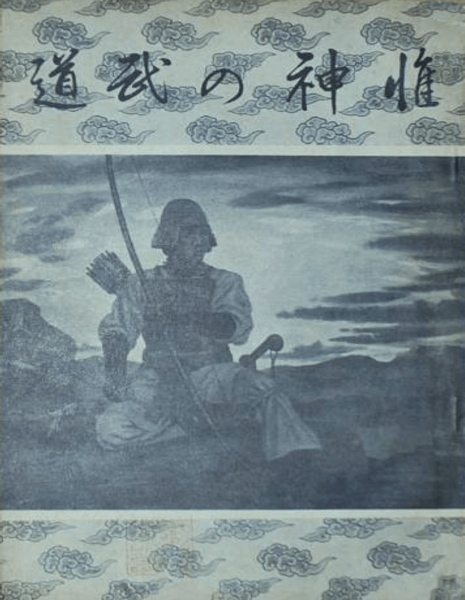
    Takuma Hisa – Kannagara no Budo, Daito-ryu Aiki Budo Hiden 1940
    Kannagara no Budo cover“Kannagara no Budo, Daito-ryu Aiki Budo Hiden” – 1940
    (惟神の武道・大東流合気武道秘伝 – 昭和15年)

    “In the spring of 1933, the bureau chief of the Asahi News sales office, Mr. Mitsujiro Ishii, who is presently the Minister of Justice, introduced us to Morihei Ueshiba Sensei, vouching for him as an expert on a par with the founder of judo [a reference to Jigoro Kano]. He recommended to the person in charge of security that we learn aikijujutsu from Ueshiba Sensei. Mr. Ishii was a leading figure at the Asahi News and had tremendous influence, so while it was supposedly a “recommendation,” it was really more like a supreme command. Since those of us in the General Affairs section were responsible for security, we very much welcomed Ueshiba Sensei, and we began learning at the Asahi Budo Dojo.”

    “Meeting Morihei Ueshiba” – from “Remembering Takuma Hisa
    by Stanley Pranin, Aikido Journal

    Takuma Hisa occupies a unique place in the history of pre-war Aikido. One of the major students of Aikido Founder Morihei Ueshiba in Osaka, he also went on to became one of the major students of Daito-ryu Chuku-no-so Sokaku Takeda, Morihei Ueshiba’s instructor,

    Born in Kochi Prefecture in 1895, he made a name for himself as a sumo wrestler during his time as a student before going on to become the Director of General Affairs of the Asahi News corporation in Osaka.

    Yoshimura, Tonedate and Takeda in Osaka

    Front row: Yoshiteru Yoshimura, Sokaku Takeda, Masao Tonedate

    Here is the classic (and oft-repeated) story of how Takuma HIsa met Sokaku Takeda, in his own words:

    On June 21st 1936, when we were training in Aikido under Ueshiba Sensei, a man came to the headquarters reception desk thrusting an iron staff suddenly with his right hand and holding a fine sword in his left “I am the Founder of Daito-ryu Aiki-jujutsu, Soke Sokaku Takeda. I have heard that you lads are learning from my student Morihei Ueshiba, but he is still inexperienced. If you have the will to learn true Aiki-jujutsu then become my students now and learn from me!”. Before anybody could say a word he took the security guards into the dojo. Keeping the fact that I was the division head a secret, I snuck in after the security staff and was astonished to see the reality of Takeda Sensei’s secret techniques. I went to Ueshiba Sensei right away and informed him of the appearance of the Soke, Takeda Sensei. I thought that Ueshiba Sensei would immediately go to beg his teacher’s pardon, but contrary to my expectations he became extremely dismayed and ended up withdrawing! So it came about that Ueshiba Sensei’s students would receive instruction in the early morning as before at the Umeda dojo, and then in the afternoon we would train with Sokaku Takeda Sensei in the night duty room of the headquarters building. At some point he left for Tokyo without any farewell to Asahi whatsoever, but Sokaku Takeda Sensei became increasingly committed and started to appear with Mr. Tokimune Takeda. According to the records:

    • First Time: June 21st 1936 to July 25th, 36 days
    • Second Time: November 1st 1936 to November 30th, 30 days
    • Third Time: August 17th 1937 to September 30th, 44 days
    • Fourth Time: October 22nd 1938 to November 14th, 22 days
    • Fifth Time: March 26th 1939
      Takuma Hisa – Menkyo Kaiden and eighth dan
      Yoshiteru Yoshimura (吉村義照) – eighth dan.
      Masao Tonedate (刀祢館正雄)

    He gave us the certificates and left for Hokkaido. As I look back now, it is almost fifty years since I began to learn Aikido. During that time, beginning with both Takeda Sensei and Ueshiba Sensei, then Director Tonedate and Security Chief Yoshimura, everybody has passed away. I am the only one left alive. I am eight-four this year, and have been stricken with paralysis, but I would like to use what strength I have left to transmit these techniques to future generations and somehow repay my debt to my Sempai.

    “The Appearance of Takeda Sensei”
    Menkyo Kaiden Takuma Hisa, 1982 – Takumakai Kaiho issue #50

    Takuma Hisa and Sokaku TakedaTakuma Hisa receives Menkyo Kaiden (“Certificate of Complete Transmission”)
    pictured with Daito-ryu Chuku-no-so Sokaku Takeda, 1939

    Takuma Hisa was one of two people to receive Menkyo Kaiden in Daito-ryu directly from Sokaku Takeda, the other person being Masao Tonedate (presumably an honorary certification due to his position at the Asahi News company). Kodokai Founder Kodo Horikawa would receive Menkyo Kaiden from Tokimune Takeda after his father’s death (but at Sokaku Takeda’s request).

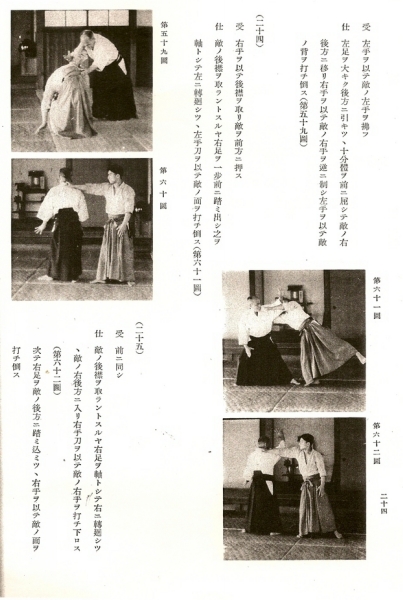
    After the war he would go on to establish the Takumakai, but before that, one year after receiving Menkyo Kaiden from Sokaku Takeda, he published a book on Daito-ryu – “Kannagara no Budo, Daito-ryu Aiki Budo Hiden” (惟神の武道・大東流合気武道秘伝). Representing what may have been the most comprehensive manual on Daito-ryu published until that time, the title page specifies that the volume is not to be distributed to non-students.

    Interestingly, Takuma Hisa excerpted large portions of the technical explanations directly from Moritaka (Morihei) Ueshiba’s 1933 technical manual “Budo Renshu” (see “Aikijujutsu Densho – AKA Budo Renshu, by Moritaka Ueshiba“). Further, although Hisa’s volume consists of photographs rather than drawings, it’s clear that many of the techniques themselves are identical.

    This ought not to be surprising, since what Morihei Ueshiba was teaching at the time was, without question, Daito-ryu. This was clearly stated by Yoshio Sugino, who was a student at the time and a contemporary of Takuma Hisa – “Of course Aikido was with Ueshiba Shihan – when I was studying it was still called Daito-ryu Aiki-jutsu” (“Interview with Yoshio Sugino of Katori Shinto-ryu, 1961“).

    Takuma HIsa had an extraordinary opportunity to compare the teachings of his two instructors – Daito-ryu Chuku-no-so Sokaku Takeda and Aikido Founder Morihei Ueshiba:

    Takeda’s instruction gave Hisa the chance to compare the techniques that he had been taught for the previous three years (1933-1936) by Ueshiba with those taught by Takeda. His conclusion was that they were the same—meaning that Ueshiba had not by that time significantly modified or evolved what he had been taught by Takeda. In later years, Hisa was adamant about Ueshiba’s and Takeda’s techniques being identical. He stated this clearly at a round table talk, “When Tomiki came to Osaka to teach aiki-bujutsu to the Asahi people, the techniques that both master Ueshiba and Takeda taught were the same. Definitely the same. Master Ueshiba should say that he was taught them by master Takeda. He should say that it was Daitoryu. But he never said that. Mr. Tomiki (who also traveled from Tokyo to Osaka to teach Ueshiba’s system at the Asahi dojo) knows this, doesn’t he. But Ueshiba never said it.” And Tomiki answered, “Definitely not. ‘I [Ueshiba] established everything…[smiling mysteriously]’. However old martial artists would often do that way.” [Shishida (Ed.), 1982, p.1]

    “The Process of Forming Aikido and Japanese Imperial Navy Admiral Isamu Takeshita: Through the analysis of Takeshita’s diary from 1925 to 1931”
     – Fumiaki Shishida (Waseda University, Tokyo, Japan)

    Thus, it should not be surprising that the explanations of principle and technique that Takuma Hisa learned from Morihei Ueshiba in 1933 should be repeated in his volume documenting the teachings of Sokaku Takeda published in 1940.

    But there’s more…

    In 1954 (five years after he told Morihiro Saito in Iwama that he had “completed” Aikido) Morihei Ueshiba published a book that he distributed privately to his students. This book was mentioned by Aikido 10th Dan Michio Hikitsuchi during the course of this interview:

    Is our current style of practice different from that when you started?

    Yes, the waza were done differently. You know, the other day I pulled out a book, Maki-no-Uchi. That was O-Sensei’s first book. We practised along the lines described in Maki-no-Uchi. ‘

    Did O-Sensei distribute that book?

    No. To have it, you had to have O-Sensei’s permission. For me, that was when I reached what would now be called shodan.

    Was it a secret book, something that was never shown around?

    Well, I don’t know whether I would call it “secret”. It was, after aIl, a book, and there probably are people who can learn just by reading. But it would have been very hard for someone to read the book end understand what it was about unless that person were practicing Aikido. Unless you were shodan or higher, you wouldn’t know what to make of it. I think that is still true today. It’s not as if you can tell someone, “Here, do it as the book shows.” Aikido is something that becomes a part of you – something that comes through the spiritual training [shugyo] of physical practice [keiko].

    Comparing the three volumes – Moritaka (Morihei) Ueshiba’s 1933 “Budo Renshu“, Takuma Hisa’s 1940 “Kannagara no Budo, Daito-ryu Aiki Budo Hiden” and Morihei Ueshiba’s 1954 manual “Aikido Maki-no-Ichi” reveals some interesting similarities.

    First, it’s important to note that the techniques pictured in the two volumes by Morihei Ueshiba are virtually identical, and are duplicated in many cases by the photographs in Takuma HIsa’s volume:

    Kubi Shime 1933Kubi-shime, “Budo Renshu” by Moritaka Ueshiba – 1933

    Kubi Shime 1940Kubi-shime, “Kannagara no Budo” by Takuma Hisa – 1940

    Kubi Shime 1953Kubi-shime, “Aikido Maki-no-Ichi” by Morihei Ueshiba – 1953

    Next, and perhaps more telling, is that the technical explanations given by Moritaka (Morihei) Ueshiba in 1933 in “Budo Renshu” are duplicated verbatim in Takuma Hisa’s volume – but they are also duplicated verbatim in Morihei Ueshiba’s 1954 volume “Aikido Maki-no-Ichi“. That is, there was virtually no change in either the technical depictions or explanations over a 21 year period, and there was no variation even when the volume in question was discussing Daito-ryu and not Aikido (although, for what it’s worth, Takuma Hisa often referred to his art as simply “Aikido”).

    What does that mean?

    Well, as I previously argued in “Budo – Moritaka Ueshiba’s 1938 Technical Manual“, all of this lends support to the argument that the radical phase change to the technical core of Aikido that is so commonly accepted to have occurred after the war…never happened. Or perhaps, it happened, but not at the behest of Morihei Ueshiba.

    This is further affirmed by Yasuo Kobayashi Sensei’s testimony as to the content of his training with Morihei Ueshiba when he entered Aikikai Hombu Dojo in 1954:

    Moderator: There were two books published before the war, “Budo” and “Budo Renshu”, was it only those techniques?

    Kobayashi: Yes, that’s right. Of course, we did not do staff (jo) or sword (ken).

    There is a discussion of this issue in “The Ueshiba Legacy, by Mark Murray” which you may like to read if you find this topic interesting.

    Here is a good visual comparison of the pre-war and post-war technique of Morihei Ueshiba that illustrates this point quite clearly:

    Also of interest is this very interesting study by John Driscoll, originally published on AikiWeb, showing the almost exact correlation between the techniques taught by Morihei Ueshiba and the techniques of the Daito-ryu Hiden Mokuroku – 82% according to this study, although that percentage would undoubtedly be much higher if the comparison were carried out against Morihei Ueshiba’s 1954 volume “Aikido Maki-no-Ichi” rather than the modern Aikido curriculum spread by the Aikikai in the post-war years.

    …and here comes the download – this freely available PDF formatted version of “Kannagara no Budo, Daito-ryu Aiki Budo HIden” is available through the efforts of Scott Burke, who lives in Fukuoka, but often comes to Hawaii to join the Sangenkai workshops with Dan Harden.Many thanks to Scott, and kudos for his continuing series of “Aikileaks”.

    I hope that you enjoy it!


    Published by: Christopher Li – Honolulu, HI

  • Mamoru Okada – Training with Aikido Founder Morihei Ueshiba

    Mamoru Okada – Training with Aikido Founder Morihei Ueshiba

    Mamoru Okada SenseiMamoru Okada Sensei (岡田主), 1921-2014

    This is another of a type of essay that I really enjoy reading – memories of meeting and training with Aikido Founder Morihei Ueshiba from the perspective of ordinary students. In this essay Mamoru Okada recounts his memories of meeting Morihei Ueshiba in Osaka in 1949, after seeing him at a public demonstration held for members of the Nishi Health System. Interestingly, it appears that the Founder was already making regular trips to the Kansai area at that time.

    Okada Sensei would go on to establish the Aikido Nobi Dojo (合気道野比道場) in Yokosuka in August 1980, and passed away in 2014 – a seventh dan in the Aikikai.

    If you enjoy this type of essay you may also enjoy “Mr. Kimura’s Aikido Memories” (Part 1 |Part 2) – which presents memories of training with Morihei Ueshiba at the pre-war Kobukan Dojo in 1942, and “Aikido and Me – Training with Aikido Founder Morihei Ueshiba” – which presents memories of training with Morihei Ueshiba in Osaka in the 1960’s.

    Osaka Central Public HallOsaka Central Public Hall, 1951

    Mamoru Okada – Me and Aikido

    – Translated by Christopher Li

    The first time that I saw a demonstration by Aikido Founder Morihei Ueshiba Sensei was in March of Showa year 24 (1949), at a lecture held by the Nishi Health System (西式健康法) at the Osaka Central Public Hall (大阪中之島中央公会堂).

    Koichi ToheiKoichi Tohei on his way to Hawaii in 1953

    Translator’s Note: Katsuzo Nishi created a series of exercises in 1927 that he named the “Nishi Health System”. He was also a student of Aikido Founder Morihei Ueshiba, who adopted some of those exercises into his warm-up exercise routines. The Nishikai (the organization formed around the Nishi Health System) was instrumental in inviting Koichi Tohei to Hawaii in 1953.

    Kingyo Undo and Hifuku UndoTwo of the Nishi Health System exercises
    Kingyo Undo (“goldfish exercise”) and Hifuku Undo (“dorsal-ventral exercise”)

    That day, after the regular lecture by Katsuzo Nishi Sensei (the founder of the Nishi Health System), there was a special demonstration by Morihei Ueshiba Sensei, so that the members of the Nishikai would be able to see his exquisite skills in Aikido for themselves.

    Katsuzo NishiKatsuzo Nishi demonstrates the “Hifuku Undo” (背腹運動) exercise

    Nishi Sensei had a long friendship with the Founder, and was even on the board of directors for the Aikikai. I was twenty-seven years old and employed by Harima Dock Co., Ltd. (later to merge with Tokyo’s Ishikawa Heavy Industries and become the IHI Corporation) in Aioi City in Hyogo Prefecture. Influenced by my parents, I had admired Nishi Sensei since the time that I was a child, and that day we took about three and a half hours to come all the way from Aioi City to attend the lecture. During his lectures Nishi Sensei would often say “Aikido is surely true Budo, the movements of Morihei Ueshiba Sensei’s techniques can be likened to a tetrahedron composed of equilateral triangles, and the Nishi Health System has also incorporated the theoretical system of that structure, it is used on our association emblem. Compared to other structures, a tetrahedron composed of equilateral triangles provide the greatest level of strength for the smallest volume, and can be said to be the most efficient. I think that everybody should certainly experience Aikido at least once.” – and on that day he gave all of the members that chance.

    Nishi Health System EmblemThe Nishi Health System emblem and an explanation of
    the four primary elements – nutrition, skin, mind (in the center) and limbs

    I attended together with my parents, and I remember being deeply impressed to see the exquisite flow of the Founder’s techniques for the first time. At the demonstration it was announced that there would be a special training workshop held beginning the next day at the Sonezaki Police Station in Umeda in Osaka, so the three of us decided to participate. There were many participants at the workshop, which was held over the period of a week, and the Founder instructed even us beginners with kindness.

    Running Water Never Spoils“Running water never spoils”
    Calligraphy by Nishi Health System Founder Katsuzo Nishi

    We immediately applied to become students, and our names were entered into the student register that the Founder carried with him. He did this publicly as soon as we were accepted as students. At the time we also had a house in Rokko, in Kyoto City, and we traveled to training from there. When we returned home we practiced the shiho-nage technique that we had been taught that day with each other, repeating our training through trial and error.

    My father came from a farming family and had a business selling seeds and seedlings. My mother was the daughter of a fishmonger and had graduated from a women’s teaching college, she was working as a teacher at an elementary school. I was an older child with no idea what it would be like to have siblings. From my childhood my mother would tell me tales of great heroes instead of fairy tales.

    For example, Yamato Takeru (日本武尊), Minamoto no Yoshitsune (源 義経), Kusunoki Masashige (楠木 正成), Kimura Shigenari (木村重成), Sanada Yukimura (真田 幸村), Araki Mataemon (荒木又衛門), Toju Nakae (中江藤樹), Yoshida Shoin (吉田松陰), Sakamoto Ryoma (坂本龍馬), Saigo Takamori (西郷隆盛), and others. It might be thought that this is what germinated my yearning for the sword. Wanting to learn Kendo even one day sooner, when I was a fifth year student in elementary school I asked my mother to take me to ask advice from someone who worked at the same school where she was employed and excelled at Kendo. That teacher advised me “Your body hasn’t developed yet, and you still have to deal with your middle school entrance examinations, so it would be better for you to learn Kendo after you enter middle school.”. I felt deflated, but I waited impatiently until the day that I would become a middle school student.

    Happily, in April of Showa year 9 (1934) I was able to enter Hyogo Prefectural Kobe Middle School #1. I was a fresh first year student, unused to the khaki colored uniforms and the white furoshiki that we used at the school, but I immediately went to visit the after-school Kendo dojo inside the school and applied to join. There were a number of sempai lined up around the entrance to the dojo, but I was permitted to join and became a member of the Kendo club. I was filled with happiness, and from then on I would train every day, plunging myself in a life dedicated to the sword.

    Thank you for visiting the Aikido Sangenkai blog. You can show your appreciation and support the distribution of more free content by donating today!

    Thanks,

    Chris

    In Showa year 14 (1939) I went to school at Kobe Kotoku Kogyo’s mechanical engineering department (now Kobe University’s engineering department), and at the end of Showa year 16 (1941) I received an accelerated graduation due to the outbreak of the war in the Pacific. In October of Showa year 17 (1942) I enlisted in the army, and until August of Showa year 20 (1945) I worked on the front line of domestic defense as an aviation mechanic.

    After the war I entered Harima Dock Co., Ltd. of Aioi City in Hyogo Prefecture and returned to my life as a member of society.

    When I was in middle school and vocational school I would sometimes travel for Kendo tournaments – the joy of victory and the teeth-grinding agony of defeat were both repeated uncounted times. After I entered the Harima Dock Co., Ltd. I joined the Kendo club, and traveled to tournaments and participated in company competitions. In November of Showa year 16 (1941), before graduating from Kobe Kotoku Kogyo, I received a san-dan certificate from the Dai Nippon Butokukai (大日本武徳会), and after the war I received go-dan in April of Showa year 31 (1956) and then a Renshi certificate in December of Showa year (1959) from the All Japan Kendo Federation (大日本剣道連盟). So, I felt that I was able to realize a little bit of the dreams of the sword from my childhood.

    The Founding of the All Japan Kendo FederationThe Founding of the All Japan Kendo Federation, 1952
    Morihei Ueshiba’s close friend Nakayama Hakudo, center-right

    However, I cannot doubt that being able to meet Aikido Founder Morihei Ueshiba was a turning point in my path of the sword, and along with my contact with Katsuzo Nishi Sensei was the biggest turning point in my life.

    At the time the Founder was living in the dojo in Iwama, in Ibaraki, or at the Hombu Dojo in Wakamatsu-cho, Shinjuku-ku, Tokyo. Every month, or every other month he would come to Kansai (Western Japan) for one or two weeks, and instruct workshops for the students there. I still hadn’t found a good place to train, so I trained intermittently by grasping those opportunities. There was a workshop held at the Nagata Police Station. I believe that the majority of the participants were teachers of the Nishi Health System or were Nishi Health System members. It was at this time that I met Aritomo Murashige Sensei (村重有利) and received instruction from him.

    Translator’s Note: Aritomo Murashige (1895-1964) was a student of Morihei Ueshiba from around 1931, and also studied Judo with Jigoro Kano and Tenshin Shoden Katori Shinto-ryu along with Minoru Mochizuki. He was the first person to bring Aikido to Burma (Myanmar), in 1953, as part of the Japanese government’s program of compensation for their WWII occupation. Murashige Sensei was active during WWII – one person is known to have said “When one came near him it felt as if there was a rain of blood”.

    Seigo Yamaguchi and Aritomo MurashigeSeigo Yamaguchi (left) with Aritomo Murashige (right) in Myanmar

    In between training sessions the Founder would speak about Omoto-kyo – before the war he went to China with Onisaburo Degushi Seishi (the Founder of Omoto-kyo), fought with mounted bandits and was arrested together. They were rescued miraculously at the last instant, just as they were ready to give up their lives – he made a great presentation to Murashige Sensei and the other students.

    Onisaburo Deguchi and Morihei UeshibaUnder arrest in Mongolia
    Onisaburo Deguchi (second from left) with Morihei Ueshiba (third from left)

    Soon after that Murashige Sensei was sent to teach in Burma, and then I heard that he passed away in a traffic accident. It’s a sad thing. There was also training at the house of Mr. Ishimi in Osaka (the older brother of the current mayor of Himeji City), I think that there were about fifteen tatami mats, and I also participated in that training.

    Also, I followed the Founder to Isaburo Tanaka (田中伊三郎 / also called 万川 / Bansen Tanaka) Sensei’s dojo in Suita City and was able to train a little there.

    I’m sorry for talking about personal matters, but while my mother was a woman she was also extremely decisive, and she was overflowing with a desire to seek the truth. Throughout her entire life she followed that path, it wouldn’t be too much to say that she would learn from great personages whenever she encountered them, from the very beginning to the very end. In my mother’s later years she gave me five photographic portraits and told me to hang them up in the tatami room of my home. They were the Founder Ueshiba Sensei, Katsuzo Nishi Sensei, Hideo Sonobe (園部 秀雄) – the Soke of Jikishinkage-ryu Naginata (a woman) , Masataro Sawayanagi (澤柳政太郎 – the former president of Kyoto University), and one more person – the Jodo Shinshu follower Shiro Tsuyama (津山四郎). Since then, in our home every morning and evening our entire family sits in front of the altar and, after praying to the Buddhas, pays their respects to the photographs of those five great personages.

    奥村、富木、植芝・満州国

    In front of the Shinbuden Dojo
    at Kenkoku Daigaku in Manchukuo (occupied Manchuria)

    Kenji Tomiki and Morihei Ueshiba center,
    Hideo Ohba in back row – second from left

    Shigenobu Okumura in back row – second from right

    Translator’s Note: It was Hideo Sonobe who commented on Morihei Ueshiba’s famous demonstration in 1939 with Hideo Ohba in Manchuria. Here is the story as told by Fumiaki Shishida (a student of Kenji Tomiki and a professor at Waseda University) in Ohba’s biography 

    It was Hideo Ohba who took ukemi for Ueshiba for the demonstration. He later talked about this event as follows: “Since the Emperor of Manchuria was in an exalted position at that time like the Emperor of Japan, I thought I should not take ukemi for Ueshiba in the way I usually did. If Ueshiba Sensei were a true master, he could freely handle a true punch, thrust or grab. Therefore, I decided to attack him seriously. When we stood on the platform, I saw many martial arts masters present in the large dojo of the Shimbuden. When I glanced at Ueshiba Sensei, his beard was sticking out towards me, his hair was standing on end and his eyes were glittering. I thought to myself that he was indeed a true master. Then I concentrated on taking ukemi for him, thinking how different it was to face a master. After the demonstration, we bowed and sat in the corner of the dojo and were supposed to walk over to the seats where the masters were sitting. However, I heard someone thunder, ‘You idiot!’ Ueshiba Sensei was short-tempered. He couldn’t wait until we returned to our seats. He shouted at me in that way in front of everyone. Until then, I thought he was a wonderful and truly great master, but his shout made my spirit pop like a bubble. We sat down. Ueshiba Sensei didn’t even smile. He was in a bad mood. So I felt tiny. Who do you think showed up then? It was Hideo Sonobe who was said to be without peer in Japan or anywhere in the use of the Naginata. She came all the way up to where the masters were sitting while Iai and Naginata kata were being demonstrated one after another. She said, ‘Mr. Ueshiba I have never seen more wonderful techniques than what you showed today. They were fantastic!’ Ueshiba Sensei, who had been in a bad mood, asked her what part she liked. He asked me to find a place where they could talk and we all went down to the basement of the Shimbuden and they discussed the theory of martial arts for two hours. While I was listening to their discussion Ueshiba Sensei asked her what she liked and she replied that she liked the ‘connections’ (tsunagari) between techniques. However, I didn’t understand these connections. I understood that the Dai Nihon Butokukai [Kyoto-based organization which governed Japanese martial arts] then was having a hard time trying to decide who they should choose as the best swordsman of that year and had asked Sonobe Sensei for her opinion. When I heard Sonobe Sensei tell Ueshiba Sensei that she had never seen such wonderful techniques even though she had seen him demonstrate often, I decided to learn Naginata in order to search for these ‘connections.’”

    Hideo would always recount this story to his students when he was in a good mood. One time I asked him the following question, “Sensei, when you attacked Ueshiba Sensei seriously, could he execute techniques like he usually did in his regular demonstrations?” Judging from the fact that he was scolded on that occasion, the answer was obvious. I asked this question because I wanted to confirm it. He answered, “Ueshiba sensei seemed to have a hard time executing techniques smoothly.”

    I think that Tomiki sensei was critical of the fact that Ueshiba’s demonstrations became gradually softer. Tomiki’s belief was that such softness was a way of making the person throwing look good, and was different from how martial arts should be. This demonstration of Ueshiba and Ohba received the highest praise from a top martial artist because of Ohba’s serious attacks, and the fact that he refused to participate in a prearranged performance the way he normally would have. I think that behind this fact lies an important hint as to what aikido should be. There seem to be some people within the Japan Aikido Association who see that their kata demonstrations are different from the flowing demonstrations of other schools, and try to change them in that direction. However, things should be the opposite. I think what is important is that we should master each technique perfectly as did Ueshiba Sensei, and then try to achieve a connection or flow between techniques. Hideo’s experience taught us not only the limitation of Ueshiba’s techniques (one cannot throw someone in a dance-like manner), as well as his incredible mastery, but also how a demonstration should be.

    Sonobe HideoHideo Sonobe (sixth from right) at the Kobukan (光武館) Dojo around 1954

    When she had the chance during a workshop at the Sonezaki Police Station my mother invited the Founder to visit us in Aioi City. This wasn’t something that any of us could have thought of, much less have been able to do. But the Founder consented and it came to pass. I think that it was around October of Showa year 24 (1949). We used the banquet hall of the Aioi Credit Union (相生信用組合) to gather Judo students and other people who were interested to view a demonstration by the Founder. As otomo (“attendants”) the Founder brought with him Tadashi Abe Sensei (阿部 正), who would later go to France as an instructor, Nariaki Hirano Sensei (平野成秋) from Tanabe City, and Mr. Oyama, who came from boxing (Translator’s Note: This may be Kunio Oyama, from Iwama.). Abe Sensei took ukemi for the demonstration. Thus it was that the light of Aiki shone even in the shipbuilding city of Aioi. We were especially grateful that the Founder stayed with us in our home while he was in Aioi.

    When I think of all of our carelessness back then I feel ashamed. We served him a humble meal, which he ate cheerfully, and then after a short chat he introduced our family to the basics of suwari-waza shomenuchi ikkyo. He stayed with us for the night and the next day, after taking the time to watch us clear the fields and cultivate the land of our mountain farmland, he returned to Tokyo in the afternoon.

    Later on around Showa year 33 (1958), during a trip to Kansai, the Founder stopped by my home. His otomo at the time were Nobuyoshi Tamura Shihan (田村信喜), who would spend many years teaching in France, and Seiichi Sugano Shihan (菅野誠一) who teaches in New York.

    On that occurance he was only able to stay for a short time, so I believe that we served him lunch. I think that this was the time that the Founder said “Let me write something for you.”, and wrote “Masakatsu, Agatsu, Katsuhayahi, Takemusu Aiki, Tsunemori” (正勝、吾勝、勝速日、武産合気、常盛) for me on a piece of calligraphy paper. Aside from the name “Morihei”, the Founder would also use the name “Tsunemori” (常盛).

    Takemusu Calligraphy“Takemusu” calligraphy by Aikido Founder Morihei Ueshiba
    signed “Tsunemori”

    I framed that calligraphy paper, and now it hangs in my Aikido Nobi Dojo. I hope that I can impress on my children that this is a family treasure of our household. We were honored that he would come to stay twice at the home of rank beginners. I often reflect deeply on the warm feelings of the Founder and I must continue to impress this on my children.

    I, who had begun to burn with a passion for Aikido, somehow managed to get by until that one day in the summer of Showa year 24 (1949) when I went to visit the Founder in Iwama for the first time.

    The Founder came to greet me cheerfully. It was also the first time that I had met his wife. I visited the Aiki Shrine and was able to hear the voice of the Founder as he prayed. After that he permitted me to join the training.

    At that time Morihiro Saito Sensei (斉藤守弘) was serving as an uchi-deshi, and I also asked Saito Sensei for instruction. I was still a beginner, so I was completely absorbed. I believe that the dojo had a wooden floor. After being kindly entertained in the evening I stayed there for the night.

    Early the next morning, after the Founder greeted the sun respectfully, we visited the Aiki Shrine, where we heard the Norito (“shinto prayers”) rising resonantly – it was an extremely refreshing feeling. If you could excuse me, many years have passed and some of the details have become fuzzy, so some of the details might be mistaken. I am trying to give you an outline of what it was really like, so please be forgiving.

    So, that day the Founder was scheduled to go to Aikikai Hombu Dojo, so I accompanied him as his otomo. It was still not long after the war and Hombu Dojo was an old fashioned wooden building. The dojo was divided into a number of small rooms, and it appeared that there were a number of families living there. It was the first time that I met Ni-Dai Doshu Kisshomaru Ueshiba and his wife. I left Hombu Dojo that day after receiving much generous hospitality.

    After that my mother also became enthusiastic about visiting the Iwama Dojo, so she took off for Iwama Village in Ibaragi Prefecture on her own from Aioi City in Hyogo Prefecture. When she transferred to the Joban Line at Ueno Station she saw a young person in a car and asked them the way to Iwama. Miraculously, that young person was training Aikido in Iwama at that time – his name was Mr. Yoshitomo Machida (町田良友), and he lived in Iwama at the time. Mr. Machida told my mother that he was training in Aikido, and took her to the Aikido dojo in Iwama so that my mother was able to meet the Founder and his wife there.

    The meeting of Mr. Machida and my mother was certainly unexpected. My mother completed her journey to Iwama and returned home without incident. After telling us about her trip she told us something that the Founder had said – “It seems that you son is pursuing the path of Aiki with enthusiasm, if you leave him with me I can develop him into a professional.”, was the gist of it, I believe. My spirit was moved, but I had already followed the path of a mechanical technician and I had a responsibility to protect the livelihood of my family, so I couldn’t make such a bold decision and was unable to take advantage of the Founder’s kindness.

    Mr. Machida was a university student at the time, and my mother asked him to help with some projects related the the Nishi Health System. As a result, he came to Kansai just for that and I was able to meet him face to face for the first time. Mr. Machida gave us a great deal of assistance during that time and we have remained friendly to this day.

    Published in the Kobe University Technical Club (KTC) newsletter issue 72, March 1st 2011


    Published by: Christopher Li – Honolulu, HI

  • Budo – Moritaka Ueshiba’s 1938 Technical Manual

    Budo – Moritaka Ueshiba’s 1938 Technical Manual

    Gozo Shioda and Morihei UeshibaUshiro technique – Gozo Shioda and Morihei Ueshiba in “Budo”, 1938

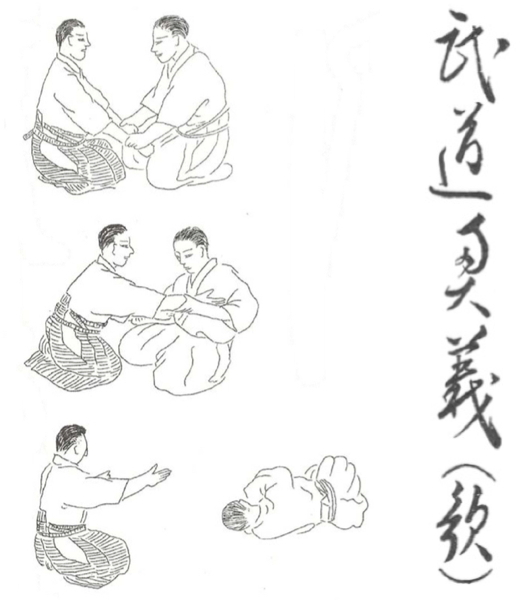
    First there was “Budo Renshu” (武道練習) in 1933 (published in English under the name “Budo Training in Aikido“), which was given to select students at Moritaka Ueshiba’s pre-war Kobukan Dojo as a teaching license. This work includes pictures of techniques hand drawn by Takako Kunigoshi and explanatory text assembled and edited primarily by Kenji Tomiki.

    Budo Renshu - 1933Ushiro technique – “Budo Renshu”, 1933

    At the time of its publication and through the end of World War II Aikido Founder Morihei Ueshiba used the name “Moritaka” – a name he received through his relationship with Onisaburo Deguchi (出口王仁三郎), from the word “shukou” (“Moritaka” can also be read “shukou”) that appeared in Deguchi Seishi’s Norito (祝詞, “Shinto prayers”).

    Don’t worry if you don’t have a copy, the PDF formatted version is freely downloadable from “Aikijujutsu Densho – AKA Budo Renshu, by Moritaka Ueshiba

    Aikido Maki-no-Ichi - UshiroUshiro technique – “Aikido Maki-no-Ichi”, 1954

    In 1954 Morihei Ueshiba published “Aikido Maki-no-Ichi”, edited by Ni-Dai Doshu Kisshomaru (Koetsu) Ueshiba. This book duplicated many of the pictures and most of the text of the earlier 1933 manual “Budo Renshu”.

    Again, don’t worry if you don’t have a copy, the PDF formatted version is freely downloadable from “Aikido Maki-no-Ichi – O-Sensei’s First Book on Aikido“.

    Thank you for visiting the Aikido Sangenkai blog. You can show your appreciation and support the distribution of more free content by donating today!

    Thanks,

    Chris

    In between the above two works, in 1938, Morihei Ueshiba privately published another book, a technical manual called “Budo”, for Prince Kaya Tsunenori, who was one of his students at the time. This manual was (re) discovered entirely by accident in 1981 when Aikido Journal editor Stanley Pranin was shown a copy by Zenzaburo Akazawa during the course of conducting an interview.

    Zenzaburo AkazawaZenzaburo Akazawa with Aikido Founder Morihei Ueshiba, 1938
    Morihei Ueshiba’s wife Hatsu, center
    Morihei Ueshiba’s daughter Matsuko, kneeling
    Matsuko was once married to Morihei Ueshiba’s 
    one-time successor Kiyoshi Nakakura

    A loose translation of “Budo” was published in English under the name “Budo: Teachings of the Founder of Aikido” by John Stevens. There is also a commentary by Morihiro Saito published under the name “Budo: Commentary on the 1938 Training Manual of Morihei Ueshiba“.

    I’ve discussed parts of this book before, in articles such as “Morihei Ueshiba, Budo and Kamae” (if you’re interested, the injunctions about “six directions” in “Budo” are repeated in “Aikido Maki-no-Ichi”) and the following parts two and three.

    Strangely enough, “Budo” has never been published in Japanese (wthe Morihiro Saito commentary contains both Japanese and English, but omits much of the original text).

    Do I have to say “don’t worry if you don’t have a copy”? Well don’t, because the PDF formatted version of the 1938 technical manual will be freely downloadable below. This is the Japanese version, of course, so you may want to refer to the two editions above with regards to the English translation and commentary. This copy was originally posted by Eric Grousilliat on his French language Budo Shugyosha blog.

    Like “Budo Renshu”, “Budo” was often distributed to students as a licensing document.

    Ogi no Koto - BudoThe Last Page of “Budo”

    On the last page of “Budo”, displayed above, we can see that this copy was issued by Moritaka Ueshiba in 1938 as a licensing document. The text on the right confirms that this document certifies the transmission of “Ogi no Koto” (奥義之事 / “Inner Mysteries”). This may likely be in imitation of the Daito-ryu “Hiden Ogi no Koto” scrolls that Morihei Ueshiba both received from his instructor Sokaku Takeda and distributed to students such as Kenji Tomiki and Minoru Mochizuki.

    In comparing the three volumes, you will see that the techniques from “Budo Renshu” carry through to “Budo” and then carry through to “Aikido Maki-no-Ichi“.

    Aikijujutsu Densho - Ikkyo“Budo Renshu” – 1933


    Budo, 1938 - Ikkyo“Budo” – 1938

    Aikido Maki-no-Ichi, 1954 - Ikkyo“Aikido Maki-no-Ichi” – 1954

    If you chance to examine and compare the text of the three volumes, which give very detailed and complete explanations of Morihei Ueshiba’s technical principles, you will find something similar – the textual explanations are consistent and continuous across all three volumes.

    This is significant because it shows that what Morihei Ueshiba was teaching in 1954 was the same as what he was teaching in 1933 and in 1938. It shows that five years after he told Morihiro Saito in Iwama (in 1949) that he had “completed” Aikido…he was still distributing the same material, containing the same explanations and the same techniques that had given his students in 1933 – when they were firmly students of Daito-ryu Aiki-jujutsu.

    Further, we have Morihiro Saito’s repeated testimony that what the Founder taught him in Iwama in the 1960’s most closely resembled what appears in the publication “Budo”, from 1938.

    Morihiro Saito BudoMorihiro Saito references the 1938 teaching manual “Budo”

    “I once doubted that Saito Sensei’s methods were closely rooted in O-Sensei’s teachings because of the apparent differences in their execution of techniques. I based myself on the Founder’s demonstrations in the films from his final years where he performed very few techniques, many of them involving little contact with his uke. On the other hand, Saito Sensei’s aikido was precise, martial and technically diverse. However, I was forced to reevaluate my opinion on this key point following the discovery of O-Sensei’s 1938 technical manual “Budo” where photos of several key basic techniques are virtually identical to the aikido forms taught by Saito Sensei in Iwama. My later exposure to the more than 1,000 photos from the Noma Dojo series of 1935 reinforced this change in my thinking.”
    – Stanley Pranin, Aikido Journal editor
    The Iwama Aikido Conundrum

    There is another important person, Takuma HIsa, who had a chance to compare the teachings of his two instructors – Daito-ryu Chuku-no-so Sokaku Takeda and Aikido Founder Morihei Ueshiba:

    Takeda’s instruction gave Hisa the chance to compare the techniques that he had been taught for the previous three years (1933-1936) by Ueshiba with those taught by Takeda. His conclusion was that they were the same—meaning that Ueshiba had not by that time significantly modified or evolved what he had been taught by Takeda. In later years, Hisa was adamant about Ueshiba’s and Takeda’s techniques being identical. He stated this clearly at a round table talk, “When Tomiki came to Osaka to teach aiki-bujutsu to the Asahi people, the techniques that both master Ueshiba and Takeda taught were the same. Definitely the same. Master Ueshiba should say that he was taught them by master Takeda. He should say that it was Daitoryu. But he never said that. Mr. Tomiki (who also traveled from Tokyo to Osaka to teach Ueshiba’s system at the Asahi dojo) knows this, doesn’t he. But Ueshiba never said it.” And Tomiki answered, “Definitely not. ‘I [Ueshiba] established everything…[smiling mysteriously]’. However old martial artists would often do that way.” [Shishida (Ed.), 1982, p.1]

    “The Process of Forming Aikido and Japanese Imperial Navy Admiral Isamu Takeshita: Through the analysis of Takeshita’s diary from 1925 to 1931”
     – Fumiaki Shishida (Waseda University, Tokyo, Japan)

    The explanations of principle and technique showing what Takuma HIsa learned in 1933 (“Budo Renshu”) are repeated in 1938 (“Budo”), which Morihiro Saito testified was what Morihei Ueshiba was teaching in Iwama in the 1950’s and 1960’s. This is supported by the fact that the identical explanations and techniques appear in 1954 (“Aikido Maki-no-ichi”), in a volume distributed by Morihei Ueshiba long after the war.

    All of this lends further support to the argument that the radical phase change to the technical core of Aikido that is so commonly accepted to have occurred after the war…never happened. Or perhaps, it happened, but not at the behest of Morihei Ueshiba.

    There is a discussion of this issue in “The Ueshiba Legacy, by Mark Murray” which you may like to read if you find this interesting.

    One last tidbit before we proceed to the download…

    Kannagara no Budo“Kannagara no Budo – Daito-ryu Aiki Budo Hiden”, 1942

    Here we have the same technique appearing in Takuma HIsa’s “Kannagara no Budo – Daito-ryu Aiki Budo Hiden”, published in 1942. Takuma Hisa received Menkyo Kaiden in Daito-ryu from Sokaku Takeda in 1939. Interestingly, he gives there the same exact explanation (word for word) about Shomenuchi in this book about Daito-ryu that Morihei Ueshiba gave in “Budo Renshu” in 1933…which is also the same exact word for word explanation that appears in “Aikido Maki-no-Ichi” in 1954.

    “Strike while exercising the technique of the unity of opposites (陰陽合致) in the hand-sword.”

    The “opposites” above are, translated more literally, “In” and “Yo”, “Yin” and “Yang”, the core principles that suffuse so much of Morihei Ueshiba’s explanations, and form the basis for Chinese martial arts and cosmology. Interesting in and of itself, but it is also interesting that the bulk of the explanation of principle and technique through this entire book about Daito-ryu…duplicates the text in Morihei Ueshiba’s 1933 and 1938 manuals, and that the same explanations that appear in Morihei Ueshiba’s 1954 manual.

    And now, the full scanned PDF version of the 1938 technical manual “Budo”, by Aikido Founder Morihei Ueshiba:

    Enjoy!


    Published by: Christopher Li – Honolulu, HI

  • Aikijujutsu Densho – AKA Budo Renshu, by Moritaka Ueshiba

    Aikijujutsu Densho – AKA Budo Renshu, by Moritaka Ueshiba

    Aikido Founder Morihei UeshibaAikido Founder Morihei (Moritaka) Ueshiba
    “Aikijujutsu Densho” AKA “Budo Renshu”, 1934

    From the early 1920’s through the end of World War II Aikido Founder Morihei Ueshiba used the name “Moritaka” – a name he received through his relationship with Onisaburo Deguchi (出口王仁三郎), from the word “shukou” (“Moritaka” can also be read “shukou”) that appeared in Deguchi Seishi’s Norito (祝詞, “Shinto prayers”).

    The actual voice of Onisaburo Deguchi chanting Shinto prayers

    It was during this time period that he published the books “Budo” (1938) and “Budo Renshu” (1933), which both appeared under the name “Moritaka Ueshiba” (植芝守高).

    Aikijujutsu Densho - Mokuroku pageThe last page of “Aikijujutsu Densho” (“Budo Renshu”) showing its
    status as a licensing document, issued in Showa year 9 (1934).
    Signed “Ueshiba Moritaka” and stamped (top right) “Aikijujutsu”.

    “Budo” was originally created for Prince Kaya Tsunenori, a member of a collateral branch of the imperial family. Kayanomiya would eventually become Superintendant of the Army Toyama School – where Morihei Ueshiba would act as an instructor before the war. An English edition (“Budo: Teachings of the Founder of Aikido“), translated by John Stevens, was published in 1991, and a separate edition -“Budo: Commentary on the 1938 Training Manual of Morihei Ueshiba“, translated by Sonoko Tanaka and Stanley Pranin, was published in 1999.

    “Budo Renshu” (published in English under the name “Budo Training in Aikido“), published in 1933, was given to select students as a teaching license. Unlike “Budo”, which is composed of still photographs of Morihei Ueshiba demonstrating technique, “Budo Renshu” is composed of pictures hand drawn by Takako Kunigoshi, a student at Morihei Ueshiba’s Kobukan Dojo who began training shortly before her graduation from Japan Women’s Fine Arts University. This was also discussed in the article “Three Doka and the Aiki O-Kami“.

    “Budo Renshu” also contains detailed written explanations of the forms and principles of Morihei Ueshiba’s art that were largely complied and edited by Kenji Tomiki, one of Morihei Ueshiba’s senior students who began training at the Kobukan Dojo in Tokyo around 1926.

    More information about Tomiki Sensei is available in the articles “Kenji Tomiki: Judo Taiso – a method of training Aiki no Jutsu through Judo principles” and “Aikido Shihan Kenji Tomiki’s Goshinjutsu“.

    In 1954 Morihei Ueshiba published “Aikido Maki-no-Ichi”, edited by Ni-Dai Doshu Kisshomaru (Koetsu) Ueshiba. This book, which was not publicly distributed (but is available here), duplicates most of the text and many of the drawings that first appeared in the 1933 publication “Budo Renshu”. That is to say – this book demonstrates that the technical explanations, both written and graphical, and the descriptions of principles that Morihei Ueshiba taught were the same in 1954 as they were in 1933, when the art was called “Daito-ryu Aikijujutsu”.

    The document that will be available for download below, as well as the rest of the content on this site, is provided free of charge as a service to the community, and will continue to remain free of charge. You can help support this project by contributing a little bit to help support our efforts. Every donation (even $1) is greatly appreciated and helps to cover our server and bandwidth costs, and the time involved. The more support that we get the more interesting new content we can get out there!

    By donating you also help support our efforts at Aikido Hawaii, which has provided a state-wide resource for all Aikido in Hawaii, regardless of style or affiliation, for almost twenty years.

    Thanks,

    Chris

    The edition of “Budo Renshu” that will be available for download below is presented courtesy of Scott Burke, who lives in Fukuoka, but often comes to Hawaii to join the local Sangenkai workshops. He was also generous enough to provide scanned copies of “Aikido Maki-no-Ichi” and “Kenji Tomiki: Judo Taiso – a method of training Aiki no Jutsu through Judo principles“. It was issued by Morihei (Moritaka) Ueshiba in Showa year 9 – 1934.

    The cover of Aikijujutsu DenshoThe cover of “Aikijujutsu Densho”

    As you may have noted above, the actual title on the cover of the book is not “Budo Renshu” (武道練習), but rather “Aikijujutsu Densho” (合気柔術伝書).

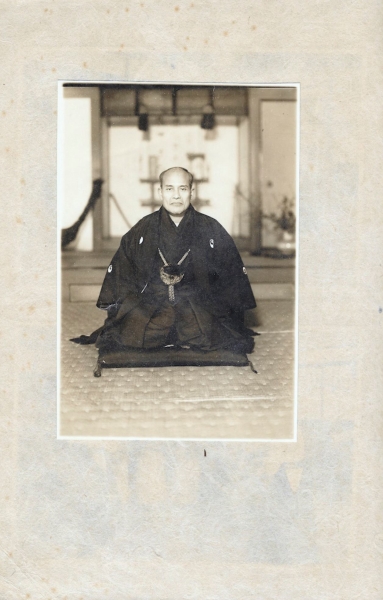
    The book opens with a formal portrait of the founder (above) and includes photos of Morihei Ueshiba demonstrating Happo Bunshin (八方分身) at the Kobukan Dojo in Ushigome (Wakamatsu-vho) that opened in 1931. The technique he was showing was included in the Daito-ryu scrolls issued in that same year.

    If you look closely, the person the second from the right in both photographs is none other than Aikido 9th Dan Rinjiro Shirata, who was known as the “Kobukan Prodigy”.

    Rinjiro Shirata in Aikijujutsu Densho

    Happo bunshin – second from right in both photos:
    Rinjiro Shirata Sensei (白田林次郎)

    Shirata Sensei was one of the few post-war Aikido instructors to have received copies of both “Budo Renshu” and “Budo” directly from Morihei Ueshiba before the war.

    Here’s a little interlude about Ichiro Shibata’s experiences when he encountered Rinjiro Shirata in 1977 (from “It Had To Be Felt #21: Shibata Ichiro: A Lean and Hungry Look“, by Ellis Amdur: ):

    Another day that I vividly recall was during the first International Aikido Federation consolidation in, I believe, 1977. That morning, instead of Doshu, Shirata Rinjiro sensei taught class. There were easily one hundred and fifty people on the mat. Shirata sensei was allotted one and one-half hours. The majority of the students were foreign, with a particularly numerous French contingent, many of whom had high dan rankings. Shirata sensei had a very quiet demeanor, very gentle, very humble. The manners of French students were particularly appalling. Shirata sensei bowed in and started warm-ups. Many of these high-ranking Europeans started engaging in conversations, ignoring the warm-ups (these were not the dojo regulars — these were representatives of national organizations, many of whom ranked each other, who behaved with all the uncouth gaucherie of a United Nations bureaucrat with diplomatic immunity). After fifteen minutes (this was one of those “hidden in plain sight” moments — he did some solo exercises that, as poorly as I remember, I’d never seen before), Shirata sensei took a bokken. He started speaking about shihonage, underscoring what an important technique it was, and demonstrated shihogiri with the bokken. With surely a chuckle — well aware that the majority of those in the class were dismissing him merely because he was unknown to them – he said, “I’m sorry, I don’t know much about the sword. Osensei developed a lot of things after I studied with him.” The French kept talking, something that Shirata sensei ignored. I made a small mark at this point, because two of these six dans were standing, conversing in front of me, in the front row of the serried ranks of students <yes, standing!> while he was teaching, and enraged, I grabbed both of them by the koshiita of their hakama and slammed them into seiza, like cracking a whip. They whirled around and I said, “Shut the f**k up.” Cross-cultural communication — they understood my English! — and they turned around, bustling like a couple of broody hens on their knees. I suddenly felt a hard poke in my back. I turned around, ready for some kind of Gallic expostulations, and there was Waka-sensei (Moriteru), giggling with a big grin on his face.

    Then Shirata sensei called Shibata-san out for ukemi. It didn’t start out well. The class was over one-half hour old, the old man had just done warm-ups and a “simple” set of sword swings, and he hadn’t exerted any authority over the class. Shibata-san, perhaps, can be forgiven, in that he reached out, in bored fashion, to take what he apparently assumed was a nice, apparently ineffectual old guy’s arm. I should mention that Shirata sensei’s hands were huge, like rhododendron bushes hanging from massive wrists. Imagine Shibata-san sticking out an arm towards the west. Shirata-sensei went further west. And further. I believe he covered one 1/3 the width of the Aikikai’s mat. Shibata-san’s face was like that of Wiley Coyote in the Roadrunner cartoons when he realizes that the rope he took hold of was attached to an anvil that had just been dropped off a cliff. The final cut of Shirata sensei’s shihonage was like Itto-ryu’s primordial cut: perfectly centered, from sky to ground, except he was cutting with a human being in his hands instead of a sword. Shibata-san made one of the most magnificent recoveries I’ve ever seen. I truly thought his arm was going to be ripped off his body, but he managed, with two huge strides and a dive to get around in time to take a thunderous breakfall. Shirata sensei threw him three more times, Shibata-san taking impeccable ukemi now, and he got up, a man in love. Others of us felt the same, both for the deserved come-uppance of our well-liked, but feared sempai, and also for this unknown-to-us, titanically powerful old man. Unbelievably, though, many of the French were still talking, casually strolling off the mat, even as Shirata sensei demonstrated another technique. Shibata-san, who, I’m sure, had been fuming at their behavior already, launched himself like an out-of-orbit comet managing a multiple attack of the entire Western world. Well, actually, he attacked the entire Western world. He was sweeping around the mat, jumping in to a pair of practicing foreigners, and grabbing one after another, launching them through the air, off the mat onto the wooden runway, or literally splattering them against the walls, then moving on to another pale-skinned pair and doing the same. It was like watching a fin-nipper in an aquarium, with all the guppies swirling away every time he drew near, one after another caught and mangled. Then, all of a sudden, he grabbed me, and spinning, wound up to throw me right into a wall. I managed to step inside him and turn, an inward tai-no-henko, spun him another half turn, and with our momentum, his back slammed against the wall. His eyes were blank and he raised a fist, but before he knocked me out, I grabbed his shoulders and yelled, “Shibata-san, Ore da! Ore da!” (It’s me! It’s me!). He shook himself like a wolf throwing off water, patted me on the shoulder and in English, said in a merry tone, “Oh, I’m sorry!” and spun away, grabbed another Frenchman and sent him flying.

    The last half-hour of the class was much better behaved, I must say. Shirata sensei simply continued, unperturbed throughout the entire time, as if to say, “I’m simply here doing what I’m doing. If you want to pay attention, you are welcome.”

    Just one more interesting note before we get to the download…..it is immediately apparent from comparing the post-war versions of “Budo Renshu” that were published by the Aikikai and Ni-Dai Doshu Kisshomaru Ueshiba (published in English under the name “Budo Training in Aikido“) to the original edition that in the post-war version many of the drawings have been re-traced. This is most-likely because they were working from photocopies or other low quality copies of the original work. What is interesting, is that many of the people in the post-war drawings appear to be….happier!

    Budo Renshu - pre-war versionOriginal version – stern and focused Kobukan practitioners
    Note the downturned eyebrows

    Budo Renshu - post-war versionPost-war version – happy Aikikai practitioners

    And now, the full scanned PDF version of the 1934 “Aikijujutsu Densho” AKA “Budo Renshu”:

    Enjoy!


    Published by: Christopher Li – Honolulu, HI

  • Three Doka and the Aiki O-Kami

    Three Doka and the Aiki O-Kami

    The Secret Teachings of Budo“The Secret Teachings of Budo (Poems)” – From “Budo Renshu” – 1933

    The 1933 training manual “Budo Renshu”  (published in English under the name “Budo Training in Aikido“) was initially given to the students of Aikido Founder Morihei Ueshiba as a kind of a teaching license.

    It was filled with illustrations depicting techniques (such as the one above) taught at the Kobukan Dojo which were drawn by Takako Kunigoshi, a student at the Kobukan who began training shortly before her graduation from Japan Women’s Fine Arts University.

    Takako Kunigoshi and Shigemi Yonekawa

    Takako Kunigoshi and Shigemi Yonekawa

    It is believed that the sections of text were assembled by Kenji Tomiki, under the direction of Morihei Ueshiba.

    Among the text that precedes the technical portion of the manual is a section entitled “The Secret Teachings of Budo (Poems)” that contains many of the Doka (“Poems of the Way”) written by O-Sensei.

    There is a similar collection in the 1938 technical manual “Budo”. A loose translation of “Budo” was published in English under the name “Budo: Teachings of the Founder of Aikido” by John Stevens. There is also a commentary by Morihiro Saito published under the name “Budo: Commentary on the 1938 Training Manual of Morihei Ueshiba“, but if memory serves that edition did not include the Doka.

    Together, those two collections make up the bulk of the pre-war Doka that exist today. There are also a number of Doka that appear in the post-war works of Morihei Ueshiba such as “Takemusu Aiki” (a highly abridged version of which was published by John Stevens as “The Heart of Aikido: The Philosophy of Takemusu Aiki“).

    The Doka are often quoted without context or explanation (for example, as they appear in John Stevens’ “The Art of Peace: Teachings of the Founder of Aikido“, or in various internet memes).

    Why are they important?

    Just like the man said – these are “The Secret Teachings of Budo (Poems)” – Morihei Ueshiba encoded many of the inner teachings of his art in these short poems.

    Actually, it was/is a very common practice in China and Japan to preserve knowledge (particularly martial knowledge) in the form of poems or “songs” for future generations – and Morihei Ueshiba was no exception.

    For example, here is one that was quoted by Morihei Ueshiba, who often stated that it contains the secret of Aikido:

    来たれば即ち迎え、去れば即ち送り、
    対すれば即ち和す。
    五五の十
    二八の十
    一九の十
    是を以て和すべし。
    虚実を察し、陰伏を知り、
    大は方処を絶ち、細は微塵に入る。
    殺活機にあり、変化時に応ず。
    事に臨んで心を動ずること莫(なかれ)や。

    If it comes, then meet it, if it leaves, then send it away.
    If it resists, than harmonize it.
    5 and 5 are 10.
    2 and 8 are 10.
    1 and 9 are 10.
    You should harmonize like this.
    Intuit true and false, know what is hidden,
    The large suppresses all, the small enters the microscopic.
    There are chances for life and death, without reacting to changes.
    Approach things without moving your heart (without being disturbed).

    The above is a passage from a Chinese text on strategy that is more than 900 years old – for a more detailed discussion about that you may want to read “Kiichi Hogen and the Secret of Aikido“.

    For some some other examples, let’s take a look at a few of Morihei Ueshiba’s classic Doka here, and then take a brief look at how he further encoded his training method for future generations.

    Here is the first Doka…

    Morihei Ueshiba Doka - Spirit of Great Love

    Doka and calligraphy by Aikido Founder Morihei Ueshiba

    主之御親至愛
    之心大壺空
    世の営み之本と
    生りぬる

    “The spirit of the great love of the divine parent Su-,
    vast and limitless.
    It is the origin of the workings of the world

    “Su-” (主) has one of those layered meanings that the Founder was so fond of using. While it is sometimes translated as “Lord” (we’ll see a place where that happened later on in this article), according to Seiseki Abe, the Founder’s calligraphy teacher (the original of the calligraphy above belonged to Abe Sensei), it represents two things – “breath” and Amenominakanushi (天御中主).

    Let’s start with Amenominakanushi – the “Diety at the Absolute Center of Heaven” – the Founder said that this diety represents you, yourself.

    Amenominakanushi was the first Kami to come into being on the “High Plain of Heaven” (“Takamagahara” / 高天原).

    Where is the High Plain of Heaven?

    Here’s what Masahisa Goi had to say about it:

    高天原がここにあるんですよ。みんなの体ですよ。

    Takamagahara is right here. It’s everyone’s body.

    Goi Sensei was a close friend of Aikido Founder Morihei Ueshiba. The Founder once said that Goi was the only person who truly “knew his heart”. He was also the inventor of the Peace Prayer.

    But there’s more about that, the Founder himself was quite specific:

    タカマガハラも自分にあるのであります。天や地をさがしてもタカマガハラはありません。それが自己のうちにあることを悟ることであります。

    “Takamagahara is within yourself. If you search for Takamagahara you will not find it on Heaven or Earth. That is when you will become enlightened to the fact that it exists within yourself.”

    Morihei Ueshiba

    from “Aikido and the Structure of the Universe

    Amenominakanushi manifests in a triumvirate with Takamimusubi (representing “Yang” or “Heaven”) and Kamimusubi (representing “Yin” or “Earth”).

    In other words, “Heaven-Earth-Man”, a.k.a. the “Sangen” (“Three Origins”) in “Sangenkai“. Yin and Yang opposing forces matched inside the body, inside oneself.

    Further, these forces are bound together by “great love”. Here’s how that works out:

    1. Love is “Ai” = 愛 or “A”+”i”.
    2. “A”+”i” = 天 + 意, or the “intent of Heaven”

    The technical reading here is that Yin and Yang are manifested as opposing forces through intent,  and this is the source of the “workings of the world” – this is how things move, how things work.

    Now, before somebody says “well, what about the love part?” – there’s a multilayered meaning here that makes everything work out!

    1. According to Morihei Ueshiba’s teacher Onisaburo Deguchi there is selfish (“bad”) love and unselfish (“good”) love, and the love of the Kami is unselfish (“good”) love.
    2. Kami is written “K+a” and “M+i”. In other words, “Kami” is “Ai”, which is both “love” (the good kind!) and “heavenly intent”.

    So we see that when Morihei Ueshiba said “Aiki is the study of intent” (合気は魂の学びである) and when he said “Aiki is love” (合気は愛なり) that he was referring to intertwined concepts in a phrase with multi-layered imagery.

    That crossover between “intent” and “love” is actually key concept for Morihei Ueshiba, but that’s deep enough in that direction for the time being. Moving back on track…here’s a note about Heaven-Earth-Man in the Chinese arts before we move on to fire and water:

    Ten-Chi-Jin, Heaven-Earth-Man

    Heaven-Earth-Man – from “Illustrated Explanations of Chen Family Taijiquan”

    From this fundamental triad, many other triads can be developed to explain internal arts and internal training. Heaven’s energy (yang qi) flows downward and is received by Earth. Earth’s energy (yin) flows upward. The two interact and co-mingle in living things.

    Tom Bisio: “What is an Internal Art?

    Now, let’s get to the “breath” part – if you remember, that was the second element represented by Su-, according to Seiseki Abe.

    “Su is the beginning of universal breath, movement and power.

    The Spiritual Foundations of Aikido“, by William Gleason

    Breath” is “Iki” – which is commonly written 息, but that the Founder said was composed of the characters for “water” and “fire” (水火). According to Seiseki Abe what is being referred to in this Doka is the breathing in which fire and water are concentrated and mixed in the tanden (丹田).

    火・水(カ・ミ)の動きによって中心ができる。中心ができるから万物の生「イキ」がある。これが水火の恵みという。 

    It is through the movement of Fire and Water (“Ka” + “Mi”) that the center is created. It is because the center is created that the life (“Iki”) of all things exists. This is called the blessing of Water and Fire (“Iki”).

    Aikido Founder Morihei Ueshiba

    Oral transmission to Bansen Tanaka

    As seen above, “Fire and water” were often spoken about as “Kami” by the Founder (adding more layers to the multilayered encodings that the Founder delighted in using). “Kami” also means “God”, and of course the Founder often spoke of the Shinto gods as well, which illustrates the importance of background knowledge when attempting to put the speeches and writings of the Founder in context.

    Fire and water, by the way, didn’t originate with Morihei Ueshiba, they came from China – and from India before that. In China they are an integral part of the internal martial arts (as they were integral to Aikido for Morihei Ueshiba):

    On the most basic level, internal martial arts and internal exercises focus on engaging with the two fundamental forces in the body, water and fire, the archetypal expressions of Heaven (yang) Earth (yin) which move within human beings. These forces have a relationship with the kidneys (water) and the heart (fire).

    Tom Bisio: “What is an Internal Art?

    There is a more detailed discussion of this internal process in Tom Bisio’s article “Daoist Meditation Lesson Seven Theory: Three Treasures and the Circulation of Water and Fire“. Also, there is more about Morihei Ueshiba’s thoughts on the matter in “Morihei Ueshiba and the Way of the Cross“.

    In any case, now we can see that the original Doka refers to the basic Chinese cosmology of the world – Heaven and Earth, Water and Fire, Heaven-Earth-Man, and we see from the context provided that this cosmology is presented in the context of internal training, martial internal training.

    Yin and Yang manifested as opposing forces through intent within one’s own body.

    For reference, here is a translation of the same Doka translated by John Stevens, that appeared in “The Essence of Aikido: Spiritual Teachings of Morihei Ueshiba”:

    SU, Exalted Father
    with a heart of love
    as vast as the sky–
    it is the source of all that
    functions in this world.

    Actually, the differences in translation here are not that large, but perhaps you can see that it is difficult to divine the meaning represented by the Doka from a stand alone reading.

    Moving on to the second Doka…

    Morihei Ueshiba Doka - Structure of the World

    Doka and calligraphy by Aikido Founder Morihei Ueshiba

    「世の仕組國
    の御親の命
    もて勝速日立
    つ天の浮き橋」

    Take the life given to you by the divine parents
    of the nation and the structure of the world,
    and swiftly
    stand on the Floating Bridge of Heaven”

    According to Seiseki Abe (the original of this calligraphy belonged to Abe Sensei as well), the “divine parents of the nation” are the three creator gods of the Kojiki that we saw in the first Doka – Amenominakanushi (representing “Man” – or oneself), Takamimusubi (representing “Yang” or “Heaven”) and Kamimusubi (representing “Yin” or “Earth”), the foundation of the “Aiki O-Kami” – the “Great Gods of Aiki” (along with the five generations of earthly deities / 地神五代 and the seven generations of heavenly deities / 神代七代).

    Once again – the Heaven-Earth-Man model that we saw above.

    This may be of interest to Aikido folks, since one of the definitions of Aikido given by the Founder in the first chapter of “Takemusu Aiki” is 「合気道は天地人和合の道と理なり。」 – “Aikido is the Way and Principle of harmonizing Heaven, Earth and Man.”

    The mini-diagram of Heaven-Earth-Man that we see here was expressed by the Founder as the “Ame no Uki Hashi”, the “Floating Bridge of Heaven” (also mentioned above).

    Here’s a fun fact – “Takemusu Aiki” is the largest and most reliable collection of the Founder’s lectures. The most common phrase in “Takemusu Aiki” is not “Takemusu Aiki”, not “Love”, not “Harmony”, not even “Aiki” – it’s “Ame no Uki Hashi”, which may tell you a bit about it’s importance as a model of Morihei Ueshiba’s method:

    合気道はまず天の浮橋に立たなければならないと言われる。天の浮橋とは火と水の交流という。丁度十字の姿、火と水の調和のとれた世界である。つまり高御産巣日、神産巣日二神が、右に螺旋して舞い昇り、左に螺旋して舞い降り、この二つの流れの御振舞によって世界が出来たという。火と水でカミになり、このカミ(火と水)の根源は一元に帰るが、一元から霊魂の源、物質の根源が生まれる。

    It is said that Aikido must first stand on the Floating Bridge of Heaven. It is said that the Floating Bridge of Heaven is the exchange of Fire and Water. Precisely in the form of a cross, it is the world of Fire and Water in harmony. In other words, it is said the this world is created through the two actions of the twin gods Takami-Musubi and Kami-Musubi winding up in a spiral on the right and winding down in a spiral on the left. Fire (“Ka”) and Water (“mi”) become “Kami”, the source of this “Kami” (Fire and Water) returns to the one, but the one becomes the source of the physical and the spiritual.

    Even those who trained with the Founder directly had a hard time dissecting this. A direct student of Morihei Ueshiba O-Sensei once expressed it to me this way:

    The Founder told us that we would be unable to practice martial arts if we did not stand on the Floating Bridge of Heaven. We were told that if we could not stand on the Floating Bridge of Heaven then our training would not bring forth Aikido technique, so it was essential that we do so at all costs.

    However, we didn’t understand anything about where this Floating Bridge of Heaven was. Since we didn’t understand where it was there was no way that we could stand on it, so the reality was that we just put on a good face and kept on applying techniques to each other.

    I’ll leave a detailed discussion of the Floating Bridge of Heaven alone for now, except to say that he was essentially talking about the basic model of Yin-Yang (in-Yo) matched opposing forces. You can find out more about the Floating Bridge of Heaven in these articles:

    So…the Doka above is describing the basic structure of Yin-Yang forces at work, the classical Chinese structure that moves from the structure of the world to the structure of the nation to the structure of the individual (the “life”).

    Then, it instructs you to “stand on the Floating Bridge of Heaven”, which as we saw above, the Founder stated as an absolute requirement for producing “Aiki”.

    For the Founder, as in the classical Chinese model, the structure of the universe was linked and mirrored in the government and the individual.

    Note that the Founder states above that this model is the source of both the physical and the spiritual..

    In other words, the physical practice of Aiki is linked to, and inseparable from, both spiritual and cosmological Aiki.

    For reference, here is the commonly published translation of the same Doka. This is the one that is part of a list edited by Seiseki Abe – but not translated by him:

    “Build up the world”
    This command he did grasp
    Received from the honored mother of the nation
    Thus stands Katsuhayabi
    On the Floating Bridge of the Heavens

    That there are some differences in translation ought to be immediately apparent. Note that this translation misses some of the references, making some of the implications quite different.

    Moving on to the third Doka…

    Morihei Ueshiba in Iwama next to one of his Doka

    Stone monument at the Aiki Jinja in Iwama
    The inscribed Doka is by Aikido Founder Morihei Ueshiba
    calligraphy by Seiseki Abe

    「美しき
    この天地の御姿は
    主の作りし
    一家なりけり」

    “So beautiful,
    the form of this Heaven and Earth
    created by Su-
    to be a member of the one family”

    As noted above, “Su-” is “breath”, composed of fire and water, which represents Amenominakanushi – whom the Founder identified as representing oneself.

    In other words, the Founder is again talking about “Heaven-Earth-Man”, here as a method of internal training that creates a unification of opposing forces (Heaven and Earth, Yin and Yang) inside Man, inside oneself, and that this process is a path to creating better human beings – those who have the capability to form the world family.

    So here we have a model for Morihei Ueshiba’s training in a nutshell – a technical method driven by internal training that crosses into personal development and refinement that drives a potential societal transformation. All of that makes sense in the light of the second Doka, which shows that all of the various systems are actually linked and inseparable.

    For reference, here is a translation of the same Doka translated by John Stevens, that appeared in “The Essence of Aikido: Spiritual Teachings of Morihei Ueshiba”:

    How beautiful,
    this form of
    heaven and earth—-
    all created by the Lord,
    we are members of one family. 

    Once again, that there are some differences in translation ought to be immediately apparent. Note that “Su-” is translated here as “Lord” (if you recall, this was mentioned above). The translation is not incorrect because of that, but it does make determining the meaning of the Doka much more difficult.

    Doka from the Aikido of Honolulu dojo

    A version of the Iwama monument Doka
    from the Hawaii Aiki Kai dojo on Waialae Avenue
    calligraphy by Aikido Founder Morihei Ueshiba

    Moving on – here’s a photo of the Shomen at the Hawaii Aiki Kai dojo on Waialae Avenue, this is the original Hawaii Aiki “Kwai” dojo that was built in 1961. It was the first dojo in the United States to be built specifically for Aikido, and when the Founder came to dedicate the dojo it was the one and only time that he ever taught Aikido in the United States.

    Shomen at the Aikido of Honolulu dojo

    The Shomen at the Hawaii Aiki Kai dojo on Waialae Avenue

    When O-Sensei came to Hawaii in 1961 he said:

    “I have come to Hawaii in order to build a “silver bridge.” Until now, I have remained in Japan, building a “golden bridge” to unite Japan, but henceforward, I wish to build a bridge to bring the different countries of the world together through the harmony and love contained in Aikido. I think that Aiki, offspring of the martial arts, can unite the people of the world in harmony, in the true spirit of Budo, enveloping the world in unchanging love.”

    There’s that bridge reference again – remember it, because it will come up again a little bit later.

    Aikido of Honolulu calligraphy

    Detail of the Hawaii Aiki Kai dojo scroll

    As noted previously, the “Aiki O-Kami” (“Great Gods of Aiki”) in the center of this scroll are expressing the foundation formed by the three creator gods of the Kojiki – representing here the basic Yin-Yang model of paired opposing forces embodied in the Floating Bridge of Heaven mentioned above.

    On the top left the kanji reads “Sarutahiko-O-Kami” – a monkey god (luckily, this is being written in the Year of the Monkey!), this god is particularly associated with Misogi, and was one of Morihei Ueshiba’s guardian deities.

    The Founder often told Bansen Tanaka 「猿田彦大神の化身じゃ」 – “I am the incarnation of Sarutahiko-O-Kami”.

    Further, in 1958 Morihei Ueshiba visited Tsubaki Grand Shrine and said:

    “These are the basics of Aikido. Moves which unite the being with the great nature, all of them given by Sarutahiko-no-O-Kami.” He continued, “Aikido is misogi. Misogi of ourselves. Aikido is the way of misogi itself, the way to become Sarutahiko-no-O-Kami and stand on the Ame- no-Ukihashi (the bridge between heaven and earth). In other words, the skills of misogi are Aiki, the way of uniting heaven and earth, the way of world peace, the way of trying to perfect humanity, the way of the Kami, the way of the universe.

    There’s that bridge again – which makes sense, since Sarutahiko-O-Kami is, classically – the guardian of the Floating Bridge of Heaven.

    So….that’s a second reference to the Floating Bridge.

    The kanji in the top right of the scroll reads “Ame-no-murakumo Kuki Samuhara Ryu-ō” ( 天の村雲九鬼さむはら竜王). This phrase, which Morihei Ueshiba stated contains “all the techniques of Aikido” contains quite a lot of information, but we’ll leave a detailed dissection for a later time.

    In simple terms – the Founder stated that “Ame-no-murakumo Kuki Samuhara” represents the divine sword whose edges unite Heaven and Earth. In some places he would refer to this sword as 天地人合気の御剣 – “The Divine Sword of Heaven-Earth-Man Aiki”. Once again representing the basic Yin-Yang model of paired opposing forces embodied in the Floating Bridge of Heaven mentioned above.

    The last “Ryu-ō” (“Dragon King”) section is important as well, pointing back to Sokaku Takeda, China and India – but we’ll leave that discussion for another time.

    "Aiki" - calligraphy by Aikido Founder Morihei Ueshiba“Aiki” – calligraphy by Aikido Founder Morihei Ueshiba
    from the Hawaii Aiki Kai dojo (originally Hawaii Aiki Kwai)

    If it sounds repetitive – it is. Morihei Ueshiba was so repetitive on the basic themes of his method that at times it seems hard to believe that we have had so much difficulty noticing the patterns….

    So….three references to the Floating Bridge.

    Last kanji – the set at the bottom left of the scroll reads “Takemusu Aiki”. Most people have heard of this one….

    There’s a more detailed discussion of this phrase in “Aikido without Peace or Harmony” (and in some of the other articles), but here is the short version:

    1. “Aiki” was defined by Morihei Ueshiba as matched opposing forces (Yin-Yang forces) – 「合気というものは、初め円を描く。円を描くこと、つまり対象力。」 “In this thing called Aiki, first describe (draw) a circle. Drawing a circle is, in other words, opposing powers.“.
    2. “Takemusu” was defined by Morihei Ueshiba as the training of attractive force – 武産とは引力の錬磨であります。」 “Take Musu is the training of Attractive Force.
    3. According to Morihei Ueshiba, attractive force is generated when opposing forces are joined by Ki – 上にア下にオ声と対照で気を結び、そこに引力が発生するのである。」” Above the sound “A” and below the sound “O” – opposites connected with Ki, there Attractive Force (“Inryoku”) is created.. This is the “unification of opposites” that is so common in Chinese internal martial arts. An interesting note here is that the Founder actually used the phrase “unification of opposites” (陰陽合致) in the 1933 technical manual “Budo Renshu”. Takuma Hisa also used this phrase in “Kannagara no Budo – Daito-ryu Aiki Budo Hiden” (惟神の武道 : 大東流合気武道秘伝) in 1942, published after receiving Menkyo Kaiden in Daito-ryu from Sokaku Takeda.
    4. According to Kanemoto Sunadomari, Morihei Ueshiba’s biographer, “intent” makes “ki” work – giving us the same basic model that forms the Chinese internal harmonies – the basis of the Chinese internal martial arts: 心と意の合、意と気の合、気と力の合 – “Heart/mind leads intent, intent leads Ki, Ki leads strength/power”.

    Kanemoto Sunadomari

    “The connection of intent and the body is the beginning of Aiki.”
    Kanemoto Sunadomari

    So…more Yin and Yang (or perhaps, In and Yo, if we’re speaking Japanese) – the basic model represented by the Floating Bridge of Heaven. There is much, much more layered depth and meaning in the scroll, but one way of summarizing would be to say that it expresses Yin and Yang four ways. O-Sensei hammering the basic model of his method and training over and over – kind of a “cheat sheet” of the basic principles of the Silver Bridge that he brought to Hawaii.

    Over the years I’ve made a habit of surveying people about this particular calligraphy whenever I stop by the Hawaii Aiki Kai dojo on Waialae Avenue.

    Perhaps not surprisingly, I have found that very few people are able to even read the kanji of the scroll that they bow to at the beginning and end of each class. The scroll that they have bowed to (in some cases) for forty or fifty years.

    It’s common for instructors from Aikikai Hombu Dojo to visit each year as well, from the junior instructors on their first trips abroad all the way up to Moriteru Ueshiba Doshu and Mitsuteru Ueshiba Waka-sensei (and Kisshomaru Ueshiba Doshu before them).

    Of course, the Japanese instructors can generally read the kanji, but discussions with many of these instructors over the years have revealed that, in a reflection of the non-Japanese speakers mentioned above, the number who are able to discuss the meaning of the scroll in any depth is quite small.

    I’ll end here with a few thoughts from Masatake Fujita Sensei concerning the importance of the Founder’s words:

    I thought that if O-Sensei’s words were preserved than there might be somebody who would be able to follow after them.……..Even among those of high rank, those who don’t understand don’t understand. There are many people who are practicing Aikido today but have never even read a single book about O-Sensei.


    Published by: Christopher Li – Honolulu, HI