Tag: judo

  • The 1929 Emperor’s Cup – Kenji Tomiki and the Other Guy

    The 1929 Emperor’s Cup – Kenji Tomiki and the Other Guy

    The Showa Emperor Hirohito

    1929 Tenran Shiai (Emperor’s Cup)

    The first of three Emperor’s Cup (天覧試合) tournaments was held in 1929 to commemorate the coronation of the Showa Emperor Hirohito.

    It was also the last tournament in the competitive career of Kenji Tomiki, then a 5th Dan in Kodokan Judo and a student of both Jigoro Kano and Morihei Ueshiba – he would later become Aikido’s first 8th Dan.

    The Showa Emperor with the Crown Prince Akihito in 1949

    The Showa Emperor and

    Crown Prince Akihito in 1949

    The second Showa Emperor’s Cup was held in 1934 to commemorate the birth of the Emperor Hirohito’s son, Crown Prince Akihito – who would become the Heisei Emperor in 1989, upon the passing of his father.

    There will be a footnote to this second Emperor’s Cup at the end of this article (no fair skipping ahead!).

    Morihei Ueshiba in Manchukuo, 1940

    Celebration of the 2600th Anniversary

    of the Founding of Japan

    The third, and final Showa Emperor’s Cup was held in 1940, to celebrate the 2600th Anniversary of the Founding of Japan. The date, based upon the mythical ascension of the Emperor Jimmu to the throne of Japan (the date calculated from accounts in the Kojiki and the Nihongi), was used as an opportunity for a massive state-sponsored propaganda campaign by the military government to promote ultra-nationalism, imperial divine right, and wartime mobilization.

    Masakichi Fujita, Aikido Shihan Masatake Fujita’s father, appears above with Morihei Ueshiba in Japanese occupied Manchuria, at the celebration held there for the anniversary.

    More about that photo in “Interview with Aikido Shihan Masatake Fujita, Part 2“.

    Kenji Tomiki at the Kodokan, 1941

    In the photo above we see Kenji Tomiki and Shigemi Yonekawa demonstrating Aiki-Budo at the Kodokan in 1941 for the commemoration of the third anniversary of Jigoro Kano’s passing.

    Both of them are noted as coming from Manchukuo, Japanese occupied Manchuria, and it is noted that Aiki-Budo is a revised version of Daito-ryu. Kenji Tomiki is listed as having been born in Akita Prefecture, and a fifth dan Judo instructor.

    His rank in Judo is the same as it was during the 1929 Emperor’s Cup.

    “Showa Tenran Shiai” (昭和天覧試合), 1930

    Dai-nippon Yubenkai Kodansha

    (大日本雄辯會講談社)

    In 1930 the Dai-nippon Yubenkai Kodansha (known today as Kodansha Publishing) published a commemorative volume chronicling the 1929 Showa Emperor’s Cup, including accounts of Kenji Tomiki’s matches.

    The founder of Kodansha publishing company and owner of the Noma Dojo was Seiji Noma. The Noma Dojo was where Morihei Ueshiba’s famous photo series was taken in 1936 – the Noma Dojo photos, featuring Morihei Ueshiba and Shigemi Yonekawa.

    Shigemi Yonekawa and Morihei Ueshiba

    Noma Dojo, 1936

    The photos were taken by Seiji Noma’s son Hisashi, a student of Morihei Ueshiba, a photographer, a famous kendo player, and a close friend of Morihei Ueshiba’s adopted son and designated successor Kiyoshi Nakakura – there is an interview with Kiyoshi Nakakura conducted by Stanley Pranin here.

    Kodansha was the publisher for most of the Aikikai’s works, with which it enjoys a longstanding relationship.

    Kodansha also published “The Great Onisaburo Deguchi“, a somewhat glowing hagiography of Onisaburo Deguchi written by his grandson in 1966.

    Kenji Tomiki in 1928

    “Showa Tenran Shiai” contains accounts of four of Kenji Tomiki’s matches.

    Tomiki 5th Dan – Wakasawa 3rd Dan

    Tomiki initially threatened Wakasawa with a Hane-goshi (spring hip throw), but Wakasawa defended skillfully and both went down together. Instantly rising, Tomiki attempted another Hane-goshi. Wakasawa barely managed to endure the throw, but seizing upon the disruption in his opponent’s balance, Tomiki immediately capitalized with a Deashi-barai (forward foot sweep) to score a brilliant, clean victory. Time: 4 minutes, 12 seconds.

    Tomiki 5th Dan – Haraigawa 3rd Dan

    Haraigawa met his match in the formidable Tomiki. In this bout, both fighters attacked vigorously with their full repertoire of techniques. After a fierce, hard-fought and closely contested exchange, they readjusted their belts and clashed once more. As an impatient Haraigawa moved to attack, Tomiki swiftly countered, executing a Tsurikomi-goshi (lifting pulling hip throw) at lightning speed. Haraigawa’s body flipped entirely over Tomiki’s back and crashed down! Just as the regulation time of 7 minutes was about to expire, Tomiki secured a dramatic, close victory.

    Sekiguchi 2nd Dan – Tomiki 5th Dan

    ‘Sekiguchi is going on the offensive!’

    ‘He may only be a 2nd Dan from Toyama High School, but his transition between standing throws and ground fighting is incredible. Brilliant! He did it again!’

    The entire stadium shared this sentiment early on. The two faced off, yet neither fully locked up. Sekiguchi, fully aware that he stood no chance against Tomiki in pure standing techniques (tachi-waza), maintained a very guarded stance and refused to be drawn into a grip easily, merely contending with minor hand clashes.

    However, the instant Sekiguchi seized his opponent’s sleeve, he took the initiative and dropped directly into his signature ground technique. As he fell, he locked Tomiki’s elbow in a reverse armlock, pulling the opponent down sharply toward the ground. Tomiki countered with a response that showed he was hardly helpless on the mat, and as both tumbled together, they transitioned into ground grappling (ne-waza).

    Just then, the referee’s voice rang out: ‘Yoshi, sore made!’ (Stop, that is all!)

    At that moment, it seemed Tomiki had tried to counter with a reverse move of his own, but Sekiguchi nimbly countered back, standing up while holding Tomiki’s right elbow in a reverse lock.

    Even the veteran Tomiki 5th Dan – renowned for his consummate skill in both standing and ground combat – was overcome by the ground-grappling prodigy Sekiguchi 2nd Dan, suffering a regrettable defeat.

    Tomiki 5th Dan – Oki 4th Dan

    As soon as they engaged, Tomiki established his posture carefully, controlling his opponent while steering into an advantageous position to fully set up his attack (tsukuri). Seizing the decisive moment, he launched a fierce, masterclass assault with an Osoto-gari (major outer reap). With spirit and timing in perfect unison, Oki lost his balance from the sudden momentum and fell, clinching Tomiki’s championship victory in Division 4.

    …Tomiki’s match against Oki was his final match in active competition:

    “In addition, he entered the prestigious Imperial Martial Arts Tournament (Tenranjiai) in 1929 as the judo representative from Miyagi Prefecture and placed within the top 12 after being forced to withdraw due to an injury.”

    Kenji Tomiki: “The Second Jigoro Kano” – by Stanley Pranin

    Showa Emperor’s Cup

    Roundtable Discussion

    There was an interesting comment about Morihei Ueshiba from Rear Admiral Chikatami Honda (海軍少将本田親民), Managing Director of the Kodokan, in the Roundtable Discussion about the Emperor’s Cup.

    Rear Admiral Chikatami Honda

    Apparently, Honda was concerned about the danger involved in Morihei Ueshiba’s approach, and preferred the emphasis on personal development in Judo training.

    Here are the comments from Chikatami Honda:

    “I have one observation concerning the Judo currently being practiced at the Kodokan.

    To put it simply, there is a man named Ueshiba who is practicing some extremely dangerous methods of gyaku-reversal/locking techniques.

    There are people in the Navy, such as Admiral Takeshita, who are learning from him, and there are many others who are studying his methods as well.

    Its principal aim is to defeat the opponent with a single blow.

    Someone once advised me about this. He said that the Judo of the present-day Kodokan, as General Todoroki had just said, would be of no use in a situation where one actually had to fight for one’s life, because it does not go so far as to “deliver the finishing blow”.

    (*This refers to an earlier comment by General Shinzo Todoroki: “To speak frankly, very few people practice Judo among either veterans or active military personnel. The reason is that Judo techniques are seen as extremely graceless. Practitioners immediately go to the ground and do nothing but scramble desperately to win with newaza (ground techniques). This is seen as incompatible with the military spirit.”)

    From that point of view, someone suggested that perhaps the Kodokan ought to adopt something like what Ueshiba teaches.

    He apparently even made this suggestion in front of Master Kano. He said, in effect, “You should take a look at this; it will be of great interest.”

    I have no particular objection to what Master Kano and I have seen, but I did not think that this was a reason to become his student.

    As for the criticism that Kodokan Judo is deficient because, ultimately, in a contest, it has no means of delivering a decisive finishing blow, there is actually much that can be said in its defense.

    That would take rather a long time to explain, but there are thousands of words that could be said concerning the origins, essence, purpose, and effects of Kodokan Judo.”

    This position was summarized in Ushitora Miyashita’s reply to Honda’s comment:

    “I think it is an excellent thing that Master Kano conceived of Judo as a method for training both body and mind and devoted himself to researching it.”

    It’s interesting to note that Morihei Ueshiba’s art was criticized as being overly dangerous in 1930, while it was Judo, with its sporting competitions, that was the art of personal development.

    Here is a similar comment, from “Mr. Kimura’s Aikido Memories, Part 2“, about training with Morihei Ueshiba in 1938:

    “Aikido in the old days was to throw them down and kill them, everything was throwing techniques, I was told to throw them at an angle that would drive their head into the ground. When it was time to be thrown by Sensei during training we’d scramble away. We didn’t train until the throwing was over. so we didn’t get taught.”

    Morihei Ueshiba said something similar when he (at first) refused an invitation to demonstrate his art to the Imperial family in 1941, as quoted by Gozo Shioda:

    “I can’t show false techniques to the Emperor. Basically in aikido, the opponent is killed with a single blow. It’s false if the attacker is thrown, leisurely stands up, and attacks again. [On the other hand], I can’t go around killing my students.”

    Morihei Ueshiba was reassured that the regular techniques they did in training would be acceptable, and the demonstration went ahead. Ironically, both of the uke – Gozo Shioda and Tsutomu Yukawa, came away with injuries.

    The common narrative in modern Aikido is that Morihei Ueshiba, having experienced a kind of enlightenment, radically altered his technical approach after the war, changing it to an “Art of Peace” and “loving protection” of the attacker.

    There are several difficulties with this argument.

    The first one being that there is no real evidence that Morihei Ueshiba actually changed his technical approach.

    Morihiro Saito, for example, maintained that what Morihei Ueshiba taught in Iwama after the war was most similar to the content of “Budo – Moritaka Ueshiba’s 1938 Technical Manual“.

    Further, “Aikido Maki-no-Ichi – O-Sensei’s First Book on Aikido“, published in 1954, which Morihei Ueshiba used as an instructional manual after the war, is identical in content to “Aikijujutsu Densho – AKA Budo Renshu, by Moritaka Ueshiba“, published some twenty years earlier.

    Fortunately, we can see for ourselves that Morihei Ueshiba’s technical approach was essentially unchanged from before to after the war in this video comparing pre-war and post-war Aikido.

    What about love and loving protection? Well,this is the Aikikai’s current “Ethic Charter of Aikido“:

    “The Spirit of Aikido: Aiki means Love. To accomplish the mission and responsibility to cherish and protect all things is the true way of Budo.”

    Which seems to be a fine example of what would appear to be the post-war transformation of Morihei Ueshiba, and this actually quotes Morihei Ueshiba. The difficulty is with the timeline, since this quotation is actually based on a statement by Morihei Ueshiba from 1925:

    “At that moment, I was enlightened: the source of budo [martial discipline] is God’s love—the spirit of loving protection for all beings. Endless tears of joy streamed down my cheeks. . . . I understood: budo is not felling the opponent by our force; nor is it a tool to lead the world into destruction with arms. True budo is to accept the spirit of the universe, keep the peace of the world, correctly produce, protect, and cultivate all beings in Nature. The training of budo is to take God’s love . . . and assimilate it and utilize it in our own mind and body.”

    Of course, this is fine rhetoric and a worthy ideal, but there is an issue with the timeline and the narrative of a post-war transformation, since the rhetorical ideal comes from 1925…and Morihei Ueshiba did the precise opposite for the next twenty years.

    Two decades during which he taught the police, the military, the Japanese version of the Gestapo, and volunteered his skills to actively assist in assassination plots. Two decades during which he insisted that his art “killed with one blow”.

    More than that, the “one blow” narrative was so pervasive that it was a caution in the first of a list of rules for training that Morihei Ueshiba posted on the wall of his Dojo before the war…and after the war.

    Although it was eventually taken down from the wall at Aikikai Hombu Dojo, it was still around in “AIKIDO, The Arts of Self-Defense” by Koichi Tohei, Edited by Morihei Uyeshiba, revised edition 1961:

    “One blow in AIKIDO is capable of killing an opponent. In practice, obey your instructor, and do not make practice a time for needless testing of strength.”

    Eventually, it was the people who came after Morihei Ueshiba, rather than Morihei Ueshiba himself, who substantially changed both the technical art and the ethical/philosophocal framework in an attempt to market the art to a more general post-war audience.

    Not to mention that there were some additional issues with the translation of Morihei Ueshiba’s speeches in the post-war period – some of which are discussed in “War and Peace – Morihei Ueshiba, Lost in Translation“.

    There is an interesting discussion of these two legacies, the two legacies of Morihei and Kisshomaru Ueshiba in “The Ueshiba Legacy – Part 1, by Mark Murray“.

    Ironically, however, many non-competitive Aikido practitioners are often still seen to insist that Aikido is “too dangerous” for competition – while at the same time insisting on the mythology of a post-war “transformation”.

    The 1934 Showa Tenran Shiai

    Commemorating the Birth of the Crown Prince

    But wait…that’s not all!

    As promised above, here is an interesting footnote to the second Emperor’s Cup in 1934 from the commemorating volume for that event, again published by the Dai-nippon Yubenkai Kodansha company.

    Jiro Takeda in the Showa Tenran Shiai

    Kenji Tomiki is often said to have been one of two people sent to train with Morihei Ueshiba by Jigoro Kano, but that’s really just a common misundertanding.

    Kenji Tomiki actually met Morihei Ueshiba in 1926 through an introduction of a friend at the Waseda University Judo Club, Hidetaro Nishimura, who was an Omoto believer.

    After seeing a demonstration by Morihei Ueshiba in 1930, Jigoro Kano sent two of his students to train under him at Morihei Ueshiba’s Kobukan Dojo.

    One was Minoru Mochizuki, who would go on to establish Yoseikan Aiki Budo, and was offered the opportunity to be adopted into the Ueshiba family as Morihei Ueshiba’s successor.

    The second one was…the “other guy”, that few people remember today – Jiro Suzuki, who appears in the entry from the 1934 Emperor’s Cup above.

    A Kodokan Judo 6th Dan, he is also listed as having trained in Tenshin Shoden Katori Shinto-ryu (as Minoru Mochizuki did), Shinto Muso-ryu Jojutsu, Tanken-jutsu, Jutte-jutsu, and Kusarigama-jutsu.

    It also notes that he trained in Daito-ryu Aiki-jujutsu at the Ueshiba Dojo, receiving Ogi Hiden (奥義秘伝). This likely refers to a scroll similar to the “Hiden Ogi no Koto” (秘伝奥義の事) scroll that Minoru Mochizuki received from Morihei Ueshiba in 1932.

    Find out more about Kenji Tomiki here:

    A Letter from Kenji Tomiki to Isamu Takeshita

    Aikido Shihan Kenji Tomiki’s Goshinjutsu
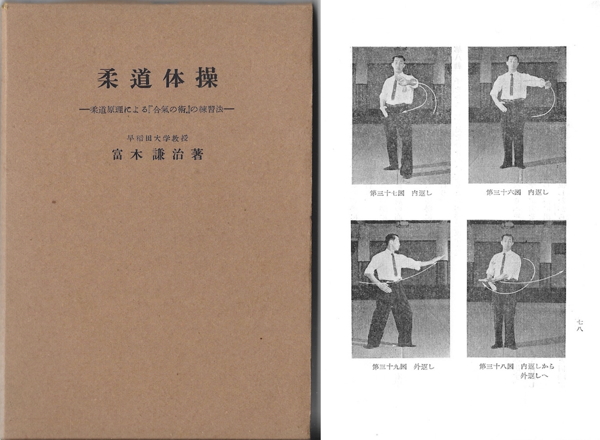
    Kenji Tomiki: Judo Taiso – a method of training Aiki no Jutsu through Judo principles

  • Aikido Shihan Kenji Tomiki’s Goshinjutsu
    Aikido Shihan Kenji Tomiki’s Goshinjutsu
    Kenji Tomiki with Morihei Ueshiba in 1926

    Around 1926 – the year Kenji Tomiki started Aikido
    Morihei Ueshiba next to Admiral Isamu Takeshita,
    Center rear: the son of Gonnohyoe Yamamoto*
    Lt. Colonel Kiyoshi Yamamoto
    Kenji Tomiki standing next to Kiyoshi Yamamoto

    Right: nephew of Gonnohyoe Yamamoto*
    Vice Admiral Eisuke Yamamoto

    *Admiral Gonnohyoe Yamamoto was
    the 16th and 22nd Prime Minister of Japan

    Kenji Tomiki (富木謙治) began training under Aikido Founder Morihei Ueshiba in Daito-ryu Aiki-jujutsu in 1926.  He was largely responsible for the compilation and editing of the text in Morihei Ueshiba’s 1933 training manual “Budo Renshu”  (published in English under the name “Budo Training in Aikido“), and was later appointed to be Morihei Ueshiba’s representative at Kenkoku University in Japanese occupied Manchuria.

    At the time that he started training with Morihei Ueshiba he was already a student of Judo – an uchi-deshi (“live-in student”) to Judo Founder Jigoro Kano. He was encouraged to visit Ueshiba by a fellow Judo student at Waseda, Hidetaro Kubota (who later changed his name to Nishimura), who had trained with Morihei Ueshiba in Ayabe during the 1920’s.

    Daido GakuinDaido Gakuin (大同学院) in Manchuria prior to 1945

    In 1936 Tomiki left Tokyo to become a part time instructor at Daido Gakuin in Japanese occupied Manchuria. Before he left he went to pay his respects to Jigoro Kano, and was told:

    「富木君、講道館には植芝さんのところで君が学んできたような技が必要なんだ。昔の柔術というのは、みな植芝さんと同じようなことをするのだ。しかし、あれをどうやって練習させるかが難しいんだよ」

    “Tomiki-kun, the Kodokan needs the kinds of techniques that you learned at Ueshiba-san’s place. Because the jujutsu of the past, they all do the same kinds of things that Ueshiba-san does. But it’s how to practice those things that is difficult!”

    This was Kenji Tomiki’s conundrum after the war, just as it was a conundrum for JIgoro Kano, and even Kisshomaru Ueshiba – namely, how the older arts could and should be modified for popularization among the general public (there’s a little about the changes in post-war modern Aikikai Aikido in “The Ueshiba Legacy, by Mark Murray“) .

    Judo TaisoA page from “Judo Taiso” by Kenji Tomiki, 1954

    In 1954 Tomiki published a book called “Judo Taiso” (“Judo Exercises” – the book is available for free download from the article “Kenji Tomiki: Judo Taiso – a method of training Aiki no Jutsu through Judo principles“). This book represents some of Tomiki’s earlier work at integrating the work of his two teachers and then presenting the results to the general public.

    “Judo Taiso” (mentioned above), the texts that will be available for download below, and the rest of the content on this site are provided free of charge as a service to the community. You can help support this project by contributing a little bit to help support our efforts. Every donation (even $1) is greatly appreciated and helps to cover our server and bandwidth costs, and the time involved. The more support that we get the more interesting new content we can get out there!

    By donating you also help support our efforts at Aikido Hawaii, which has provided a state-wide resource for all Aikido in Hawaii, regardless of style or affiliation, for almost twenty years.

    Thanks,

    Chris

    When Keizou Yamamoto (山本敬三) went to train with Kenji Tomiki at Waseda University in 1957 he encountered that book:

    Although I had gone to Waseda University with the intention of learning Aikido, we were given a booklet called “Judo Taiso”, and we did the Judo exercises that Sensei had invented. I understood at last, years later, that Sensei had deeply respected the late Jigoro Kano Sensei – “The way that I see Aikido is through Judo”, he said. In the forward to that book that Tomiki Sensei wrote was the following:

    “I was introduced to Kodokan Judo some forty-five years ago, when I was in elementary school. Leading to the present day I have received instruction beginning with the late Jigoro Kano Sensei, and then through many Sempai. From around thirty years ago I was taught Aikido by Morihei Ueshiba Sensei. “Judo Taiso” was born through the comprehensive study of both of these people, with the structure based on Aikido technique. The movement of the body has been transformed to modern gymnastics and with this the unification of power developed through the “Principles of Judo” and the management of the body can be practiced.”

    Tomiki further discussed some of the issues surrounding this problem in this interview with Aikido Journal, in which he was asked about some of the spectacular feats that Morihei Ueshiba was able to perform with his internal skills:

    This problem is one of modern physical education’s muscle training. It’s called isometrics. That is to say, by pushing or pulling you train either the outer muscles or the inner muscles. When you get perfect at this form of training you can hardly see any muscle movement at all during the exercise. When you can’t see any movement you are using the muscle very skillfully. But, in the educational field if you demand a similar level of perfection then you are making a big mistake. If anyone trains sufficiently it is possible to do it to some degree, but, of course, there are limits what a human being can do. Perfection is a problem of belief. Can we call it religious faith? If we have to disrupt our partner’s psychological state through some hypnotic technique it would not be a matter of religion as we usually think of the word. I for one, take the normal point of view that education appropriate for the general public is correct and I think aikido should be something usual, or normal, as well.

    Tomiki wasn’t alone in these sentiments, his teacher Jigoro Kano also wrestled with the problem of balancing his desire to preserve the traditional arts of Japan with the his desire to create an art that would be suitable for the modern educational system and the general public:

    The pioneer who modernized the feudal era schools of bujutsu and brought them to into the context of modern physical education was Master Jigoro Kano, the founder of Judo. When I say that he modernized ancient bujutsu, what I mean is that, first of all, he categorized and arranged the techniques so that they transcended schools. The main feature of this rearrangement was organizing and categorizing the major techniques according to the form of combat, so as to make tournaments (shiai) possible. 
    – “On Jujutsu and its Modernization” by Kenji Tomiki

    And Kano dealt with similar issues as well – according to Takamura-ha Shindo Yoshin-ryu (新道楊心流)  Menkyo Kaiden Toby Threadgill, there was a point in time when the entire Internal Power (内力の業) training syllabus of Shindo Yoshin-ryu was included in Kodokan Judo textbooks – a chapter that was removed from later editions. Here he speaks a little bit about that section of the training:

    They are solo exercises that inculcate the proper balance, movement and muscular application utilized in our greater curriculum. These types of exercises are actually quite ubiquitous in Japanese jujutsu schools of the Edo Period, although they are rather unfamiliar to those outside the membership of specific Nihon koryu. According to Yoshin ryu lore, this form of body training was introduced to Japan from China in the mid-Edo Period. In the case of Yoshin ryu, the Nairiki no Gyo were specifically created adaptations of Chinese practices intended to augment the study and application of specific body skills required in Yoshin ryu’s greater curriculum.
    – From “An Interview With: Toby Threadgill, Menkyo Kaiden, Takamura ha Shindo Yoshin ryu

    In the end, Tomiki opted to follow Jigoro Kano’s thinking and introduce a form of competitive Aikido:

    I introduced Randori Aikido so that students could make their techniques more effective by ‘free play’. These techniques originate from Kata and can develop through Randori to competition. In order to teach the spirit of Budo in a modern educational system, it is necessary to introduce it as a sport. The reason I developed Randori Aikido from Kata Aikido is because I wished to follow the method and thinking of Dr. Jigaro Kano in which he evolved Judo from old style Jujutsu

    That would lead to his eventual break with the Aikikai and the Ueshiba family over the issue of competition in Aikido. Morehei Ueshiba’s granson Moriteru Ueshiba even went so far as to say that Aikido with competition can no longer be considered “Aikido”:

    For example, those that have instituted competitive matches have obviously forgotten the true nature of Aikido, and cannot be called Aikido.
    – From “Aikido ™ – Can it really be trademarked?

    Nonetheless, Tomiki was still in Morihei Ueshiba’s thoughts in his last moments, as we see here in this recollection from Yoshinkan Aikido Founder Gozo Shioda:

    Four of the younger deshi were staying with Sensei. He was asleep when I went there, but he suddenly woke up and said, “It’s you, thanks for coming. I’m riding on a winged horse around the heavens. I can see the earth. Shioda, what is [Kenji] Tomiki doing now? I’m watching.”

    At that time Kisshomaru had changed his name and was called Koetsu. He was waiting at the foot of the bed and Ueshiba Sensei said the following, “Shioda, I want you to support Koetsu on the technical side. I want you always to cooperate with him. I’m counting on you.” Kisshomaru stood there and listened.
    – From Aiki News issue 93 (now Aikido Journal)

    So…now we have a couple of downloadable documents in PDF format (provided from scans originating with Eddy Wolput and the Study Group Tomiki Aikido).

    Kenji Tomiki - Goshin Jutsu no KataKenji Tomiki shows a technique from the Goshinjutsu no Kata

    The first is “Kodokan Goshinjutsu” (講道館護身術), by Kenji Tomiki. This is Kenji Tomiki’s commentary on the Kodokan Goshinjutsu no Kata (講道館護身術の形 / Kodokan Self Defense Kata), first published in 1958.

    The Kodokan Goshinjutsu no Kata is a set of pre-arranged forms, set techniques, intended to focus on self-defense applications. Created by a Kodokan committee over a period of some three years, Kenji Tomiki had a huge influence on the final form of the Kata.

    In the introduction to the Kodokan book “Goshinjutsu”, Risei Kano (嘉納 履正), Jigoro Kano’s son and the second president of the International Judo Federation, wrote:

    The writer of this Book, Professor Kenji Tomiki, has deep understanding of Judo as Professor of Waseda University and also is an authority on the research of Aiki-Jutsu in the light of Judo principles. In formulating the Goshin Jutsu no Kata, he played a leading role in the panel.

    Kenji Tomiki and Tadao Otaki gave the first public demonstration of the Goshin Jutsu no Kata at the Kagami Biraki in 1956 at the Nippon Budokan.

    Kenji Tomiki - Introduction to Goshinjutsu“Introduction to Goshinjutsu” by Kenji Tomiki, 1974

    Next is Kenji Tomiki’s “Introduction to Goshinjutsu” (護身術入門), published in 1974. This book is an interesting follow-up to the “Kenji Tomiki: Judo Taiso – a method of training Aiki no Jutsu through Judo principles” publication mentioned above.

    It is also clearly aimed at the general public, although there are also some interesting sections.

    Teko no Genri - Kenji Tomiki, Introduction to Goshinjutsu

    For example, here is one about the “Principle of the Lever”. Here Tomiki talks about Yin/Yang (In/Yo) opposing forces with a central non-moving pivot in the text, but in terms of modern mechanics as a force couple. According to Wikipedia this is defined:

    A couple is a pair of forces, equal in magnitude, oppositely directed, and displaced by perpendicular distance or moment.

    Further:

    Its effect is to create rotation without translation, or more generally without any acceleration of the centre of mass.

    The above ought to be familiar material to those folks training in the Sangenkai method.

    Also, here is one demonstration using a spinning top to illustrate the stability and power of spiral force:

    Koma no GenriThe principle of the spinning  top

    Gendai AikiThe “Gendai Aiki” correspondence course

    As a final bonus, the six volume “Gendai Aiki” series of books below is a 1970’s correspondence course in Aikido – the type of course one often sees advertised in the back of Manga and other popular magazines. The series was not authored by Kenji Tomiki, but was clearly written by someone who had experience with the Tomiki system of Aikido. I hope that you find these interesting as well.

    Enjoy!


    Published by: Christopher Li – Honolulu, HI

  • Kenji Tomiki: Judo Taiso – a method of training Aiki no Jutsu through Judo principles

    Kenji Tomiki: Judo Taiso – a method of training Aiki no Jutsu through Judo principles

    Budo Renshu - Secret Teaching Poems

    “Secret Teachings of Budo (Poems)” – from “Budo Renshu”, 1933
    also see “Three Doka and the Aiki O-Kami

    The first known book published by Aikido Founder Morihei Ueshiba (“Moritaka Ueshiba” at the time of publishing) was the 1933 training manual “Budo Renshu”  (published in English under the name “Budo Training in Aikido“). This manual was initially given to his students as a kind of a teaching license.

    It was filled with illustrations depicting techniques taught at the Kobukan Dojo which were drawn by Takako Kunigoshi, a student at the Kobukan who began training shortly before her graduation from Japan Women’s Fine Arts University.

    The text portions of this work were largely complied and edited by Kenji Tomiki, one of Morihei Ueshiba’s senior students. Kenji Tomiki began training at the Kobukan Dojo in Tokyo around 1926 after being encouraged to meet Morihei Ueshiba by Hidetaro Kubota (who later changed his name to Nishimura), a fellow Judo student at Waseda.

    Kobukan Gasshuku in 1934Aikido Founder Morihei Ueshiba, back row center
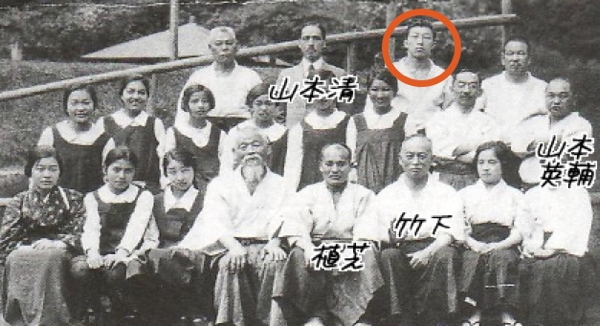
    Kenji Tomiki, back row right (red box)
    1934 summer gasshuku, from the Kobukan Dojo newsletter “Kobu” (皇武)

    Hidetaro Kubota had trained with Morihei Ueshiba in Ayabe, on the Omoto-kyo compound. One of Kuboto’s fellow students, Yutaka Otsuki(大槻豊), would later go on to found his own school of “Otsuki-ryu Aiki-jujutsu”.

    Otsuki-ryu Aiki-jujutsu HIden Ogi“Hiden Ogi” scroll issued in “Otsuki-ryu Aiki-jujutsu” by Yutaka Otsuki (大槻豊), 1940

    Kenji Tomiki, also a senior student of Judo Founder Jigoro Kano, would go on to become Morihei Ueshiba’s designated representative at Kenkoku University in Japanese occupied Manchuria.

    Kenji Tomiki and Morihei Ueshiba in 1942Kenji Tomiki and Morihei Ueshiba in Manchuria, 1942

    When the Dan ranking system became required by the consolidation of Japanese martial arts by the Japanese government prior to World War II under the Dai Nippon Butokukai he would receive the very first 8th Dan ever to be issued by Morihei Ueshiba.

    Tomiki was an instructor at Aikikai Hombu Dojo after the war, but a division gradually developed over the issue of competition in Aikido and the division grew into a split between Tomiki and the Aikikai organization when Tomiki established his Shodokan Dojo in 1967 to refine his teaching methods and then held public tournaments beginning in 1970.

    The cover of Aikido Maki-no-Ichi, 1954

    “Aikido Maki-no-Ichi”, published by the Aikikai in 1954

    In 1954 Morihei Ueshiba published “Aikido Maki-no-Ichi”, edited by Ni-Dai Doshu Kisshomaru (Koetsu) Ueshiba. This book, which was not publicly distributed (but is available here), duplicates much of the text and many of the drawings that first appeared in the 1933 publication “Budo Renshu” – text that was originally compiled and edited primarily by Kenji Tomiki.

    Also in 1954, Kenji Tomiki published a book demonstrating his own efforts at combining the scientific methodology and educational pedagogy that he had absorbed from Jigoro Kano with the teachings that he had received from Morihei Ueshiba.

    Judo Taiso, by Kenji Tomiki Sensei

    “Judo Taiso – a method of training Aiki no Jutsu through Judo principles”
    by Kenji Tomiki, 1954

    Like “Aikido Maki-no-Ichi” mentioned above, this manuscript (which includes a forward written by Jigoro Kano’s son Risei Kano – 嘉納 履正) was recovered through the efforts of Scott Burke, who lives in Fukuoka, but often comes to Hawaii to join the local Sangenkai workshops.

    About half of the work itself is text – but the pictorial content in the remaining sections should be understandable even to non-Japanese speakers.

    Enjoy!


    Published by: Christopher Li – Honolulu, HI

  • Aikido and Judo – Interview with Gozo Shioda and Masahiko Kimura

    Aikido and Judo – Interview with Gozo Shioda and Masahiko Kimura

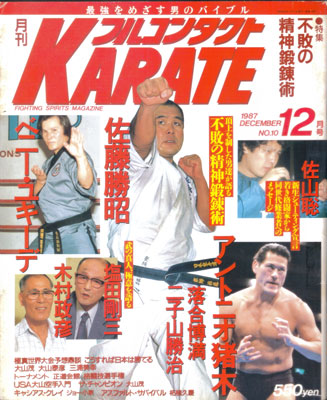
     Full Contact Karate, December 1987Full Contact Karate Magazine – December 1987

    More Full Contact Karate at the Aikido Sangenkai! Previously we presented a translation of the article “Secret Technique: The Secret of Aiki” (秘技・合気の秘密) from the  January 1996 issue of the Japanese magazine “Full Contact Karate” (フル・コンタクト・カラテ). This time we’re happy to present the English translation of an interview with Yoshinkan Aikido Founder Gozo Shioda (塩田剛三) and legendary Judo champion Masahiko Kimura (木村政彦) that appeared in the December 1987 issue of Full Contact Karate.

    Gozo Shioda was born in Shinjuku, Tokyo in 1915. He began training with Aikido Founder Morihei Ueshiba O-Sensei in 1932 and trained under him for eight years before the war. After World War II he established Yoshinkan Aikido and became one of the major figures in the post-war Aikido world.

    Masahiko Kimura was born in Kumamoto in 1917. At the age of 18 he became the youngest Judo 5th Dan in history, after defeating eight opponents in a row at Jigoro Kano’s Kodokan Dojo. It is said that he was defeated only four times in his professional career, one of those losses to Aikido student Kenshiro Abbe (although Abbe would not begin studying Aikido until some years later). He is most well known in the Western world for the famous match in 1949 in which he defeated Brazilian Jiu-Jitsu Founder Hélio Gracie.

    Gozo Shioda and Masahiko Kimura were classmates at Takushoku University, which also counts such famous Karate instructors as Masatoshi Nakayama and Mas Oyama among its alumni.

    (more…)