Standing and walking – that’s pretty basic. It’s so basic that it’s really the first thing you learn in most budo, or even in life – if anybody can remember back that far.
Like everybody else, I received basic instructions in how to stand when I started Aikido – point the front foot forward and the back foot out at an angle. Some places break that down into a more detailed description, but that’s usually the gist of it.
Pretty easy right? Anybody can do it – which may be the problem. If anybody can do it, and you’re doing essentially the same thing that you’ve always done…why are you spending all that time on the mat?
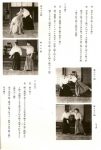
“Budo” is a pre-war technical manual published in 1938 by Aikido Founder Morihei Ueshiba. It was originally created for Prince Kaya Tsunenori, member of a collateral branch of the imperial family. Kayanomiya would eventually become Superintendant of the Army Toyama School – where Morihei Ueshiba would act as an instructor before the war.
“Budo” remains the largest and most organized collection of technique from the pre-war period, and an English edition (“Budo: Teachings of the Founder of Aikido“), translated by John Stevens, was published in 1991.
A separate edition, the “Takemusu Aikido Special Edition”, translated by Sonoko Tanaka and Stanley A. Pranin, was published in 1999 (“Budo: Commentary on the 1938 Training Manual of Morihei Ueshiba“). This edition is composed of some excerpts from the Japanese text, along with a commentary by Morihiro Saito, in both English and Japanese.
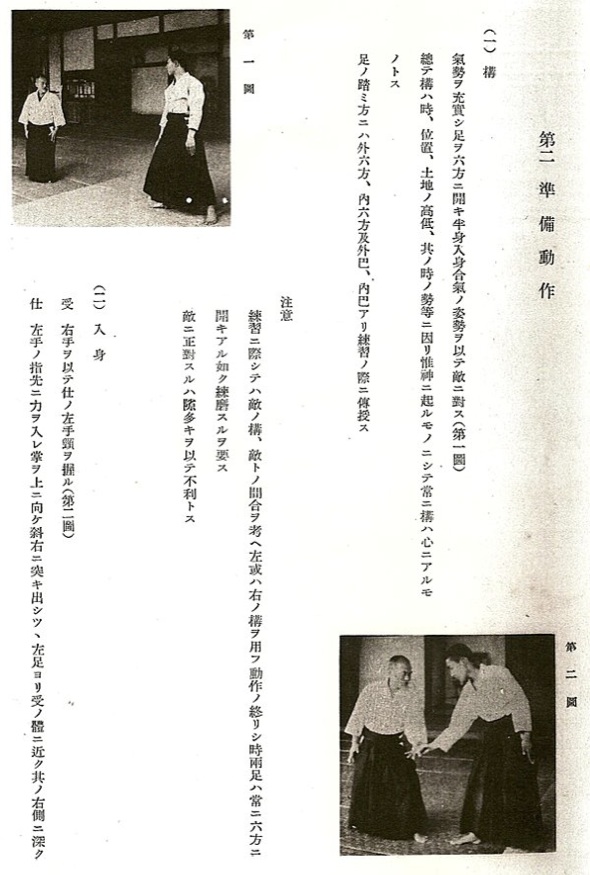
Here is the original Japanese text, followed first by my English translation, and then by the English translation by John Stevens.
Fill yourself with Ki power, open your legs in six directions and face the enemy in the hanmi irimi posture of Aiki (see Figure 1).
When assuming any stance, align yourself with the principles of the Kami according to your position, the level of the terrain and your spirit at that time, and always keep this stance in your heart.
In footwork there is an external six directions and an internal six directions as well as an outer spiral and an internal spiral, this will be taught in practice.
Caution:
Concerning the stance of the enemy in training. Be mindful of the distance between you and the enemy and assume a left or right stance. At the end of each movement always open both legs in six directions, it is necessary to train this.
If you face directly towards the enemy there will be many openings and you will be at a disadvantage.
The standard translation, from “Budo: Teachings of the Founder of Aikido” (translated by John Stevens):
2. Basic Movements
(1) Stance
Fill yourself with ki, assume a hanmi stance with your feet apart opened at a sixty-degree angle, and face your opponent with a flexible aiki posture (1).
The exact stance depends upon time, place, and terrain; further, it must arise in accordance with divine principles. A good stance reflects a proper frame of mind.
Both the front foot and the back foot should be open at a sixty-degree angle. The reason for this will become clear in practice.
Note: During practice be ever mindful of your opponent’s stance and his relative distance; assume, accordingly, a left or right stance. When the movement ends, it is essential that your feet should always be open at a sixty-degree angle. If you face your opponent full of openings you will be at a great disadvantage.
Right away you can see some differences. This is normal – no two translations, especially from a language like Japanese, are going to be absolutely the same. Some things are differences in expression, some in how the translator chose or was able to interpret the work, some are just mistakes.
Some phrases in Japanese cannot be translated directly into English without losing their original meaning – and the same for English phrases into Japanese.
Looking at the passages above, there are some minor differences and some not so minor differences.
The title of the section, for example, I translated as “Preparatory Movements”, instead of “Basic Movements”. Mine is a more literal translation of the actual Japanese, but if you compare the two you’ll see that, in the end, the difference is really not very important. Who cares? Not me.
There are some other differences, however, further down.
I translated the first sentence of the passage as:
Fill yourself with Ki power, open your legs in six directions and face the enemy in the hanmi irimi posture of Aiki (see Figure 1).
The John Stevens translation is:
Fill yourself with ki, assume a hanmi stance with your feet apart opened at a sixty-degree angle, and face your opponent with a flexible aiki posture (1).
There are are two big problems here.
First, the word “flexible” appears to have been inserted in the place of “irimi”. This seems a little odd, since most Aikido students ought to be familiar with at least the basic concept of irimi – and I’m not sure exactly how Ueshiba was trying to express “flexibility” with the word in this case (I can imagine some possibilities – but it involves a fair amount of speculation).
Secondly, and probably more importantly, the phrase “open your legs in six directions” is replaced, in the Stevens translation, by “feet apart opened at a sixty-degree angle”, which is completely different than the original Japanese text – which reads as I have represented above.
Does it matter?
Well, let’s look at “roppo”, or “six directions”.
There is another, partial translation of “Budo”, by Sonoko Tanaka and Stanley A. Pranin published as “Budo: Commentary on the 1938 Training Manual of Morihei Ueshiba”. In that text they note that the original Japanese text actually says “six directions”.
Problem solved?
Maybe not, because the assertion given there is that “six directions” is basically another way to say “hanmi”, which was not in common usage at that time.
Now is the problem solved?
Again, maybe not. Oddly enough, the word “hanmi” appears in the first sentence of the original Japanese. If the word “hanmi” was not in common usage at the time then why would Morihei Ueshiba use both that word and “six directions” in the same sentence?
What, then, could “six directions” mean?
Interestingly, “six directions” is a common term in Chinese internal martial arts. Take a look at Liu Mian Mo Li (六面摸力) in Yiquan, for a good example – a force balanced through your body in six directions. In this case we’re talking about basic stability in all directions – something that makes all kinds of sense in terms of standing up and walking in a martial situation. This is fairly common in Chinese internal martial arts – for example, here is a good example of six-direction force in Xingyi Quan.
One more interesting note – in “Budo: Commentary on the 1938 Training Manual of Morihei Ueshiba” they also note that “step from a roppo stance” is used in Kabuki as well. What is not noted, however, is that some traditional Noh schools also use this phrase – in the sense of universal stability and balanced forces that is shared with Chinese internal martial arts.
Now, how about the line:
In footwork there is an external six directions and an internal six directions as well as an outer spiral and an internal spiral, this will be taught in practice.
In the standard translation by John Stevens this line is given as:
Both the front foot and the back foot should be open at a sixty-degree angle. The reason for this will become clear in practice.
Again, we see that the phrase “six directions” has been replaced “sixty-degree angle”, although that is totally at variance with the original Japanese.
Further, the phrase “an outer spiral and an internal spiral” has been completely omitted from the English translation in “Budo: Teachings of the Founder of Aikido”. These spirals are also omitted from “Budo: Commentary on the 1938 Training Manual of Morihei Ueshiba”.
So…does that section of the description really matter?
Well, I suppose that you could argue that, for the sake of historical accuracy alone, it is important to provide as complete a translation as possible.
But there’s more.
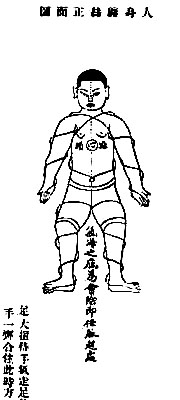
Inner and outer spirals through the legs and body are also commonly described in Chinese internal martial arts (there may be a theme developing here!). Here is a diagram and excerpt of text from “Illustrated Explanations of Chen Family Taijiquan” by Chen Xin, the emphasis of the underlined section is mine.
Coiling power (Chan Jin) is all over the body. Putting it most simply, there is coiling inward (Li Chan) and coiling outward (Wai Chan), which both appear once (one) moves. There is one (kind of coiling) when left hand is in front and right hand is behind; (or when) right hand is in front and left hand is behind; this one closes (He) (the hands) with one conforming (Shun) (movement). There is also one (coiling) that closes the inside of the left (side of the body) and the back of the right (side of the body), and another which uses the through-the-back power (Fanbei Jin) and closes towards the back. All of them should be moved naturally according to the (specific) postures.
Once Qi of the hand moves to the back of the foot, then big toe simultaneously closes with the hand and only at this moment (one can) step firmly.
Illustrated Explanations of Chen Family Taijiquan
Ever hear of it? I hadn’t – because it doesn’t appear in any of the published English translations.
But what about the Japanese editions?
Well…there are none.
Hard as it is to believe, there has never been a commercial re-publication of the text of “Budo” in Japanese. The only people in Japan who have read “Budo” are those that have gotten hold of the original publication or a homemade copy. The very existence of “Budo” itself was known only to a few people until it was rediscovered by Stan Pranin through Zenzaburo Akazawa (a pre-war student of Ueshiba) around 1979. Even Morihiro Saito, who, it could be argued, spent more time alone with Ueshiba after the war than anybody else, was astonished to learn of this text!
So…just as in the blog post “Kiichi Hogen and the Secret of Aikido“, we once again have Morihei Ueshiba citing a basic concept from the Chinese martial arts as being central to Aikido.
We also have a clear example of the problem with that exists in the transmission of basic information in Aikido – from both the English and Japanese sides.
What don’t we know, and what don’t we know we don’t know?
Hya..it makes for interesting reading but imho the correct translation means little in the way of instruction. You either have that state..or you don’t. In terms of transmission to others I wouldn’t bother with any of that…there are far easier ways to explain and replicate that…things that anybody can do with the same results. It’s funny in that way sometimes…millions of hours training against someone with very little yet I can get them to do basically the same ^^ these days I don’t bother looking at the past as in some ways they had a strange mindset which is a poor example now for other countries..some today still have that and will go into conflict against everyone..we’ve seen it happen… read the words of the more enlightened and things can be easier…other places with less problems have always done that..
Glad you enjoyed it Lee – I didn’t mean for anybody to follow this in terms of technical instruction, but I think that these things are important for people who are interested in figuring out what Morihei Ueshiba was talking about.
Great article, Chris. I think you’re on the right track. The “coiling” of the Chen-style is basically an overlay of the muscle-tendon channels, which are the basis of the acupuncture meridians. There is a connection via “channels” or muscles and tendons that go from the thumbs to the big toe. Those channels are connected with the front of the body and are engaged in “Closing” and gravity/weight. The body can be stretched the other way and there will be a connections from the little fingers to the little toes … those channels are connected with the back of the body and are engaged in “Opening” and the solidity of the ground as a force.
To say that the big toe is a source of force is to say that “Closing” or gripping power is the source of stability. All of the Asian martial arts encourage gripping by the feet.
Hi Chris, I wanted to us if you see gripping with toes as a form of feet bows? I am wondering if this helps make the base of support a bit better, rather than getting a little weak when the centre of mass approaches the end and structure tends to fall apart.? dan
I never really understood Aikido until happenstance lead me to training in Taiji (long story).
Many of the things I learned explicitly had been there implicitly in Aikido, but I’d missed them, and they weren’t taught at any kind of conscious level.
When I showed someone my old copy of Saotome Sensei’s “Aikido and the Harmony of Nature” after 5 years of Taiji I saw many things that I had not seen before, hidden in plain sight.
I have come to think that just as the study of Bunkai has revealed much that was previously hidden in Karate, there is a similar well of knowledge to be found in Aikido, but overlooked by many of the practitioners that I’ve talked to.
Thanks Christopher, I would second Mike’s comment about the spirals. They are real and I use them in my teaching. They are not the whole of it, but I am glad to have you confirm they were there in Ueshiba’s teaching too…! Wow, this is getting exciting because I got to the spirals from the magic square. They work most of the time but I’ve also incorporated other functional models of movement that work immediately, once taught. Other models are less functional, but no doubt even these mysteries will reveal their truths to me in due course. Thanks for your scholarly research, man. I’ve always had a suspicion John Stevens wasn’t translating things fully. I know it isn’t his fault. I’m aware of translation theory and the choice every interpreter must make, to be true to the original text (or the source language) and risk incomprehension upon translation into English or to cobble together a bridge of understanding using terms and concepts available in the target language (English in this case). Meditation, study, practice. A love of this art and a love of love itself. I think between us all we can reveal many of the things that have been ‘hidden in plain sight’, or deliberately hidden from view for nefarious institutional purposes, or simply lost through translation gaps. Great job..!
Hi Mike, interesting points you make about the connections between the fingers and toes. I’ve figured that one out on my own some time back. I just thought I’d add that Yoshinkan aikido stresses the big toe too. We used to drill the big toe into the ground. That was a very early clue for me. Any roads, perhaps our paths will meet one day soon. 🙂
Apparently the same spiral thing was rediscovered by Noro in France. For Kinomichi, it appears to be a fundamental issue and is emphasized in the teaching. Maybe it is not that trivial indeed.

Hya..it makes for interesting reading but imho the correct translation means little in the way of instruction. You either have that state..or you don’t. In terms of transmission to others I wouldn’t bother with any of that…there are far easier ways to explain and replicate that…things that anybody can do with the same results. It’s funny in that way sometimes…millions of hours training against someone with very little yet I can get them to do basically the same ^^ these days I don’t bother looking at the past as in some ways they had a strange mindset which is a poor example now for other countries..some today still have that and will go into conflict against everyone..we’ve seen it happen… read the words of the more enlightened and things can be easier…other places with less problems have always done that..
Glad you enjoyed it Lee – I didn’t mean for anybody to follow this in terms of technical instruction, but I think that these things are important for people who are interested in figuring out what Morihei Ueshiba was talking about.
Best,
Chris
I’m waiting for Henry’s response.
🙂
Great article, Chris. I think you’re on the right track. The “coiling” of the Chen-style is basically an overlay of the muscle-tendon channels, which are the basis of the acupuncture meridians. There is a connection via “channels” or muscles and tendons that go from the thumbs to the big toe. Those channels are connected with the front of the body and are engaged in “Closing” and gravity/weight. The body can be stretched the other way and there will be a connections from the little fingers to the little toes … those channels are connected with the back of the body and are engaged in “Opening” and the solidity of the ground as a force.
To say that the big toe is a source of force is to say that “Closing” or gripping power is the source of stability. All of the Asian martial arts encourage gripping by the feet.
Thanks Mike – and thanks for the great comments!
Hi Chris,
I wanted to us if you see gripping with toes as a form of feet bows? I am wondering if this helps make the base of support a bit better, rather than getting a little weak when the centre of mass approaches the end and structure tends to fall apart.?
dan
There are certainly bows in the feet – but I try to avoid thinking of gripping since IME it tends to induce tension.
Best,
Chris
I never really understood Aikido until happenstance lead me to training in Taiji (long story).
Many of the things I learned explicitly had been there implicitly in Aikido, but I’d missed them, and they weren’t taught at any kind of conscious level.
When I showed someone my old copy of Saotome Sensei’s “Aikido and the Harmony of Nature” after 5 years of Taiji I saw many things that I had not seen before, hidden in plain sight.
I have come to think that just as the study of Bunkai has revealed much that was previously hidden in Karate, there is a similar well of knowledge to be found in Aikido, but overlooked by many of the practitioners that I’ve talked to.
Thanks Christopher, I would second Mike’s comment about the spirals. They are real and I use them in my teaching. They are not the whole of it, but I am glad to have you confirm they were there in Ueshiba’s teaching too…! Wow, this is getting exciting because I got to the spirals from the magic square. They work most of the time but I’ve also incorporated other functional models of movement that work immediately, once taught. Other models are less functional, but no doubt even these mysteries will reveal their truths to me in due course. Thanks for your scholarly research, man. I’ve always had a suspicion John Stevens wasn’t translating things fully. I know it isn’t his fault. I’m aware of translation theory and the choice every interpreter must make, to be true to the original text (or the source language) and risk incomprehension upon translation into English or to cobble together a bridge of understanding using terms and concepts available in the target language (English in this case). Meditation, study, practice. A love of this art and a love of love itself. I think between us all we can reveal many of the things that have been ‘hidden in plain sight’, or deliberately hidden from view for nefarious institutional purposes, or simply lost through translation gaps. Great job..!
Thanks Keni, I’m glad that it spoke to you!
Best,
Chris
Hi Mike, interesting points you make about the connections between the fingers and toes. I’ve figured that one out on my own some time back. I just thought I’d add that Yoshinkan aikido stresses the big toe too. We used to drill the big toe into the ground. That was a very early clue for me. Any roads, perhaps our paths will meet one day soon. 🙂
Apparently the same spiral thing was rediscovered by Noro in France. For Kinomichi, it appears to be a fundamental issue and is emphasized in the teaching. Maybe it is not that trivial indeed.