Tag: translation

  • War and Peace – Morihei Ueshiba, Lost in Translation

    War and Peace – Morihei Ueshiba, Lost in Translation

    “The Art of War” vs “The Art of Peace“

    Translation can be a tricky and often thankless task.

    That gets more problematic these days with the rise of AI translation methods.

    I’ll note here that AI translation is often very, very, good, but on niche topics, like Aikido, it’s often very, very bad, and that’s largely due to small mis-translations that are difficult to catch unless you have the ability to read and understand the original text. In other words, AI can accelerate translation, but not replace it (yet).

    For example, I’ve seen both Gemini Pro and ChatGpt mistranslate things as simple as Morihei Ueshiba’s name. Another AI translation text translated the phrase “The Art of Peace” in English as “The Technique of Peace” in Japanese – “technique” in the sense of something like “shiho-nage”. Obviously, this leads to the possibility of misunderstanding to a reader who does not (or can not) compare the translation to the original text.

    Still, critical evaluation of translated text, and alternative translations, are an important part of examining the historical record.

    I’ve discussed some of the issues surrounding translation in modern Aikido here:

    “Morihei Ueshiba, Budo and Kamae: Why we don’t know how to stand up and walk.“

    “Arms and Elbows: Morihei Ueshiba, Lost in Translation“

    “Morihei Ueshiba: Untranslatable Words“

    “Drinking wine with O-Sensei“

    I would also like to direct your attention to this essay from Aikido Journal founder and editor Stanley Pranin, “O-Sensei’s Spiritual Writings: Where did they really come from?“, which highlights some additional issues with source materials:

    “Recently, due to the publication of a series of books whose authorship has been attributed to Morihei Ueshiba, founder of aikido, I have felt compelled to weigh in on the subject of what O-Sensei actually did write during his career as a martial artist. The answer is in brief, “almost nothing.”

    The published books containing quotations attributed to Morihei Ueshiba available in various Western languages are based on “sanitized” Japanese versions of Morihei’s words.”

    Translations are also influenced by the style choices made by the translators themselves (this is discussed, a bit, in the linked essays above).

    Interpretive translations, often referred to as “poetic” translations, are usually more readable and attractive to the average reader, and can sometimes give greater insight into the nuance of the original text…and sometimes not, the drawback being that one is at the mercy of the translator’s interpretation and bias.

    Literal translation, on the other hand, can be much more accurate, depending upon the type of source material, the drawback being that it can miss some or all of the nuance of more abstract material.

    The best translations attempt to reach some balanced middle ground appropriate to the source material.

    However, whatever the style choices that are made by the translator, accuracy and faithful representation of the source material counts.

    This is one of those (to borrow a catchphrase).

    Here is a popular quotation from “The Art of Peace”, translated by John Stevens:

    “The Art of Peace begins with you. Work on yourself and your appointed task in the Art of Peace.”

    One of the difficulties with the texts translated by John Stevens is that he virtually never cited or included his original sources, making it extremely difficult (often impossible) to determine what was actually said by Morihei Ueshiba. Not to mention that the source materials themselves were sometimes comprised:

    “What is problematic for Prof. Stevens is that he has no way of verifying the authenticity of the Japanese text that he is using as a source.”

    “Beautiful! Inspiring!… But Did O-Sensei Really Say It?” – Aikido Journal

    In this case, the original text appears to have been drawn from “Aiki Shinzui” (合気神髄).

    “Aiki Shinzui” was largely assembled from lectures that Morihei Ueshiba gave after the war and then compiled by Sadateru Arikawa and Masatake Fujita for the Aikikai’s “Aikido Shimbun” (合気道新聞).

    This work was translated into English by John Stevens and published as “The Secret Teachings of Aikido“, but… please keep in mind the caveats given here.

    As a caution (and as Stanley Pranin noted above), those lectures were edited for content by the Aikikai, with much of the more problematic content eliminated. For example, the ultra-nationalist sentiments that Morihei Ueshiba continued to express after the war, and much of the more difficult esoteric language through which Morihei Ueshiba made his explanations:

    “Basically, my view is this. Almost without exception, quotes of O-Sensei published in Japanese were heavily edited by the staff of the Aikikai Hombu Dojo prior to publication. Although I would not go so far as to say that these edited writings violate the spirit of O-Sensei’s thinking, they alter considerably the vocabulary and forms of expression employed by Morihei, and strip out much of the Shinto-based religious context he would customarily use in his speech.”

    “Hey Stan! Did O-Sensei really say this?” by Stanley Pranin

    Additionally, there were numerous difficulties with the transcriptions themselves, leading to numerous errors – a Japanese researcher actually made a long (but still partial) list of some of those errors some years ago.

    Masatake Fujita and Morihei Ueshiba

    Masatake Fujita himself discussed the difficulties that he experienced in “Interview with Aikido Shihan Masatake Fujita, Part 2“:

    Q: I’ve heard that you were the one running the tape recorder at those sessions…

    A: That’s right. At that time the machine was still an open reel tape recorder about the size of a mikan (orange) crate. But when I held the microphone in front of his eyes he’d strike a pose and become formal. (laughing) So in order to record the natural voice of O-Sensei, as much as possible I tried to hold the microphone where he couldn’t see it and record him in secret. Then we would write it down and edit it for the Aikido Shimbun. Arikawa Shihan had a passion for that, and I would assist him, so I did the editing for both the Aikido Shimbun and “Aiki Shinzui” (合氣神髄 / published in Japanese in 2002).

    Q: The words of the Founder are really difficult to understand, were you able to understand them?

    A: No, no, I didn’t understand any of that stuff! (laughing) I really had to study hard. Also, when I was editing O-Sensei’s words it was especially difficult to determine which were the correct Kanji to use.

    Q: It must have been very difficult to just listen to the lectures and then put it all together afterwards!

    A: It was very difficult, so it took many years. It was especially difficult to transcribe the words from tape. It could lead you to a nervous breakdown! (laughing) I worked on it for a long time.

    So, moving on – finally…

    Here is the original Japanese quotation, from “Aiki Shinzui” (合気神髄):

    合気はまず己れから始まる。己れを磨き、己れに与えられた天命を果たせ。

    And here is a direct translation of the Japanese from “Aiki Shinzui” above:

    “Aiki begins with oneself. Polish yourself and fulfill the heavenly mission that has been given to you.”

    As you may have noticed – “The Art of Peace” does not exist in the original Japanese, as it does not appear in in any of the original Japanese quotations from which these quotations were drawn in the publication “The Art of Peace”, since… it’s not really a phrase that Morihei Ueshiba even used, and that’s something that’s commonly misunderstood.

    What John Stevens did was to replace the words “Aiki” and “Aikido” where they appeared in the original Japanese text with the phrase “The Art of Peace”, significantly altering the nuance and context of the quotations.

    Actually, this was done at the request of the publisher, for marketing purposes – hoping to profit off of the enormous commercial success of “The Art of War” by producing a “companion volume”.

    It worked fairly well commercially, but at the cost of altering and rearranging the original meanings and, particularly in the case of the “The Art of Peace” which consists entirely of out of context quotations, eliminating the context of the statements that would actually give them meaning.

    I’ll end this with another comment from Stanley Pranin:

    “A serious attempt to faithfully transcribe, edit and annotate the corpus of recordings of O-Sensei’s speeches and lectures has yet to be undertaken. Readers of the currently available materials should bear this in mind when researching the philosophy of the aikido founder.”

    “O-Sensei’s Spiritual Writings: Where did they really come from?” by Stanley Pranin

    Edgar Allan Poe famously stated “Believe none of what you hear and believe half of what you see.” – and that caution might well be applied to the translated word as well.

  • Morihei Ueshiba, Budo en Kamae deel 2 [Dutch Version]

    Morihei Ueshiba, Budo en Kamae deel 2 [Dutch Version]

    John Stevens Aikido Hawaii

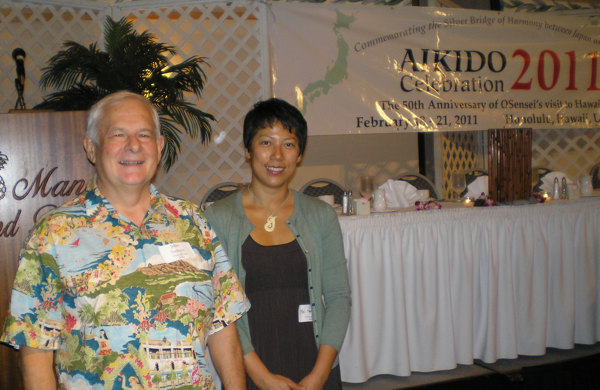
    John Stevens at the Aikido Celebration 2011 banquet in Honolulu, Hawaii

    *This is a Dutch translation of the article “Morihei Ueshiba, Budo and Kamae Part 2 – A note from John Stevens“, courtesy of Ernesto Lemke of Seikokan Aikido.

    Een opmerking van John Stevens

    Recentelijk (27 februari 2012) plaatste ik een Blog getiteld ‘Morihei Ueshiba, Budo en Kamae.’ In dat artikel gebruikte ik een citaat uit de vertaling van Budo, ‘Budo: Teachings of the Founder of Aikido’ door John Stevens.

    John Stevens vroeg me of ik een reactie wilde plaatsen, wat ik bij deze doe, samen met mijn reactie daarop.  (more…)

  • Morihei Ueshiba, Budo and Kamae Part 2

    Morihei Ueshiba, Budo and Kamae Part 2

    John Stevens Aikido Hawaii

    John Stevens at the Aikido Celebration 2011 banquet in Honolulu, Hawaii

    A note from John Stevens

    The other day (February 27th 2012) I posted a blog here entitled “Morihei Ueshiba, Budo and Kamae“. In that article I cited a quotation of the John Stevens translation of Budo, “Budo: Teachings of the Founder of Aikido“.

    John Stevens has asked that I post a response from here, which I will do, along with my own response.

    Note from John Stevens:

    I was guided through the entire text of Budo by Shirata Rinjiro. Shirata Sensei demonstrated each technique on me, and gave me his interpretation of the book’s instructions. (In other words, I received kuden “secret transmission.”) I also had access to Shirata Sensei’s annotated copy of Budo. (It was the photocopy. The original that Sensei had received from Morihei disappeared in the chaos of WWII.) Regarding the passage in question, Sensei and I talked at length about the concept of roppo kamae. The term “flexible” was chosen to describe a good stance that is vital and solidly rooted yet at the same time a stance that allows one to respond immediately to any contingency. “Flexible stance” was also meant to include the sense of “whirling,” “swirling,” “twirling.”

    Shirata Sensei—who received direct instruction from Morihei on the matter–interpreted a roppo kamae as one where the outer foot and the inner foot are opened at a 60-degree angle, as opposed to a 90-degree front foot and a 45-degree back foot. The roppo kamae is the basic stance that Morihei and Shirata Sensei assumed. It the same kamae I try to assume as I train and teach. This roppo kamae is nearly impossible to explain in words so one has to rely on, as Budo says, “oral instruction.” In fact the entire book needs to be explained by “oral instruction” from a qualified instructor (which Chris certainly is not.) In the final analysis, however, this principle should never be forgotten when discussing kamae: “If your mind is true, your kamae is correct.”

    Honestly, reading through this response hasn’t really changed my thoughts as expressed in the original blog posting.

    If you have a certain knowledge and background, then I think that his response really only strengthens the arguments that I made originally. If you don’t, then maybe that won’t be the case.

    In either event, I hope that everybody will take this as a chance to re-think and re-examine the assumptions that they have held in the past.

    Total AikidoFrom “Total Aikido”, by Gozo Shioda and Yasuhisa Shioda

    I will make a couple of points:

    1. The only major Aikido style that I am aware of that still uses the term “Roppo” on a regular basis (the Yoshinkan – whose founder also received direct instruction from Morihei on the matter) actually keeps their feet at a 90 degree angle. Somewhat similar, but more angled, to the 90 degree foot position in “Shumoku no Ashi” which other direct students of Morihei claimed to have seen (enough of that – I’m really not trying to advocate for a particular foot angle).
    2. Further, Gozo Shioda made a very clear statement about “Roppo” in his book “Total Aikido” (page 30): Originally, there was no position in Aikido that might have been called a “basic stance”. The founder, Morihei Ueshiba Sensei, while saying that the basic stance was “to open your feet to the six directions [north, south, east, west, up, down],” also wrote, “The complete kamae is what arises from where the gods lead you, depending on time, situation, the lie of the land, the spirit of the moment – kamae is what is in your heart.” [from Budo], so that the explanation for the real battle is to adapt to the circumstances that you are in.
    3. The term as used most commonly in Kabuki (this was actually cited, if you remember, in Morihiro Saito’s commentary on “Budo”), uses it in the sense of six directions of the compass (up, down, east, west, north, south) – not the angle between the feet.
    4. The response to the issue of “Roppo” is basically that it represents a hanmi of 60 degrees instead of 90. Do people really spend 30 or 40 years training daily in order to condition a difference of 30 degrees? Is that really the “secret” of the Aikido kamae? Might it not be possible that there is a different, deeper, type of conditioning being referred to?
    5. Morihiro Saito’s commentary on “Budo” has a portion of the original Japanese text, the John Stevens translation of “Budo” has none of the original text at all. I included the complete original text in Japanese – everybody is free to examine it and decide for themselves.
    6. I don’t know whether I’m a “qualified instructor” or not – and neither does John, who has never seen me teach anything, has never been to our dojo, has never seen our training. We’ve never really even touched hands, except in the pre-arranged uke-nage format of an Aikido class, and even that was really only a few times (I don’t remember exactly, but less than five). I’ve been training in Aikido for more than 30 years, and I’ve had some very fine instructors – I hope that I do them at least some justice.

    In closing, here is a comment on the blog posting that was posted (publicly) to Google+ and my response (both posted a week before I received John’s response). It more or less summarizes what I was trying to accomplish.

    Feb 28, 2012

    Great article. I have long felt that John Stevens is a well intentioned but unreliable translator. My knowledge of Japanese is very low, but when I have heard other interpretations of texts that Stevens has translated, I have always felt there was more depth in the text than Stevens is willing or able to present.

    One of the problems is that Stevens is sometimes presenting his own technical interpretation as translation. In other books, he has said that the 60 degree angle stance can be observed in photos and films of Morihei Ueshiba, but this appears to be original research on his part. I see this as presenting ones own teaching as O Sensei’s.

    As long as the translators are also prominent teachers or representatives of prominent teachers, these kinds of problems will creep in. The temptation to insert one’s own understanding, often well earned, for the intention of the author is too strong.

    Feb 28, 2012

    Christopher Li – John’s quite knowledgeable, he’s also a friend of mine and lives (literally) down the street from me, so I’m really not talking smack about him (even though that may appear to be the case).

    John has always said that his goal was about providing access to the widest range of people possible. He’s done that so well that there are some sources (“Budo” for example) that are available in English, but not in Japanese!

    On the other hand, that means that he’s had to make certain choices in translation to make things more or less understandable for a general audience – a “lite” version, so to speak. That doesn’t mean that the translation is necessarily bad – but that you have to understand the limitations under which it was done.

    Any translation is going to be seen through the lens of the translator’s opinion, mine as much as John’s, so what we really need are more translations and more examination rather than acceptance by the population of a single version or versions as canonical.

    Anyway, glad you enjoyed it! There should be more interesting things to come.

    And I hope everybody enjoyed this follow-up as well! Still more interesting things to come…


    Christopher Li – Honolulu, HI