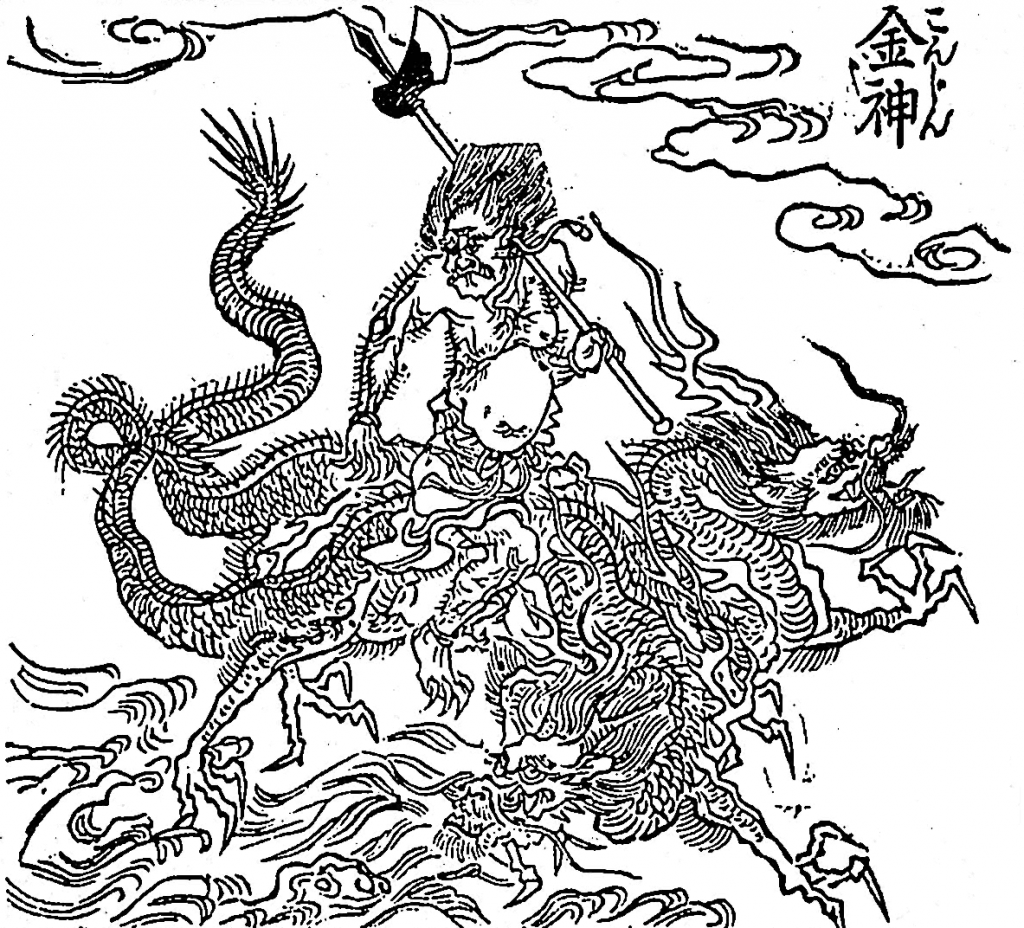
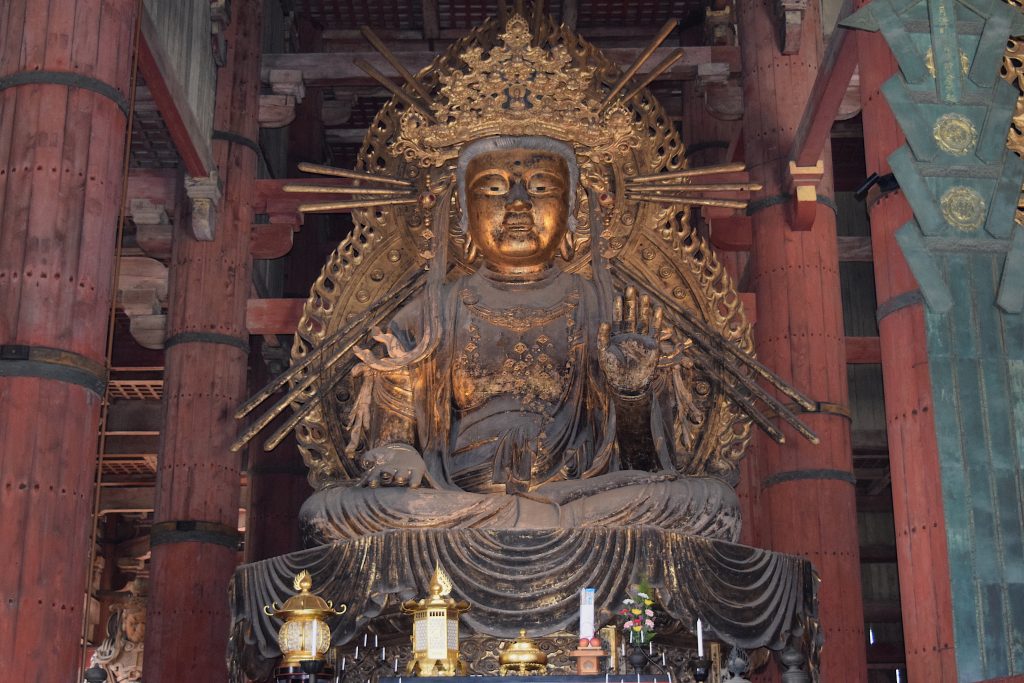
Rising dragon by Onisaburo Deguchi
Kenji Tomiki, Morihei Ueshiba’s first 8th Dan in Aikido, often referred to the famous famous rising dragon story when discussing competitive practice:
Randori practice, sparring practice, is something that is done to give life to, and demonstrate the real power of, those techniques that were first learned by the student through kata. That is to say, randori provides the means to complete a painted dragon by filling in the eyes.
The reference here, if you’re unfamiliar with the story, is to the story of the famous Chinese artist Zhang Sengyou, who painted four dragons on the walls of Anle Temple in what is now Nanjing around the year 500.
He painted the dragons completely except for the eyes, believing that the paintings were so realistic that if he drew the eyes, they would come alive and fly away.
Responding to people’s disbelief at this assertion, Zhang then painted the eyes of two of the dragons, and they immediately flew away to heaven riding on clouds and thunder. This became the famous proverb, “to paint a dragon and dot in the eyes” – 画竜点睛 (“Garyou Tensei”, in Japanese).
Of course, this represents one of Kenji Tomiki’s motivations in creating a competitive form in Aikido – to bring life to techniques trained in the classical Kata format (which he did not abandon) by applying them in under live resistance.
The second of Kenji Tomiki’s motivations was that he believed that competition could be a unifying force in the Aikido community, providing a standardized technical framework under which all Aikido students could meet and train, even if they normally employed different training methodologies at home, a commonly agreed upon neutral ground upon which Aikido students from many different traditions would be able to meet and train together.
He was not alone in conceiving of a useful place for some form of competition in the training pedagogy.

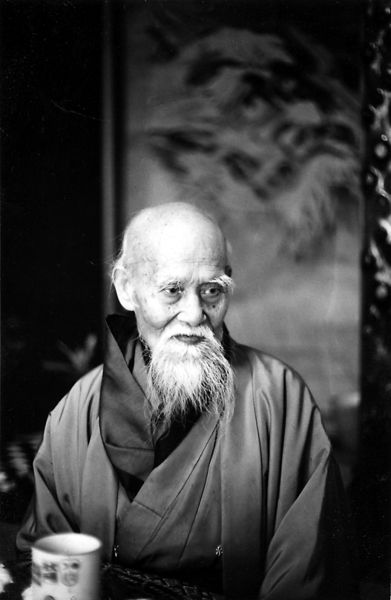
Morihei Ueshiba and Minoru Mochizuki
Minoru Mochizuki, for example, whom Morihei Ueshiba asked twice, one before and once after the war, to take over his art, instituted sparring and competition in Yoseikan Aikido.

Koichi Tohei and Morihei Ueshiba
Hawai’i 1961
In another example, Koichi Tohei, Morihei Ueshiba’s only 10th Dan to be promoted through official Aikikai channels, created a form of competition more like “figure skating” with annual Taigi Competitions.
It’s worth noting that this type of competition is also frowned upon by the Aikikai, and has been the cause of some controversy in the past:
The IAF holds a general congress every four years and the official reason for holding it in Japan is to allow the instructors residing overseas to visit Japan and recharge their cultural batteries, so to speak. An exception was made in 1992, however, when the Congress was held in Taipei. I was IAF General Secretary and it was my responsibility to organize this vast meeting with Paul C N Lee, who was President of the Republic of China Aikido Association (ROCAA). At IAF Congresses it is customary to have aikido training seminars and to hold a demonstration in which representatives from all the member nations participate. The arrangements for the aikido seminars and the demonstration were the responsibility of the host country, in this case the ROCAA. During one meeting at the Hombu, attended by Mr Lee, Fujita Sensei and myself, Kisshomaru Doshu had appeared and urged us all to exercise great caution, but to me his warning was about as obscure as Dumbledore’s warnings to Harry Potter. Fujita Sensei was a close friend of Mr Lee and fully understood the very difficult conditions under which the ROCAA was operating, but I had no idea of these conditions and was unprepared for the explosion that was about to occur.
After the arrangements for the Congress had been publicized, certain Japanese overseas instructors sent fax messages to the Aikikai requesting the dismissal of two officials, on the grounds that they were responsible for organizing competitions in aikido, at a congress that was about to take place. One official was Fujita Sensei, who was the Hombu Dojo Secretary; the other was myself, the IAF Secretary. These fax messages were received by Fujita Sensei in the Hombu office, who promptly sent copies on to me.
The Congress took place and the atmosphere can best be described as taut. The wa, so important at international aikido meetings was certainly there, but underlying this was a tension that sometimes appeared at meetings as straight conflict. I was in a very difficult position, however, for I had discovered independently that the condition imposed by the local Olympic committee in Taiwan for the operation of aikido by the ROCAA was that they had to hold aikido demonstrations that could be seen to outsiders as competitions, with judges holding up scorecards after each demonstration. The Aikikai had known about this condition for several years, but had remained silent and it was only now, with an impending demonstration that would be attended by officials of the local Olympic committee, that it had become an issue. I happened to have lunch with Doshu one day and warned him that I had no intention of resigning and that I would have to explain to the entire Congress that the Aikikai had known all along about ‘competition’ aikido in Taiwan and had done nothing about it. This lack of action would certainly be construed as approval and would cause a conflict that might have the same consequiences as Tohei Sensei’s departure from the Aikikai. Doshu pursed his lips and answered that he did not want any explosion at the Congress (the problem of wa arising again), but he added that ‘Fujita does not understand international matters.’
Both Fujita Sensei and the present Doshu, who was Hombu Dojo-cho at the time, gave up their positions in the Hombu to ‘take responsibility.’ I had also been pressed to do this by the instructors who desired my dismissal, but I refused: I was not a Japanese and did not intend to be treated like one in this instance.
“It Had To Be Felt #50: Masatake Fujita: When is a Hombu Deshi Not a Deshi? When He’s the Secretary“, by Peter Goldsbury
Be that as it may, Kisshomaru Ueshiba made the choice after the war to strictly prohibit any form of competitive practice within the Aikikai (eventually, but that will become clear later on).
Note that I say Kisshomaru Ueshiba, and not Morihei Ueshiba.
It is quite common to hear assertions that any form of competition was prohibited as a kind of “heresy” by the Founder himself, Morihei Ueshiba, and that the “heretic” (namely, Kenji Tomiki) was cast into the outer darkness, but that’s not really the entire story.
Ueshiba did not, apparently, see himself as betraying Deguchi by striking out on his own path (nor did Deguchi, from all statements we have), nor was Ueshiba, apparently, overly concerned with his students who went theirs. Shioda Gozo described visiting Ueshiba four days before his death. Ueshiba awoke and said, “It’s you, thanks for coming. I’m riding on a winged horse around the heavens. I can see the earth. Shioda, what is [Kenji] Tomiki doing now? I’m watching.” Of all the people to ask for on his deathbed! Many, including Ueshiba Kisshomaru, considered Tomiki to be the ultimate apostate— aikidō’s first 8th dan, a modern, practical, and educated man, who tried to meld aikidō and jūdō, and even ‘worse,’ established a competitive form of aikidō. In many people’s fantasy, Tomiki would be the last person that Ueshiba would want to see. But as far as Ueshiba was concerned, Tomiki, as much as anyone he taught, lived out his mission in this world—and that is all he was required to do. Tomiki’s students, too, despite their separation from Kisshomaru’s organization, were still practicing aikidō, still contributing their energy to Ueshiba. All, therefore, was well.
“Hidden in Plain Sight: Esoteric Power Training Within Japanese Martial Traditions; Tracing the Roots of Ueshiba Morihei’s Power“, by Ellis Amdur
Just as discussed above by Ellis Amdur, Morihei Ueshiba was rarely concerned with the direction that his students chose to go in their training, leaving them free to make their own choices.
In fact, he specifically refrained from establishing the kind of authoritative structure that would have supported that type of regulation over his students, stating that “there is no Soke in Budo”.
Morihei Ueshiba himself established no clear succession for his passing, once again leaving things to his students to figure out on their own.
After Morihei Ueshiba’s passing Kisshomaru’s authority and title were the result of negotiations among the remaining parties, which would lead to some difficulties – such as Koichi Tohei’s “declaration of independence” in Hawai’i recounted by Ralph Glanstein.
It was only after his father’s passing that Kisshomaru Ueshiba began to implement a kind of “iemoto” (家元) system within the Aikikai – an organization based around a family authority.
It is, however, quite common to see people appeal to authority in order to justify their own assertions.
I started presenting my koshinage in the All Japan aikido taikai. Arikawa-sensei told me to stop. He said it wasn’t aikido. I told him that until Osensei told me to stop, I’d keep doing it.
In Memory of Kuroiwa Yoshio – 黒岩洋志郎 — 1932- 2010
Morihei Ueshiba never told Yoshio Kuroiwa to stop.
He never told Kenji Tomiki to stop, either.
Morihei Ueshiba himself retired in 1942 , stating in his own words that he “left it all to Kisshomaru”, and remaining essentially a figure head where organizational matters were concerned. Actions and negotiations between Kenji Tomiki and the Aikikai were conducted and managed by Kisshomaru Ueshiba, not Morihei, as we will see below.
Additionally, the first competitions in Kenji Tomiki’s Aikido didn’t actually occur until the 1st All Japan University Student Aikido Competition on November 11th 1970 – more than a year after Morihei Ueshiba’s passing.
Morihei Ueshiba himself was opposed to competition, in general, but this was quite normal in his time.
His contemporary, Jigoro Kano, expressed reservations about competition in Judo.
Another contemporary, Gichin Funakoshi, opposed all competition in Karate.
Today those are both Olympic sports.
Competition in Kendo was still a relatively new idea, gaining popularity with Sakakibara Kenkichi – recently enough that he was said to be one of Sokaku Takeda’s own instructors.
Morihei Ueshiba himself practiced an art that already had no competition – Daito-ryu Aiki-jujutsu, and that art is still without competition to this day.
More importantly, Morihei Ueshiba himself rarely discussed competition at all, it wasn’t really on his radar, wasn’t an issue of major concern. On the rare occasions when he did discuss it, his objections were largely technical, the same types of issues discussed by Jigoro Kano and Gichin Funakoshi, rather than the ethical or moral issues often cited today by Aikido students.
Morihei Ueshiba spent much, much more time discussing other matters, at great length, most of which are largely ignored today.
This is important because the official statements by the Aikikai often cite phrases such as “immutable principles of the Founder”, leading us to ask what those principles would actually consist of, and if they’re “immutable” then how some (such as competition) can be cherry picked while others are ignored.
For example, Morihei Ueshiba’s statement in 1960 of the first (and presumably most important) principle defining Aikido – a right wing ultra-nationalistic form of Emperor worship, is not (we would hope)very popular today.
What actually happened, however, was less a matter of principles, immutable or otherwise, than it was a matter of the branding and marketing of Aikido in the post-war Aikikai by Kisshomaru Ueshiba.
The branding of Aikikai Aikido was initially spurred on by pressure from the rise of the Yoshinkan.

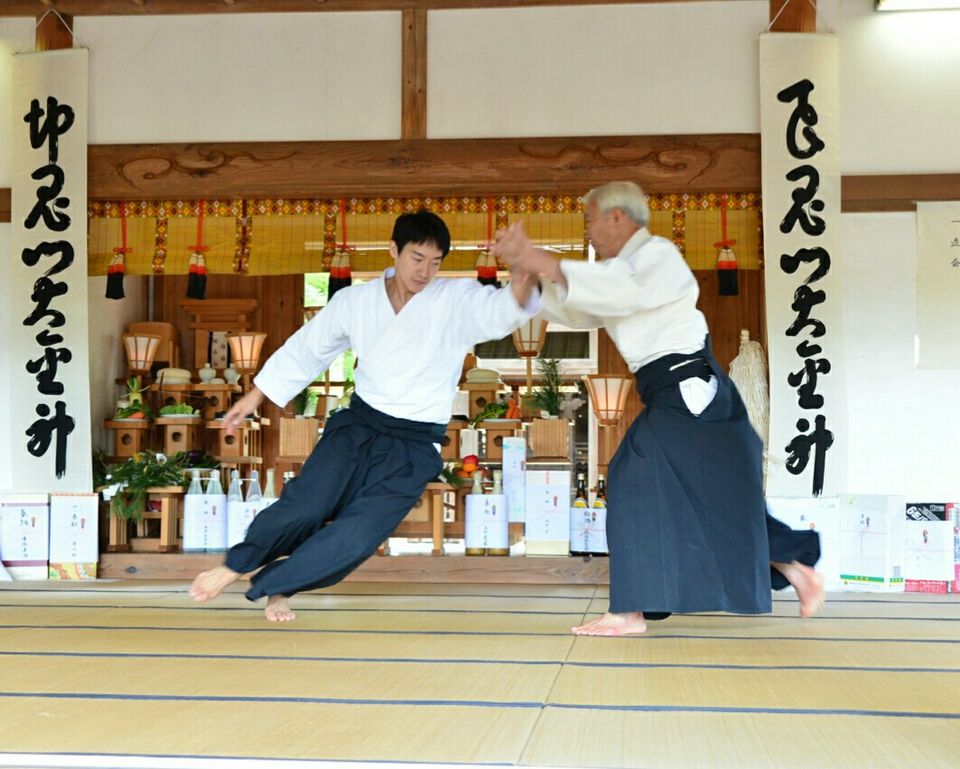
Aikido Demonstration in the 1950’s
This marketing effort was the impetus for the development of the ranking system, public demonstrations, the personality cult surrounding “the Founder”, and more, even the renaming of the techniques.
About 1954 or 55, Yoshinkan built a new dojo in Idabashi and was expanding. Compared to that new dojo, Hombu Dojo at that time still had bombing survivors living in one area of the building, the outside wooden walls were collapsing and the interior walls and tatami were old and falling apart. The number of people practicing were still few. Kisshomaru Sensei regretted there were so many articles about Yoshinkan in magazines and newspapers. Soon after, Kisshomaru Sensei started a PR campaign “Aikido was founded by Morihei Ueshiba,” and “Aikido = Ueshiba.” He worked hard to contact all O Sense’s prewar deshi and other acquaintances offering us, if need be, to give demonstrations wherever they were needed. It was incredible the care and diligence put into this. The magazines and newspapers wrote about Aikido as if there was no one else but O Sensei. They created a picture of him with a sharp glint in his eye who made practice look easy……The following day, if there were headlines like “Mysterious Martial Art, Aikido, Founder Ueshiba Morihei” with photos, Kisshomaru Sensei’s face would brighten. O Sensei’s prewar deshi and acquaintances began to call and write letters when they saw articles about him, and people began to seek him out.
Aikido, My Way – Yasuo Kobayashi
I think that it was around Showa year 30 (1955) that I saw an article in the newspaper about Aikido ni-dans and so forth, so I went to Aikido Hombu in Wakamatsu-cho and spoke to Kisshomaru-san – “Recently there was something written in the newspaper about there being dan ranks in Aikido, please correct them.”. When I did that Kisshomaru-san said “Actually, Kimura-san, we made dan ranks in Aikido after the war in order to stimulate growth.”, and that was the first time that I ever learned of the establishment of a dan ranking system (段位制度).
Mr. Kimura’s Aikido Memories, Part 2
When I was taught by the founder, we would use the kajo system and call it ikkajo, nikajo, sankajo, and so on. But when André Nocquet came to from France to the Hombu Dojo as an uchi deshi, we didn’t have such a thing as a manual, so Kisshomaru Sensei published the first Aikido book, and in it, he didn’t use ikkajo, nikajo, etc. but ikkyo, nikyo, sankyo, etc…..Well, I don’t know what Kisshomaru Sensei had in mind… I think that it was probably because the kajo system was used in the Daito-ryu scrolls that Takeda Sokaku Sensei used to award. He probably wanted to move away or update things from that. This is my just my guess though.
Interview with Isoyama Hiroshi: the Master of Iwama
Q: Could you recall a little bit about what it was like when you first began?
A: At that time the Founder almost never emerged from Iwama. At the most, practice at hombu was about 5 or 6 people, at the worst I was there by myself sometimes. The students at hombu where surrounded by an air of impending doom. They thought “If things go on like this Yoshinkan will become the main branch of Aikido”. It was in the midst of this condition that Gozo Shioda (first Kancho of the Yoshinkan) said “If this goes on Aiki will die” and founded the Yoshinkan.
Q: So Shioda sensei had that much vigor.
A: That’s right. There wasn’t even a formal grading system at the hombu of that time. For that reason, everybody sensed the danger that hombu would become merely Ueshiba Dojo. For myself, I could only do what I was able to, so first I established the first branch organization, the “Jouhoku Branch”.
Interview with Aikido Shihan Shoji Nishio
On June 10th of Showa year 30 (1955), the “Yoshinkan” dojo was established in Tsukudo-Hachiman, Shinjuku. When it opened it was a wonderful 100 tatami facility with a location near Iidabashi station, it was ideal. On the other hand, there were still refugees living in the headquarters of the “Aikikai” hombu dojo, which had not yet been fully repaired.
For many people to imagine that in the future the center of Aikido would become the Yoshinkan was entirely reasonable. This is certainly the way that it looked to people from the outside.
It was possible that the Aikikai would vanish if we could not make the right response.
Aikido Ichiro – Kisshomaru Ueshiba on the establishment of public demonstrations

Above is an announcement from the Hawai’i Times, November 9th 1961, disavowing Gozo Shioda and declaring that Aikido Yoshinkai had no relationship to the Hawai’i Aikikai or the Honolulu Aiki Dojo on Waialae Avenue.
Morihei Ueshiba visited Hawai’i in February 1961.
Gozo Shioda visited Hawai’i in November 1961.
Looking back, this announcement from the Hawai’i Aikikai is symptomatic of that brand protection that shaped the history of the early Aikikai – the response by Kisshomaru Ueshiba to the early rise of the Yoshinkan in the 1950’s, and his fears that the Yoshinkan might come to be the dominant representative of Aikido.
Ironically, just two months before Gozo Shioda left for his visit to Hawai’i he was promoted to 9th Dan by…Morihei Ueshiba, September 1961 in Iwama, as noted by Kyoichi Inoue.
This branding, and the protection of that brand, was also a large part of the rift between Kisshomaru Ueshiba and Kenji Tomiki over competition in Aikido, over similar concerns that a sporting form of Aikido would rise to eclipse the Aikikai in popularity.
Despite later claims to “immutable principles”, there was actually an initial agreement to create a compromise solution that would have included competition in Aikido:
In the early summer of 1970, Ueshiba Kisshomaru doshu and Fujita Masatake sensei came to Osaka and held a meeting with Tomiki Kenji shihan, Kobayashi Hirokazu shihan, and Uchiyama Masaharu sensei, the Chairman of Shodokan, at a Japanese restaurant in the ‘Rodan’ building in Showacho, Abeno Ward. During that meeting, an agreement was reached that on the condition that the Aikikai officially recognize the content of Aikido Kyogi (Competitive Aikido) as was being developed by Tomiki shihan as a part of Aikido, then Tomiki shihan would cease issuing his own dan rankings to his students, and that all of Tomiki shihan’s students would register as members of the Aikikai integrating Tomiki shihan’s students into the Aikikai Dan ranks. However, after this meeting, a meeting of high-ranking instructors of the Aikikai took place, and some of the key figures of the Aikikai’s Shihan division strongly opposed this proposal, leaving both Kisshomaru doshu and Kobayashi shihan in a difficult position. It seems that these teachers’ objection to the practice method of competitive aikido was, “Does this mean we must learn this practice method from Tomiki sensei? That would be unacceptable.” As such, ultimately, this plan unfortunately ended without being realized.
An attempt at a Grand Unification
It was only later, after that solution failed, that the Aikikai would take a harder line against competition.
Just to reiterate that – in 1970, a year after the passing of Morihei Ueshiba, Kisshomaru was willing to accept competition in Aikido, without any discussion of “the immutable principles of the Founder”.
A few years later the line became harder, with Kisshomaru Ueshiba attempting to protect the Aikikai brand by denying that Kenji Tomiki’s Aikido was even Aikido – the stance held by the Aikikai today.
And, in 1977 Kisshomaru Ueshiba would offer to support Kenji Tomiki in his efforts – if he would change the name of what he was doing, thereby protecting the Aikikai brand.
Several years later, around 1977, Tomiki shihan went to the Aikikai Hombu Dojo in Wakamatsu-cho, Shinjuku, for a meeting with Kisshomaru doshu. I accompanied him to and from the meeting, but I was not allowed to join the meeting itself, and so I waited for Tomiki shihan at a nearby coffee shop. I learned later that Tomiki shihan had met with Kisshomaru doshu and Shirata Rinjiro sensei, who was at that time Chairman of the Aikikai. They had apparently requested that when Tomiki shihan taught his practice methods, he use names such as ‘Tomiki ryu’ (Tomiki Style) or ‘Tomiki System’ and refrain from calling his methods ‘Aikido’.
On the way back from the meeting, Tomiki shihan appeared unusually indignant. I still vividly remember him speaking passionately, “The only person who can try to excommunicate me is Ueshiba Morihei sensei… Judo has never been called ‘Kano Judo.’ I have never aimed to develop competitive aikido for it to become a single school or style… If Aikido remains as it is now, with only kata practice, it will be ridiculed by other martial arts. Competition does not need to be the be all and end all, but aikido must include at least one aspect of competitive practice.”
Morihei Ueshiba , for what it’s worth, famously stated “there is no ‘hamon’ (‘expulsion’) in Aikido”.

In later years, Kisshomaru Ueshiba would even go so far as to claim “Only Aikido in the world of budo does not have a system of competition.” (Interview with Kisshomaru Ueshiba: the Early Days of Aikido), a claim that, while it bolsters the brand of a non-competitive Aikido, is also an outright falsehood.
His father’s own art, Daito-ryu Aiki-jujutsu, of course, has no competition to this day
Later Aikikai figures would attempt to reinforce this narrative – for example, the International Aikido Federation chairman would state:
If we put Aikido in a competition setup, it ceases to be Aikido.
Kei IZAWA – International Aikido Federation Chairman – Aiki Talks w/ Guillaume Erard
This echoes public statements by San-Dai Doshu Moriteru Ueshiba:
For example, those that have instituted competitive matches have obviously forgotten the true nature of Aikido, and cannot be called Aikido.
Aikido ™ – Can it really be trademarked?
And was followed by official letters issued by Dojo-cho Mitsuteru Ueshiba in 2019, with an introduction from Masaki Tani of the International Department of Aikikai Hombu Dojo:


At this point, I think that it is important to note that the Aikikai failed to make any response to the numerous allegations of sexual abuse and power harassment (potentially criminal actions in both the United States and Japan) involving one of their official representatives and one of their largest member organizations. These events occurred shortly after the events in the letter above, but were apparently not of sufficient importance to warrant even an official letter. These events are carefully documented in “That Stupid Girl: And the Petition to Support Women in the United States Aikido Federation“.
The letter from Mitsuteru Ueshiba regarding competition is interesting in that it raises a number of questionable assertions:
- The question as to whether non-competition can actually be called an “immutable principle set by O-Sensei”.
- The question as to whether it is wise to accept the opinions of anybody, even Morihei Ueshiba, in perpetuity over changing times and cultures.
- The question as to why some principles are claimed as “immutable” while many other parts of the training of Morihei Ueshiba are freely altered or ignored.
- The question as to whether or not the Aikikai even has the right to define “Aikido” for anybody who’s not actually a member of the Aikikai.
The letter could have said, for example, “the Aikikai has no competition as an organization, and we require that Aikikai members do not practice competition”, which would have been perfectly reasonable, and avoids the questionable appeals to authority.
However, all of the statements by the Aikikai above refer, not to an organization, but to an art, one practiced by many organizations, of which the Aikikai is just one. And, of course, competition has existed in the art of Aikido for more than fifty years.
That notwithstanding, most people in the Aikikai actually seem to have very little interest in competition, so there’s also a question as to why the Aikikai felt that such a stern declaration was even necessary.
In any case, this kind of letter doesn’t seem very inclusive of other people’s training or representative of any real attempt to create the World Family – another, perhaps, “immutable principle” set by O-Sensei.
Perhaps, the solution is actually much more simple and inclusive – practice competition if you enjoy it and find it a useful training method, don’t practice competition if you don’t enjoy it or find it a useful training method, but refrain from imposing one’s judgement on other people whose training methods don’t agree with yours based on branding and marketing concerns.