Category: Essay

  • Ai no Bujutsu – Aiki and the Bujutsu of Love

    Ai no Bujutsu – Aiki and the Bujutsu of Love

    Muko (Takeo) Nishikido

    Muko (Takeo) Nishikido

    Muko (Takeo) Nishikido (錦戸無光/武夫) was born in 1940 on Tinian in the Northern Mariana Islands near Saipan. After school in Kumamoto he moved to Osaka, where he began to train in Daito-ryu Aiki-jujutsu in 1959 and later established a dojo in Tokyo. In 1973 he met Daito-ryu Aiki-jujutsu Kodokai Founder Kodo Horikawa in Kitami City in Hokkaido through the introduction of a friend. Upon feeling his Aiki for the first time he decided to discard his previous study of jujutsu and focus on Horikawa Sensei’s approach to Aiki.
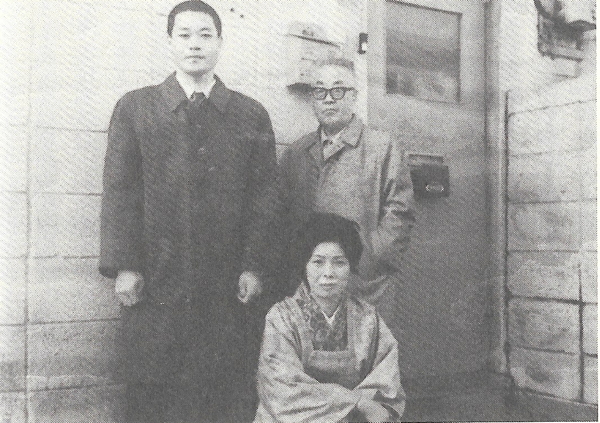
    Mr. and Mrs. Horikawa

    Muko Nishida with Mr. and Mrs. Horikawa in Hokkaido, 1973

    After commuting to Kitami for two years, he decided to relocate with his family to Hokkaido in order to further his training and received severe individual instruction in addition to the regular training at Horikawa Sensei’s dojo.

    He later established his own organization to spread the teachings of Kodo Horikawa called Hikarido (The Way of Light / 光道).

    The following article contains excerpts from “The Height of Aiki” (合気の極み), written by Nishikido Sensei and published in Japanese in 2017 by BAB Japan publishing company (BABジャパン出版局), which also publishes the popular martial arts magazine Gekkan Hiden (月刊秘伝 / “Secret Teachings Monthly”).

    Some of his emphasis on Ki, love and harmony in Daito-ryu Aiki-jujutsu may appear to be at odds with common perceptions of Daito-ryu, but it may be helpful to consider his statements in the context of similar statements from other prominent figures in the Daito-ryu world.

    • Tokimune Takeda, the son of Morihei Ueshiba’s teacher Sokaku Takeda and the Soke of Daito-ryu Aiki Budo:

    “The essential principles of Daito-ryu are Love and Harmony”

    “The goal of spreading Daito-ryu is ‘Harmony and Love’, keeping this spirit is what preserves and realizes social justice. This was Sokaku Sensei’s dying wish”

    “There is no first attack in Aiki-jujutsu. Endure as much as you should endure. Even when it becomes necessary, neutralize the opponent without causing injury through Aiki.”

    • Yukiyoshi Sagawa, one of Sokaku Takeda’s senior students and one-time successor as Soke of the art:

    “Aiki Budo is the Way of Human Development”

    “Aiki is the fitting together of Ki.
    Through this harmonious reconciliation all things under heaven and earth in the universe move peacefully without disturbance. This harmonization is Aiki.”

    • Masao Hayashima (早島正雄), who trained with both Sokaku Takeda and Sokaku Takeda’s student Toshimi Matsuda (from the first page of his book – “Taoist Aiki-jutsu – the volume of Internal Power”):

    “Aiki-jutsu is said to be the Budo of Harmony.”

    • Katsuyuki Kondo, Menkyo Kaiden in Daito-ryu Aiki-budo from Tokimune Takeda and successor to the mainline of Daito-ryu, in an interview with Aikido Journal‘s Stanley Pranin:

    What are the main differences between Daito-ryu and aikido?

    I don’t think there is any difference. In Daito-ryu, too, practice begins and ends with courtesy (rei). And its final goal is the spirit of love and harmony.
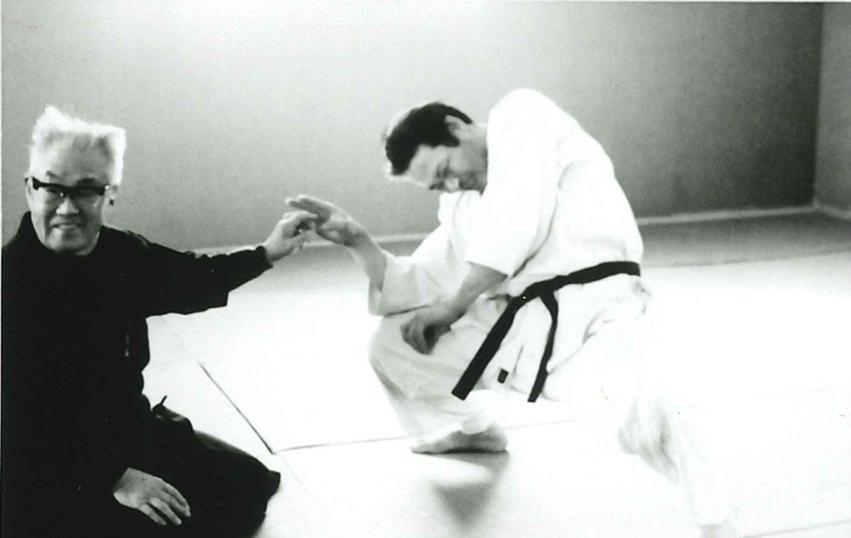
    Muko Nishikido and Kodo Horikawa

    Daito-ryu Aiki-jujutsu Kodokai Founder Kodo Horikawa
    applying Aiki to Muko Nishikido

    Ai no Bujutsu – Aiki and the Bujutsu of Love

    – Muko (Takeo) Nishikido (translation by Christopher Li)

    Daito-ryu Aiki-jujutsu is the bujutsu of “harmony” (和), as was stated by Kodo Horikawa, who established the Daito-ryu Aiki-jujutsu Kodokai, in Showa year 25 (1950) in Kitami City, Hokkaido – “Neither cut nor be cut. Neither strike nor be struck. Neither kick nor be kicked.”. It is a bujutsu that handles the opponent without causing them harm.

    In the case of the Daito-ryu Aiki-jujutsu Hikari-do, the level of harmony is gradually enhanced as training progresses from the basic techniques in Shoden to Chuden and Okuden.

    Harmony, that is, love.

    Why is that? Because it prevents contention. When one uses “Aiki” even the very impulse to counter-attack ceases to arise.

    Without harmony one cannot be led to love. The greater the harmony the deeper that love becomes. In Hikari-do we grasp this in our training through the techniques.

    At first there is no real feeling when the techniques in Aiki-jujutsu are applied to you. That is because one cannot understand how or what is being done to you.

    When Aiki was first applied to me I thought “What is this?”. The will to fight disappears. The desire to attack the opponent disappears.

    Aiki completely strips away the feeling of the opponent to fight and their strength. That can be stripped away not only for just a single person, but even when there two, three, four, five or six people.
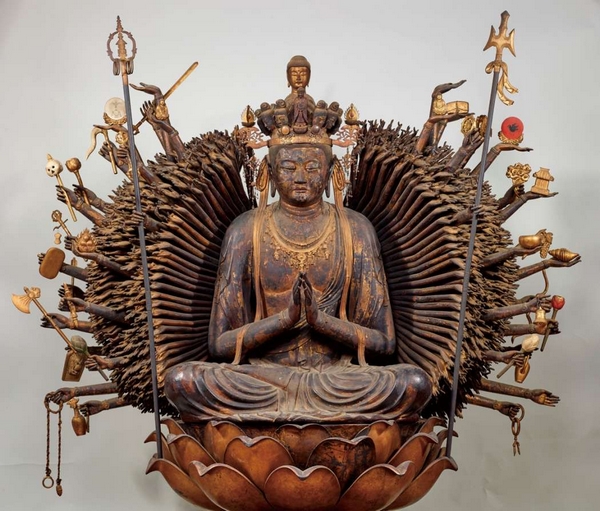
    Thousand Armed Kannon

    Seated Thousand-armed Kannon Bosatsu
    Fujiidera temple, Osaka – 8th century

    One works to create a body that that can manage situations like that in an instant. One works to create a body like the Thousand Armed Kannon (千手観音), so to speak.

    When one says “thousand”, in the past this meant a number without limit. This means that no matter where one is grabbed on their body they become able to use Aiki.
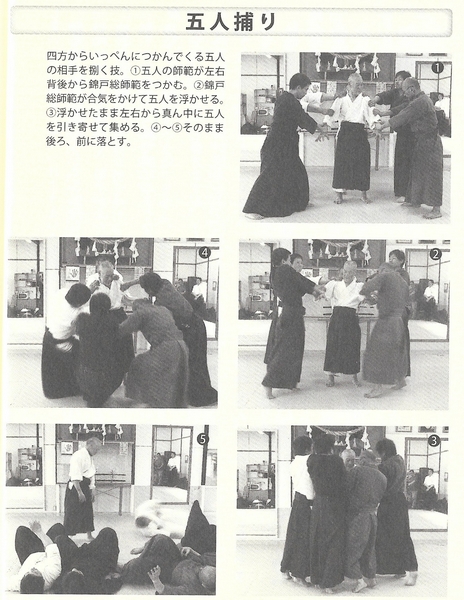
    Five person attack

    In a manner of speaking, it means that more harmony can be achieved by two people rather than one, three people rather than two, four people, five people, six people. It is the world of harmony. For that reason, contention disappears.

    I think that this is real love. One person, two people, three people, four people, five people, six people – love becomes deeper and deeper.

    Daito-ryu Aiki-jujutsu is the bujutsu of love.

    And then, as one draws closer to real training in the inner workings of Aiki, even the smallest portion of the ego becomes unable to enter. One enters into a selfless world without ego.

    This is what I have grasped to this point.
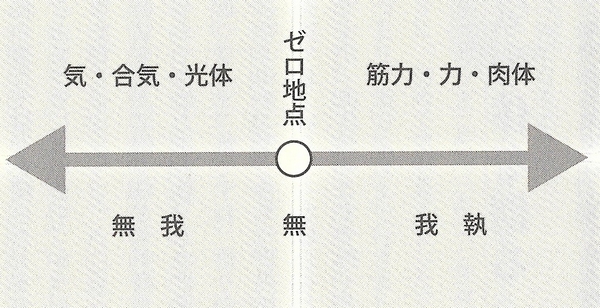
    Ego to egolessness chart

    When expressing Aiki as a chart we get something like the diagram above.

    On the right side is the world of power, the world physical strength. In terms of the spirit, it is the world of the ego. On the left side is the world of Ki, the world of Aiki. In terms of the spirit, it is the world of egolessness.

    In the center is the zero point, in other words nothingness (“Mu” / 無). One who has become enlightened to nothingness comes to this point. “Ah, it’s nothingness” is one kind of enlightenment.

    However, even if one becomes enlightened to a state of nothingness, one cannot do anything. Even a master potter will say “Nothing can be done from nothingness”. This is still the zero point. Just coming here one can still go to the right side of the world of strength, the world of the ego, or one can also go to the left side of the world of Ki, the world of Aiki.

    The right side of the world of strength, the world of the ego, is comfortable. Strength and ego can be used immediately.

    Conversely, the worlds of Ki and Aiki are severe. One cannot grasp the real thing if they compromise. If one thinks to grasp he real thing they must pass through this world of severity.

    Even when one attains enlightenment through Zen training, they come to this point of nothingness, the zero point. But if you’re satisfied there then you’ll reach a dead end. There is a much deeper world. Wherever you go, however far you go, there is a world without limits.

    The more that one uses Aiki the more that their Ki increases, their harmony increases, their spirit enters into the world without limits.

    When those people who have inhabited the world of physical strength, the world of power, the world of the ego until this time train in Aiki-jujutsu they will draw closer to the zero point. That is, nothingness. The world of enlightenment. Return to the origin. From there begins the determination of whether one will either return to the world of physical strength, power, the world of the ego again, or depart for the world of Ki, the world of Aiki.

    In Hikari-do there are many types of training done in order to return to the point of nothingness. That can be called the enlightenment of the physical body – once the body has gone that far then next one is able to enter the world of Ki, the world of Aiki.
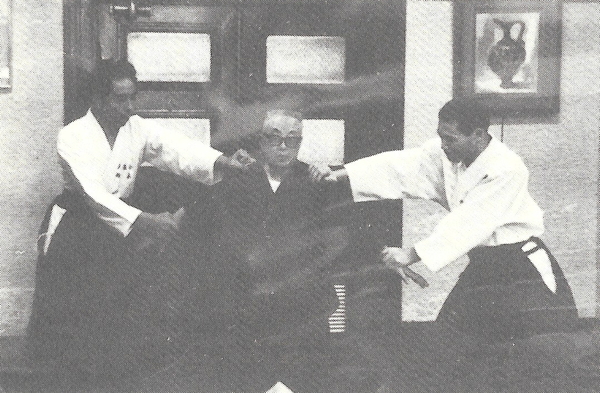
    Kodo Horikawa - Police Demonstration

    Demonstration at Police Headquarters in November 1973
    Seigo Okamoto – Kodo Horikawa – Muko Nishikido

    Building the Ki Body

    Daito-ryu Aiki-jujutsu first builds the “Ki Body” through training in the kihon (“basics”) and then enters into training in Aiki. When building the Ki Body physical strength (power) is not used. When the use of physical strength has ceased completely, there for the first time is the Ki Body.

    There was a time during my third year of receiving instruction from Kodo Horikawa Sensei in Kitami, Hokkaido that I realized that my entire body was the Ki Body. “Ah, my entire body is the Ki Body”, I realized. When I truly stopped needing physical strength, that was my first glimpse of Ki.

    In other words, I had made my way to the point of nothingness. However, I did not yet understand Aiki. If I had not been able to grasp Aiki it may be that I would have returned to the world of physical strength.

    When one trains in Aiki they experience a liberation (moksha) from the physical body. In moksha there is a liberation of the physical body and a liberation of the spirit, Aiki is a liberation of the physical body. One understands – “Ah, this is the Ki Body!”. The body of physical strength becomes the Ki Body.

    When compared with Horikawa Sensei’s sixty years of Aiki, my Aiki is still half of that at thirty years. Even if you just look at the shape of his body, Horikawa Sensei is twice as sharp as I am. I am still inexperienced.

    That Horikawa Sensei – even past eighty years old he would say “Well, Sokaku Takeda Sensei was much greater. I’m just not there yet…”.

    There are those kinds of steps in this world. It is the world of shugyo (“intense training”), so it can’t be helped. One has to build their body. Just one year, or two years of shugyo can’t hope to build the body and leap past sixty years of training.

    Hoping to get even a little bit closer to Horikawa Sensei, I thought of my own method of training. I took a heavy wooden sword and swung it five or six thousand times every morning and night. I did that for five or six hours to seven or eight hours every day, and continued for about half a year.

    Then, one day when I swung it ten-thousand times, the heavy wooden sword flew up away from me. I thought “Ah, it flew away!”.

    So then I started swinging an iron bar several times heavier than the wooden sword. Likewise, I would swing it for a few hours in the morning and the evening about 2,500 times each, 5,000 times a day. And finally the iron bar became weightless and flew up out of my hands.

    Normally I wouldn’t be able to swing it with my strength. Even with Ki I couldn’t swing it. I have swung an iron bar with Ki, but I couldn’t swing it more than a hundred times. My hands couldn’t hold it. Instead, I was better able to hold it when swinging with physical strength.

    Then I thought “OK, I’ll swing it with Aiki!”. and I swung it with Aiki – two hundred, three hundred, five hundred, six hundred, one thousand, two thousand times I swung. That was the first time that I thought “Ahh, in the end one really has to train…”. If I hadn’t swung using Aiki I would probably have gone back to my original body of physical strength.
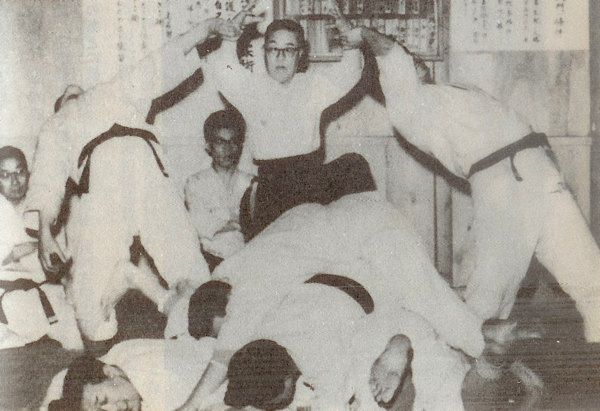
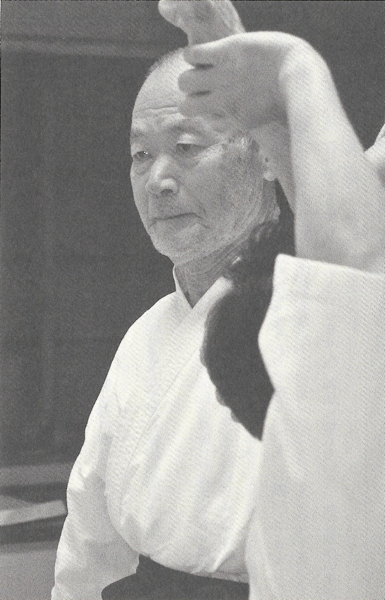
    Kodo Horikawa

    Daito-ryu Aiki-jujutsu Kodokai Founder Kodo Horikawa

    Basic Techniques and the Ki Body

    Daito-ryu Aiki-jujutsu does not require even the smallest bit of strength.

    That said, it’s not “relaxation” (脱力). I am not saying that relaxation is bad, but when one relaxes the become unable to forge themselves.

    In Hikari-do we train from the first steps of basic techniques to training to build a truly physically resilient physique. What I am teaching is training methods for the building of the Ki Body.

    I grasped this training method after meeting Horikawa Sensei. If I teach it to someone for one year their body will suddenly change. It will naturally become a physically resilient Ki Body. We have that methodology. In other bujutsu they train by learning techniques, not Ki. For that reason, they are unable to develop the Ki Body.

    In order to build the physical body, one would normally lift barbells, or other things, but if you can grasp Aiki then things like that can be done simply. Muscular strength is unnecessary. Conversely, if one uses even a little bit of physical strength then they will be unable to use Aiki.

    One must get a firm grasp on the basic techniques. This is important.

    If one cannot grasp the basic techniques properly then they will not achieve the Ki Body. They will become unable to attain the real thing. They will develop into a body that is simply composed of techniques.

    As long as one grasps the basic techniques they will quickly progress to the next level.

    One dayI asked Horikawa Sensei, “Sensei, how many years will it take to get to Aiki?”. When I did that he said, “If you grasp the basics firmly, then two or three years will be enough”.

    That’s because if one grasps the basics then they will naturally form the Ki Body. There are not that many people who think to purposely grasp the basics. Those who grasp the basics firmly progress quickly.

    But everybody, especially those who have come to learn bujutsu,  inevitably tries to throw the opponent or apply a technique and their feelings get drawn in that direction. When that happens those that could see become blind.

    Among my students were some who said, “Nishikido can’t use Ki”. But there were also those that, when they finally came to training in the Hiden Ogi techniques, said “Ahh, so there is Ki, there is Aiki!”. Also, there were those who, even when shown “This is Ki. This is Aiki.”, would think “That’s just another technique”.

    Training in Ki cannot progress well without a clear spirit of nothingness and concentration. That progress can be made is because that person’s spirit is in a state of clarity.

    The state of nothingness is not “indifference” (無関心), it is to be able to see clearly that which is not visible. The “Ki” which was invisible to that point becomes visible. One comes to see it with their spirit. They come to see it clearly.

    When one become capable of that one becomes capable of seeing Ki all of the time. To grasp this one time is simple, if one cannot grasp it then of course it is difficult. Those with idle thoughts have a difficult time grasping this.

    Even if I teach “If you do this than you will see!”, there are those who are impatient and think “It’s not this, it’s not that”.

    The basic techniques are the same, if you do that then you  will not be able to see it. It’s quick if you focus on what I am teaching, but people can’t seem to focus.

    The Resilient Aiki Body

    It is written “Aiki”, but it is read “Ki wo gassuru”. That is what Kodo Horikawa Sensei said. (*See the more detailed explanation towards the end of this article).

    In order to use Aiki, the body must become the Ki Body. The entire body becomes the Ki Body, and is used through the unification of Ki.

    To become the Ki Body means not to use physical strength. When one does correct basic training in Aiki they will naturally become the Ki Body.

    If one does not use physical strength then their strength will degenerate. When physical strength degenerates the muscles also become weaker. It’s difficult to maintain physical strength. In order to triple one’s physical strength they must really participate in a large amount of physical training. But in order to develop the Ki Body it’s acceptable to throw away that physical strength. Normally, in order to achieve the Ki Body, a normal person would take twenty to thirty years at the earliest. When one uses this with unified Ki, the Ki fills the body. As one further unifies and uses this Ki they become more and more filled with Ki. That is even further unified and utilized.

    This is Aiki training. This is Aiki conditioning. For that reason, there is no end to Aiki conditioning. And thus, it builds a resilient Ki Body.

    When one becomes able to use Aiki the Ki Body becomes even further developed. Even when training in the basic techniques of Aiki the Ki Body becomes further developed.

    There is no other bujutsu like this. From basic techniques to a training method that build the Aiki Ki Body.
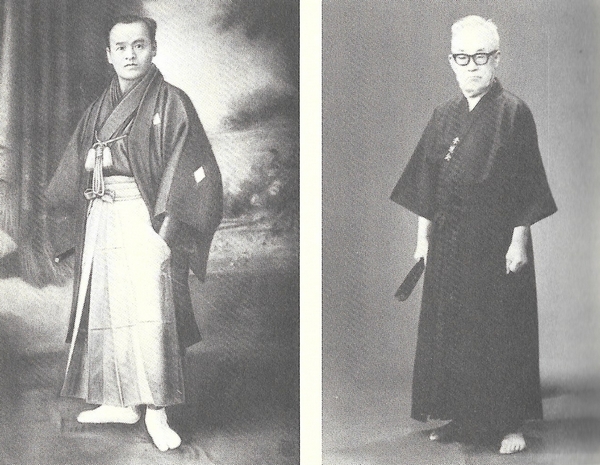
    Sokaku Takeda and Kodo Horikawa

    The Aiki bodies of Sokaku Takeda and Kodo Horikawa

    Once one becomes capable of using Aiki, then one becomes able to build the Aiki Body with Aiki. Not the Ki Body, creating the Aiki Body.

    Horikawa Sensei’s techniques were incredible, but his body was also incredible. His body was filled full with Ki. Not a soft, fluffy Ki. He was filled full with a sharp, intense Ki.

    Since Sensei was a school teacher, he had never done any kind of physical labor. I always wondered “How did he develop such an incredible body?”. He didn’t have the shape of a Ki Body, his body was in the form of an Aiki Body.
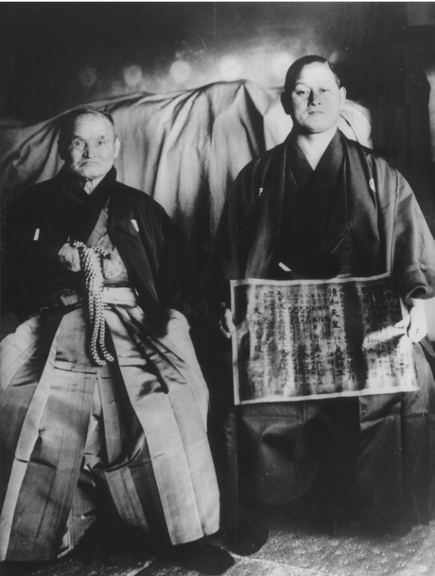
    Sokaku Takeda and Takuma Hisa

    Sokaku Takeda and Takuma Hisa
    Receiving Menkyo Kaiden in Daito-ryu Aiki-jujutsu, 1939

    Sokaku Takeda’s body was also firm and sharp. There are pictures of them together, but when compared to Sokaku Takeda’s body Takuma Hisa still looks something like a child.

    I think that Takeda Sensei must have handled Takuma Hisa Sensei like a child. Horikawa Sensei’s body was incredible, but Takeda Sensei’s was far and above even that.

    Development of the Tendons and Ligaments

    All schools of bujutsu build a resilient body through severe training. It is through that that one can become capable of using techniques such that are called “divine techniques”.

    Aiki as well was born at the end of the struggles of our ancestors devoting their entire body and souls to their training.

    There are several hundred schools of bujutsu in Japan, but the name “Aiki-jujutsu” exists only in Daito-ryu Aiki-jujutsu.

    No matter how weak one’s body is, if they truly understand Aiki and train correctly then they will develop a resilient Aiki Body.

    In Daito-ryu one first develops the Ki Body through training in basic techniques, and then begins to use Aiki. When using Ki the tendons and ligaments of the body don’t work very much. However, when one begins to use Aiki after developing the Ki Body the tendons and ligaments begin to work.

    There was a time when Horikawa Sensei was admitted to the hospital after he cut his Achilles tendon two-thirds of the way through. At that time one of the doctors in the hospital said in wonder “This person’s Achilles tendon is three times as thick as a normal person’s!”.

    Horikawa Sensei’s toes and fingers were also incredible.

    Even normally when nothing was happening they were all stretched out wide. Just the same as I when I am stretch my finger and toes out wide to their tips.

    The tendons in Horikawa Sensei’s Achilles tendon and his toes and fingers were the result of sixty years of Aiki conditioning. In other words, the tendons and ligaments throughout Horikawa Sensei’s entire body were strongly developed.

    When the tendons and ligaments throughout one’s entire body are worked through Aiki training (conditioning) the tendons and ligaments start to develop and one can build the resilient Aiki Body.

    Muscles, when one takes even a short break from muscular training, soon become weak. When one becomes of an advanced age their deterioration becomes visible. However, once tendons and ligaments are developed they do not deteriorate. Even when one reaches an advanced age that resilient body is preserved, and one can remain with a youthful appearance indefinitely.

    Horikawa Sensei told me “Even if you’re sick in bed for a week or ten days, it’s no hindrance to using Aiki”. Even if you’re sick in bed for a week or ten days, the conditioned body does not deteriorate.

    Gassuru Aiki

    This happened one day in the third year of receiving instruction from Horikawa Sensei, the first year of receiving individual instruction in Kitami.

    I asked Horikawa Sensei loudly “Sensei, Is Aiki kokyu-ho (a breathing method)?”. Horikawa Sensei was very hard of hearing.

    Sensei said “What? Kokyu-ho? Hahaha…” – he just laughed and that was the end of it.

    Then, after a few days had passed I was having tea at Sensei’s house after morning practice and an Aikido demonstration was being broadcast.

    After the demonstration was over Sensei said this – “They call it Aikido, but they aren’t using the slightest bit of Aiki!”. As one would expect, at that time I asked “Sensei, what is Aiki?”.

    When I did that Sensei stopped for a moment, took a deep breath, and said “Aiki is…”. I held my breath and watched Sensei’s face. And then this is what he said next.

    Sensei told me “Aiki is written Aiki, but the meaning is Ki wo gassuru, it is read Ki wo gassuru.”.

    “Sensei! Aiki is Ki wo gassuru?”, I said without thinking. Sensei said, nodding, “Yes, that’s right.”. I said “Thank you!” from the bottom of my heart.

    Until that time I had read a number of books about Aikido, but most of them wrote about Aiki as something like “Ki wo awaseru”.

    Translator’s Note: Horikawa Sensei appears to be distinguishing between “awaseru” (合わせる) and “gassuru” (合する). “Awaseru” is commonly used in modern Aikido in the meaning of “matching” or “harmonizing” with the opponent. “Gassuru” in this context is used in the sense of “unification” within the body, without relation to the opponent.

    Morihei Ueshiba also used this reading of the kanji for “Ai”, both in his 1933 technical manual Aikijujutsu Densho and his 1954 technical manual Aikido Maki-no-Ichi, but slightly more explicitly, as when he used the term “Inyo-gacchi” (陰陽合致) – “the unification of Yin and Yang”.

    He later (1963, from a speech at a demonstration at the Hibiya Kokkaido) stressed that this process occurs within one’s own body when he stated that “In Aikido Izanagi no Mikoto Izanami no Mikoto enter and move through this old man’s body”   (「合気道は、イザナギの尊 イザナミの尊が爺の体内に入り行っているのだ」) – Izanagi and Izanami standing in for Yin and Yang.

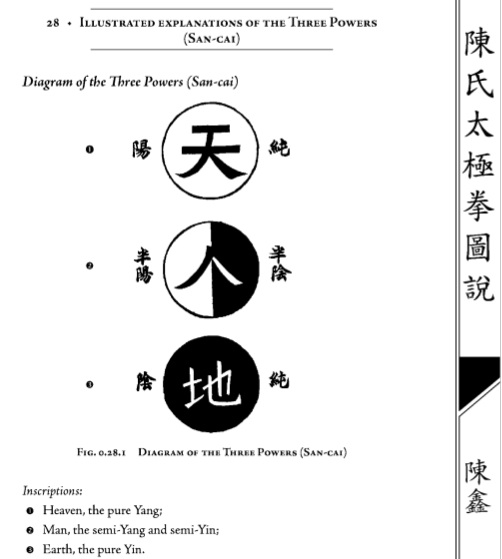
    He also presented this in his use of the phrase “Ten-chi-jin Aiki”, the classical Chinese model that “unifies the forces” (“Aiki”) of “heaven and earth” (“Yin and Yang”) in man (‘jin”).

    “Aikido is the way and the principle of harmonizing Heaven, Earth and Man
    (Morihei Ueshiba – from “Takemusu Aiki”, edited by Hideo Takahashi).

    This also lends some elucidation to one of the core principles of Daito-ryu – Aiki-inyo-ho, the “Aiki Yin-Yang Method”, or in this light, a “method for unifying the forces of Yin and Yang”, the classical Chinese union of opposites also cited by Morihei Ueshiba above.

    One last point – Nishikido Sensei titled his book 合気の極み, “The Height of Aiki”. But the character used for “height”, 極み, is also the character used for “polarity” in Taiji – 太極 – “supreme polarity”, the union of the opposing forces of Yin and Yang. In the classical Chinese model, Wuji – “nothingness” (無極) becomes Taiji (太極), the manifestation of Yin and Yang. This process was also described by Morihei Ueshiba in terms of the Kototama.

    For that reason, when I heard Horikawa Sensei’s explanation I thought “As i suspected, it’s different.”. When I understood that it was “Ki wo gassuru” it became clear to me.

    At that time I had already understood the basics of Aiki. I had already realized the concept of the Ki Body. For that reason, I was able to understand “Ah, so that’s what it is!”.

    If I hadn’t heard those words from Horikawa Sensei, It may be that I would not have been able to grasp Aiki. I was extremely thankful for that single sentence. Even now I can’t forget the joy that I felt at that time. “Sensei, arigatou gozaimasu!” – I thanked Sensei from the bottom of my heart.

    And so, that was how I was able to grasp the principle of Aiki.

    There was also another event. One day I was watching Aikido Founder Morihei Ueshiba’s demonstration at Horikawa Sensei’s home. I watched, thinking “Ah, incredible!”.

    I was able to see clearly how Ueshiba Sensei was moving. “Ah, I can see how Ueshiba Sensei is moving!”, I felt.

    Previously, I had not felt that way. I just thought “Ueshiba is incredible. Aikido is incredible.”.

    But I was able to see it. I saw clearly what Ueshiba Sensei was doing and how he was doing it.

    It must be that when one arrives at that level, things that they hadn’t been able to see before become visible, don’t they?
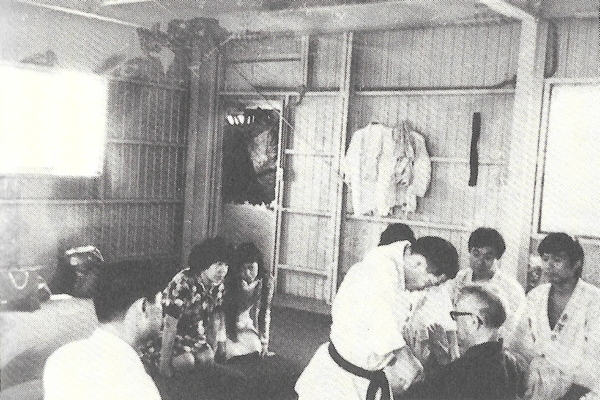
    Kodo Horikawa - Aiki-age

    Hokkaido, 1974 – Aiki-age with Kodo Horikawa


    Published by: Christopher Li – Honolulu, Hawaii
  • Aikido, qué no sabemos y por qué no lo sabemos …  [Spanish Version]

    Aikido, qué no sabemos y por qué no lo sabemos … [Spanish Version]

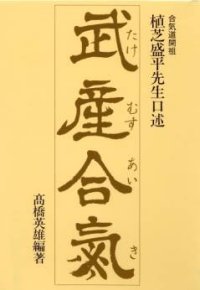
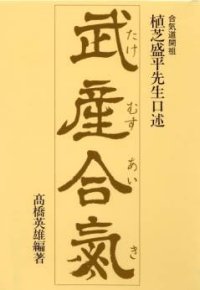
    武産合気

    “Takemusu Aiki” de Morihei Ueshiba, editado por Hideo Takahashi

    This is the Spanish translation of the article “Aikido and the Unknown“, provided courtesy of Juantxo Ruiz .

    Qué no sabemos y por qué no lo sabemos …

    Cuando Sam Chin visitó Hawaii el año pasado, nos dijo (estoy parafraseando) que no es tan malo no saberlo, siempre y cuando usted sepa que no lo sabe. Eso me llamó la atención: ¿no es esta la primera parte del problema?

    Cuando comencé en Aikido, había muy poca información disponible en inglés. Lo que estaba disponible era, lo sabemos ahora, altamente desinfectado (nota de Juantxo: vamos, que esa información no era completa y llegaba solo cierta parte): he aquí un buen ejemplo en el sitio web de Aikido Journal, y en el de Meik Skoss en su sitio web Koryu.com. Había muy pocos no japoneses que podían hablar japonés en ese momento, y mucho menos leer las fuentes originales, y la mayoría de los japoneses en el ojo público presentaban una representación más o menos uniforme de la historia y los detalles del Aikido.

    Ahora, por supuesto, hay cientos de libros en inglés sobre el tema del Aikido, entonces, ¿cuál es el problema

    Pues bien, el material en inglés, especialmente el de fuentes originales, es más un resumen que un análisis detallado del material: todavía no se ha realizado una verdadera traducción académica.

    De hecho, los materiales originales producidos por el fundador del Aikido, Morihei Ueshiba, son tan difíciles de leer que incluso la mayoría de los japoneses declinan leerlo en su propia lengua materna. Si lo leen, sin un fondo particular y experiencia, simplemente no hay decodificación. Peor aún, cuando lo leemos en inglés, no solo es a través de la lente del traductor y su comprensión, sino que está completamente fuera del contexto del mundo en el que vivió el Fundador, que es altamente especializado y complejo, y fuera de la contexto de ciertos otros campos especializados que son realmente esenciales para descubrir qué está pasando.

    Dan Harden Sangenkai WorkshopDan Harden en el Taller Sangenkai 2015 en Hawaii

    Lo sé, lo intenté, y no tuvo ningún sentido hasta años después a través de la lente de un mayor conocimiento en ciertas áreas, y por eso estaré eternamente agradecido a la generosidad de Dan Harden, que ha sido tan amable de compartir su entrenamiento con nosotros.

    Eso no es para denigrar lo que se ha hecho hasta ahora en términos de traducciones al inglés, todo tiene que comenzar en alguna parte. John Stevens me dijo que consideraba que su traducción de “Takemusu Aiki”, que sigue siendo la colección más completa del fundador en sus propias palabras, es una especie de “Takemusu Aiki – Lite”, por lo que sería al menos semi -comprensible para una audiencia general.

    Aún así, nos quedamos con una situación en la que la mayoría de los instructores y estudiantes de Aikido, ya sean hablantes nativos de japonés o no, no tienen idea de lo que el Fundador de su arte dijo o escribió de manera detallada.

    Aha! Usted dice que su maestro es un alumno directo del Fundador, un uchi-deshi, y aprendió a los pies del maestro. Desafortunadamente, la mayoría de los uchi-deshi eran niños pequeños sin los antecedentes para comprender el contenido de las conferencias, o la paciencia para soportar el dolor de sentarse y escuchar al Fundador en las frías mañanas invernales, lo decían ellos mismos. Aquí hay algunos ejemplos: estos son de entrevistas en japonés que aún no se publicaron en inglés, pero Stan Pranin tiene varias citas similares en entrevistas en el sitio web de Aikido Journal:

    Nishio and Ueshiba

    Shoji Nishio

    P: ¿Por qué se ha perdido la sustancia (de la técnica de Aikido)?

    A: Nadie escuchó lo que O-Sensei estaba diciendo. Simplemente intentaron recordar la forma externa de la técnica. Aunque O-Sensei dijo “¿De qué sirve copiar mi técnica? Si haces una técnica una vez, ya está terminada “. Debido a que hablaba como un Kami-sama (Dios), pensaron que nada de lo que él decía podía ser entendido, y ni siquiera intentaron prestar atención cuando escuchaban. Mucho más tarde, cuando olvidaron todo, a veces recordarían “Ah, eso es lo que eso significaba”. Es por eso que la práctica de la mayoría de las personas hoy está vacía. No miran otros tipos de Budo. Desde el principio, el valor de un Budo se determina mediante comparaciones con otros Budo.

    Yoshio Kuroiwa, koshi-nage

    Yoshio Kuroiwa

    P: He oído que las conferencias fueron bastante largas.

    A: las odiaba (risas). Hablaba sobre los Kojikki y otras cosas, pero mis piernas se quedaban dormidas y no podía entender nada, solo me hacía llorar. Pensar en esto ahora realmente trae cosas de vuelta.

    Yasuo Kobayashi

    Yasuo Kobayashi

    P: ¿Es cierto que no hubo discusión técnica?

    R: En términos de cómo aplicar técnicas específicas, algunas personas dicen que O-Sensei dijo esto o aquello, pero en lo que a mí respecta, nunca escuché ninguna explicación.

    Nobuyoshi Tamura

    O-Sensei venía al dojo, mostraba algunas técnicas y luego se iba. Si tenia ganas, hablab un rato. Todos éramos jóvenes, por lo que en su mayoría solo queríamos seguir con la práctica. (sobre el contenido de las conferencias) Hablaba sobre los dioses: Izanagi, Izanami, etc. En Sakurazawa-shiki (Macrobiótica) tienen algunas ideas parecidas, así que pensé que estaba hablando de algo relacionado con In y Yo (yin y yang en japonés), pero eso es todo lo que yo entendía.

    Nobuyuki Watanabe Sensei

    Nobuyuki Watanabe

    P: El Fundador solía hablar mucho sobre el Kojikki (“Un registro de asuntos antiguos”), ¿no?

    A: Sí. Una vez, el Fundador trajo un diagrama del cuerpo humano y dio una explicación mientras sostenía una copia del Kojikki en una mano. Mientras señalaba los músculos y los huesos en el diagrama, dio una explicación muy detallada, diciendo cosas como “Esto es Naohi (espíritu correcto)”, y así sucesivamente. Sin embargo, en ese momento solo me preguntaba qué significaba todo eso. Fue solo una vez, así que no puedo recordar los detalles muy bien.

    Yoshimitsu Yamada in his twenties

    Yoshimitsu Yamada

    P: ¿No hubo ninguna explicación de las técnicas?

    A: No, no. Solo discursos difíciles sobre el Kojikki, y luego él te proyectaba y decía “¡Así!”. Sin embargo, a menudo dijo que el Aikido cambia todos los días.

    Así que aquí está la primera parte del problema: la mayoría de las personas ni siquiera saben que no saben. Lo que eso significa es que la mayoría de la gente está haciendo alegremente lo que está haciendo sin tener idea de que hay, o debería haber, algo más; el entrenamiento en el que Morihei Ueshiba desarrollaba todos los días desde el día en que conoció a Sokaku Takeda en la posada Hisada en 1915 hasta que falleció en Tokio en 1969.

    Ahora bien, ¿por qué no lo sabemos?

    Creo que es posible defender firmemente que gran parte de los registros históricos fueron deliberadamente alterados u ocultados. El trabajo de Stan Pranin muestra mucho de eso.

    También es posible prestar atención a un detalle que los estudiantes del Fundador omiten mucho: que lo que obtuvieron lo consiguieron al sentir, al ser proyectados directamente por el Fundador. Una corroboración de esto es que aquellos estudiantes que obtuvieron un poco o mucho de algo del Fundador tuvieron problemas para transmitir esas cosas a sus alumnos. Es fácil ver cómo esto lleva a un colapso en la transmisión, una degradación constante de habilidades donde los estudiantes del Fundador nunca igualan el nivel del Fundador, los estudiantes de los estudiantes nunca alcanzan el nivel de sus maestros y etc.

    Peor que cualquiera de esas cosas es que muchos de nosotros nos hemos sentido cómodos sin saber realmente ni entender de lo que el Fundador estaba hablando. Pídale a la mayoría de los instructores de Aikido una explicación clara de los términos y objetivos expresados en “Takemusu Aiki” y obtendrá … muy poco. Es increíble, para mí, que un instructor en un arte se sienta cómodo al no entender claramente el discurso del Fundador de su arte.

    Por último, por ahora, “¿por qué no nos importa?” – esta es otra cosa que me resulta increíble, pero supongo que es típica de las personas en general y no es un problema específico del Aikido. En general, las personas están contentas de hacer lo que hacen y lo que han estado haciendo, y cuanto más tiempo llevan haciéndolo, menos cuestionan.

    Me sorprende cómo pocas personas, por ejemplo, cuestionan el sistema de clasificación “tradicional” en Aikido, aunque la “tradición” solo comenzó en la década de 1940 y realmente comenzó a ajustarse al intento del gobierno japonés de regular las artes marciales bajo el Dai-Nippon Butokukai.

    Debería ser responsabilidad de todos y cada uno de nosotros en Aikido ser activos en el descubrimiento de lo que no sabemos, y cómo podemos aprender esas cosas, y preocuparnos por el proceso.

    Además, creo que nos corresponde a cada uno de nosotros tener una comprensión clara de lo que el Fundador pensó sobre su arte, cuáles fueron sus objetivos técnicos, filosóficos y espirituales y poder expresar esas cosas de una manera clara y convincente.

    De lo contrario, ¿cómo puedes decir que estás entrenando el arte de Morihei Ueshiba?

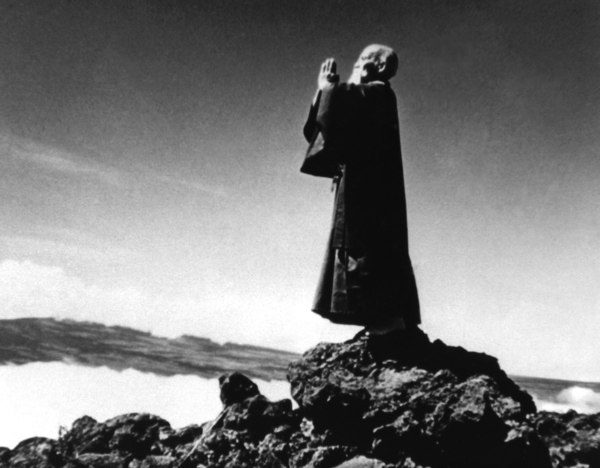
    Morihei Ueshiba meditates on top of Haleakala, Maui, 1961Morihei Ueshiba medita sobre Haleakala, Maui, 1961

    Published by: Christopher Li – Honolulu, HI

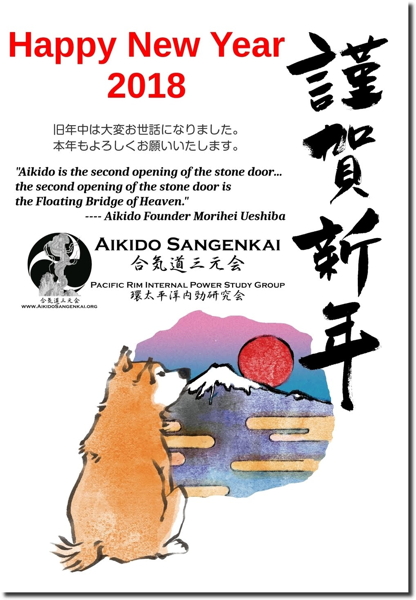
  • Happy New Year of the Dog 2018 from the Aikido Sangenkai

    Happy New Year of the Dog 2018 from the Aikido Sangenkai

    Happy New Year of the Dog 2018Happy New Year of the Dog 2018
    from the Aikido Sangenkai!

    Thank you all for your help and support over the last year. 2017 was a great year of training, and we’re looking forward to even more great training with you all in the coming year!

    The past year has seen the number of articles on the Aikido Sangenkai blog pass the 150 mark, with more articles translated into more than fifteen languages. For the coming year, our Sangenkai workshop for February 2018 has registered attendees from Japan, Korea, the mainland USA, Sweden and our local and neighbor island Sangenkai members as well as a large group of New Zealand and Australia Sangenkai members coming for a special intensive workshop in addition to the regular workshop, making the Aikido Sangenkai the only Aikido group in Hawaii to hold regular workshops with an international attendance.

    三千世界
    一度に開く
    梅の花
    二度の岩戸は
    開かれにけり

    In three thousand worlds
    The plum blossoms
    Open all at once –
    The stone door will
    Open a second time.

    Doka by Aikido Founder Morihei Ueshiba
    “Journey to the Heart of Aikido:
    The Teachings of Motomichi Anno Sensei
    “

    by Linda Holiday and Motomichi Anno

    As you can see on our New Year’s card above, Morihei Ueshiba often described Aikido as the “second opening of the stone door”. But what about the first opening, and why was it related to Aikido? For the answers to that one – check out this post about last year’s New Year’s card.

    On this year’s nengajo we have the first sun of the year (初日の出) rising over Mt. Fuji. The tradition of viewing the first rising sun of the year is also linked to the story of the stone door and the reappearance of Ama-terasu Omikami in the world.

    Which leads us to our thought for the coming year – a frequently cited quote from the Founder (actually a paraphrase of a Chinese proverb which has its roots in India – which demonstrates the pervasive nature of the idea across nations and cultures), from Aikido Tankyu #29:

    富士の高嶺に登る道は沢山有りますが、行き着く所は一つであります。即ち愛の道であります。皆それぞれ修業の方法は異なりますが、同じ所に至るのであります。日本の武は決して戦や闘いや争いの道では無いのであります。全ての者を喜んで兄弟として行く道であります。

    There are many paths to the peak of Mt. Fuji, but they all end at a single destination. That is, the path to love. Everyone has different methods of training, but they all arrive at the same destination. The martial arts of Japan are in no way the paths towards war, struggle or conflict. They are the paths which all people can take with joy as brothers and sisters.

     — Hau’oli Makahiki Hou
     — Happy New Year
     — 明けましておめでとうございます
    …and much Aloha!

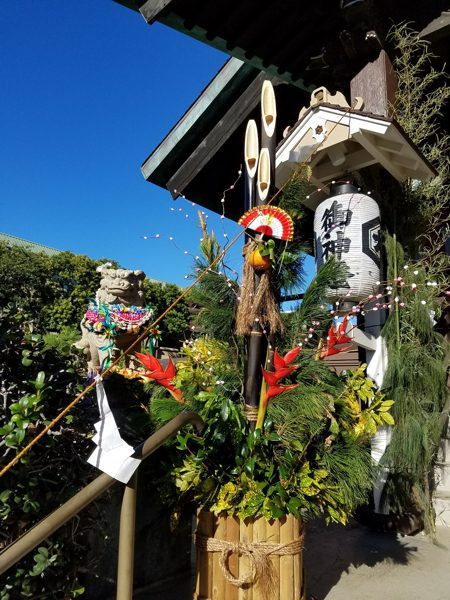
    Izumo Taishakyo Mission of HawaiiNew Year’s Day at the Izumo Taishakyo Mission of Hawaii

    Articles from the past year:

    The Phantom Manual: Yamato Ryu Goshinjutsu
    Budoka no Kotae – Talking to Kisshomaru Ueshiba Sensei
    Aikido und die schwebende Himmelsbrücke [German Version]
    Budoka no Kotae – Talking to Morihiro Saito Sensei, Part 3
    Budoka no Kotae – Talking to Morihiro Saito Sensei, Part 2
    Budoka no Kotae – Talking to Morihiro Saito Sensei, Part 1
    El grado importa – Cinturones Negros en Aikido [Spanish Version]
    Ueshiba-ha Daito-ryu Aiki-jujutsu [Spanish Version]
    El Legado de Ueshiba – Parte 1, por Mark Murray [Spanish Version]
    Cuatro Generaciones de la Familia Ueshiba [Spanish Version]
    Ueshiba-ha Daito-ryu Aiki-jujutsu
    Kiichi Hogen und das Geheimnis des Aikido [German Version]
    The Ueshiba Legacy – Part 2, by Mark Murray
    Aikido Shihan Sadao Takaoka – Meeting O-Sensei
    Aikido Shihan Seiseki Abe – Meeting Morihei Ueshiba O-Sensei
    Interview with Aikido Shihan Yasuo Kobayashi – Part 2

    Published by: Christopher Li – Honolulu, HI

  • The Phantom Manual: Yamato Ryu Goshinjutsu

    The Phantom Manual: Yamato Ryu Goshinjutsu

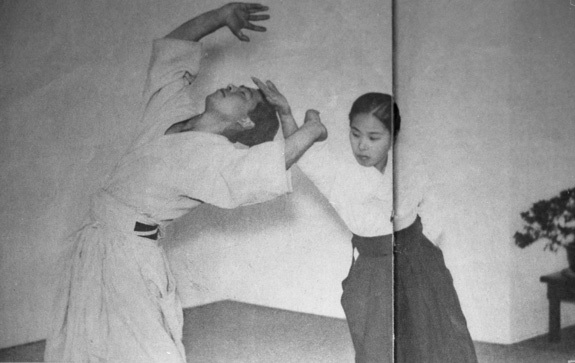
    Daiwa Goshinjutsu - Isamu Takeshita

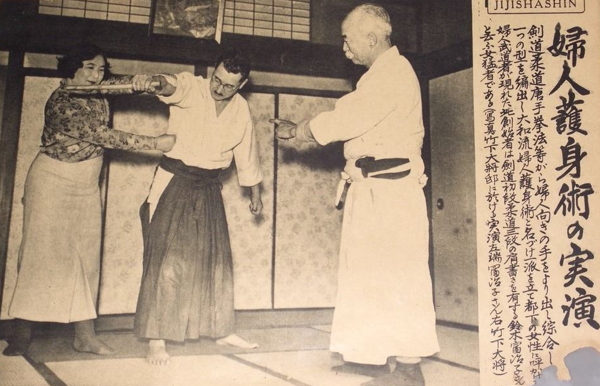
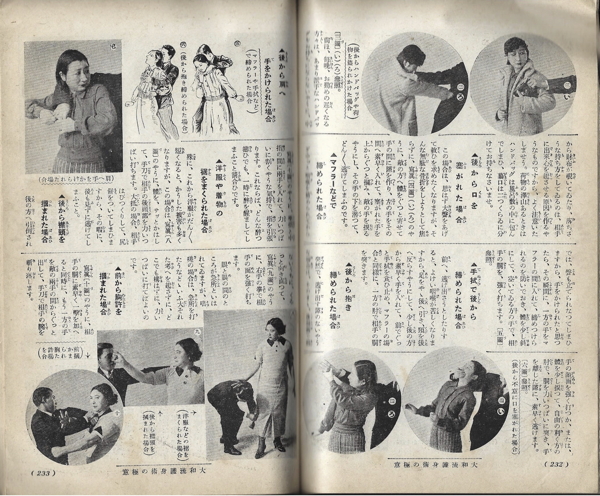
    Women’s self-defense demonstration in the Nikkan Jijishashin (日刊時事写真)
    Fujiko Suzuki (鈴木富治子), founder of Yamato Ryu Goshinjutsu (大和流護身術), left
    Sokaku Takeda and Morihei Ueshiba student Admiral Isamu Takeshita on the right.

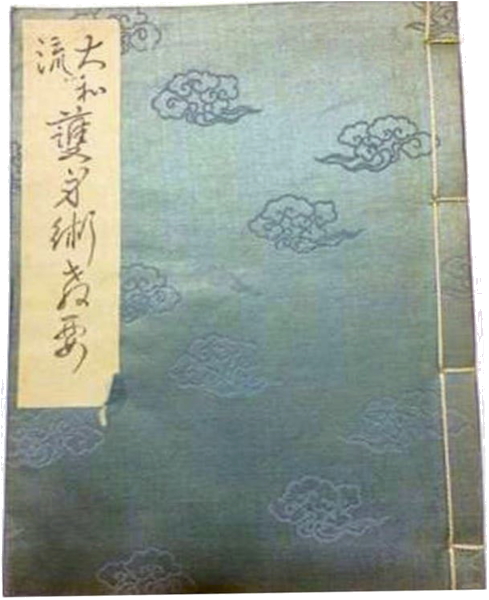
    Fujiko Suzuki’s “Phantom Manual” is available through the efforts of Scott Burke, who lives in Fukuoka, but often comes to Hawaii to join the Sangenkai workshops with Dan Harden. Many thanks to Scott, and appreciation for his continuing series of “Aikileaks”, which has previously included

    All 243 pages of this beautifully remastered manual are available for download at the bottom of this essay from Scott Burke, which explains what the “Phantom Manual” is and how it is related to Aikido Founder Morihei Ueshiba and Aikido. Enjoy!

    Yamato Ryu Goshinjutsu - 1937Yamato Ryu Goshinjutsu – 1937, by Fujiko Suzuki
    The Phantom Manual: Yamato Ryu Goshinjutsu

    by Scott Burke

    (And before anyone says it, no, this is not related to any other Daiwa Ryu, Yamato Ryu, or the 1952 Yamato Ryu “Secret Teachings of Self Defense”. “Secret Teachings of Self Defense” does contain numerous drawings copied from Kunigoshi’s Aikijujutsu Densho, so it can be considered a kind of a bootleg. There are also a number of techniques traced from photographs of a 1935 Nakazawa Ryu Goshinjutsu manual as well, I may put together a side by side later. This is a different animal altogether.)

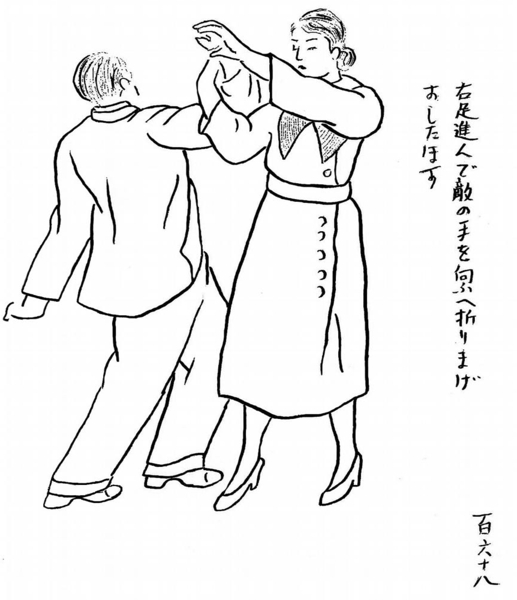
    Yamato Ryu Goshinjutsu Yamato Ryu Goshinjutsu, Page 183

    This Yamato Ryu is very much a product of Ueshiba’s students. His name is even written in the back indicating some level of oversight over the book, possibly as editor. Unless I’m losing my sight there is no mention of Aiki in this book. There is no mention of Heaven, earth, man or anything obvious pointing towards internal training methods. This is a straightforward collection of self-defense techniques for women in early Showa era Japan. As a historical document, it begs questions about who-knew-who in the mid 1930’s, as there are some interesting names attached to this work.

    Takako Kunigoshi and Shigemi YonekawaTakako Kunigoshi and Shigemi Yonekawa in 1935
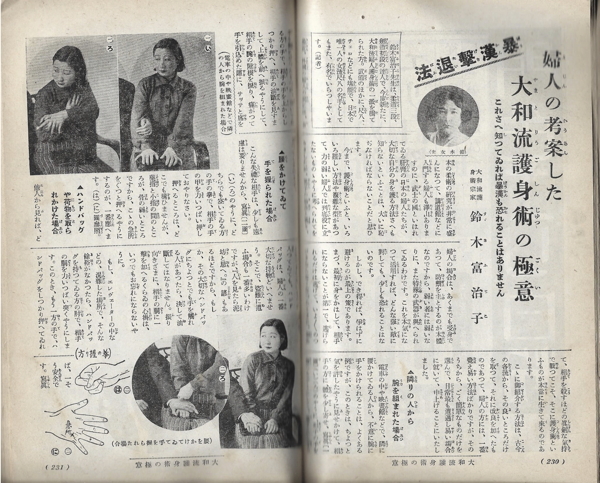
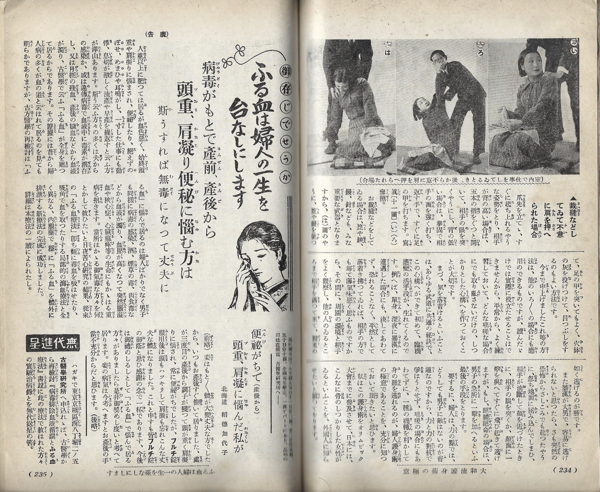
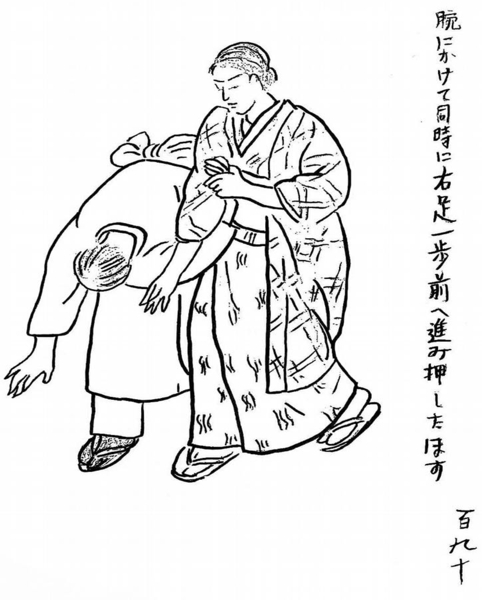
    Firstly, the illustrations are by Takako Kunigoshi, one of Ueshiba O-Sensei’s Kobukan era students and the illustrator of the famed Budo Renshu aka Aikijujutsu Densho. There are over two hundred illustrations depicting self-defense techniques. These techniques are often shown with the figures in regular Showa era (1930’s) daily wear, with only a few done with the participants wearing something like dogi. The manual’s authorship is credited to Fujiko Suzuki, a third dan Judo and shodan kendo practitioner. Her signature and a stamp with the characters Yamato Ryu Soke, are on the book. Aside from an article in a 1937 housewife helper’s magazine (below) and the 1937 Jijishashin press clipping (above) there is nothing more definitive that I can find on Fujiko Suzuki so far.

    Shufu no Tomo - Yamato Ryu 1Shufu no Tomo - Yamato Ryu 2Shufu no Tomo - Yamato Ryu 3Fujiko Suzuki – “The Secrets of Yamato Ryu Goshinjutsu” (大和流護身術の極意)
    “How to Beat Off and Defeat Hoodlums” (暴漢撃退法)
    Shufu-no-Tomo (主婦乃友) magazine, May 1937

    There are some hints that can be gleaned by looking over interviews with Kunigoshi, namely one conducted by Stan Pranin entitled “The Dainty Lady Who Lit Up Morihei Ueshiba’s Kobukan Dojo”:

    I started in January of 1933, the year that I graduated from school. I was then able to continue up to a little before the air raids began over Tokyo. At one time I had been asked to teach self-defense to female employees of a company located next to the famous Kaminari Mon (Thunder Gate) of the Asakusa Temple in Tokyo’s old town district. (Kunigoshi goes on to discuss teaching the grand daughter of Lafcadio Hearn and her concerns over the air raids over Tokyo. The earliest air raid was the famous Doolittle raid in April 1942. It seems more likely that Kunigoshi was referring to the large-scale air campaign beginning in 1944.)

    Editor: I imagine there weren’t very many women among the deshi in those days.

    There were only two of us! The other woman was two or three years younger than myself. I received New Year’s greeting cards from her up until a few years ago. Even now it seems that her nephew is going to the dojo. But as you said, in those days not many women went to train. Ever so, Ueshiba Sensei never made us feel different by changing things “because you are a woman”.

    Later on in the article is this:

    I started early in 1933 and it was after about a year that we did the book so I suppose it would have been around 1934. These pictures were really difficult to do! I had to do them all twice, you know. Even so I always felt there were some problems left. The second book was never printed after all but… At any rate, this particular version has the first drawings.

    In a later exchange about weapons practice Kunigoshi revealed the following:

    Just about the time that the war started my alma mater was on summer vacation and I spent something like three days teaching something more akin to self-defense than to Aikido. If we could have taken those 50 people who were to learn and divide then into three groups for three teachers it would have been fine but as it was after the first day one of the instructors’ voices gave out and we ended up having to do the course with only two instructors. I had to take care of 30 of them.

    The take away from this, Kunigoshi was actively teaching women’s self-defense classes, there was a second female deshi, and most interestingly, there was a second book, seemingly never published. The first of these take aways is the easiest to accept, Kunigoshi teaching women’s self-defense classes is a given. Next, an unnamed second female deshi. Well, maybe this was Fujiko Suzuki, and maybe not. Access to Kobukan membership records could clear this up quickly, but on that we’ll just have to wait and see what emerges. And lastly, a second book? Is it Yamato Ryu Goshinjutsu? Again, maybe. It’s possible that when Kunigoshi was referring to the second book she was actually referring to Aikido Maki no Ichi, a cleaned up and condensed version of Budo Renshu with some slight variations on technique endings.

    Aikido Maki-no-Ichi Page 52Aikido Maki-no-Ichi Page 52

    Or, she could have been thinking of this book, which actually did see print in 1937, although in obviously smaller circulation than Budo Renshu three years previous. The interview with Stan was several decades after the fact and Kunigoshi could simply have misremembered, I know I would be hard pressed to tell you all the details of the copyright clearance report I did for the MGM film library in 1996, though at the time it held all of my attention. At this point, I really don’t know which theory is correct. Please feel free to provide leads if you have them.

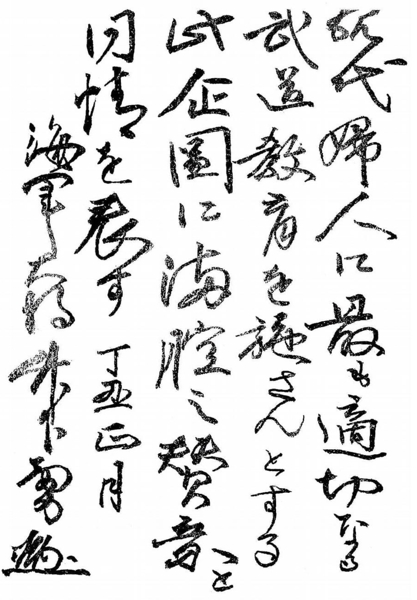
    There are handwritten introductions to the manual from different figures, which give weight to the notion that this book is closely related to Ueshiba and his 1930’s cohorts. Restoring this portion of the manual has been tricky, because it is all handwritten and of a style a bit above my ability to read. In some areas the original mimeograph must have accidentally “double stamped” it leaving the initial text especially blurry. I ran the images through Photoshop removing as much grit as I could while retaining the structure of the text. The signatures and titles are larger and easier to read, and besides some lingering grit the calligraphy for the poetry came through clearly.

    Yamato Ryu Goshinjutsu - Page 3Yamato Ryu Goshinjutsu – Page 3

    The first written portion is a set of poems written with a thick brush and is signed by Munetaka Abe. The Munetaka connection become clear, once again with the help of a Stanley Pranin article titled “Morihei Ueshiba and Gozo Shioda”:

    Mr. Munetaka Abe, Gozo (Shioda)’s middle school headmaster, was struck by the outstanding mental attitude of a young woman, Miss Takako Kunigoshi, who cleaned a nearby shrine every morning. When asked about her exemplary bearing, she gave credit to her aikijutsu teacher and suggested the schoolmaster observe a training session. Thoroughly impressed by what he saw at the nearby Ueshiba Dojo, Mr. Abe urged Gozo’s father to enroll his son there.
    …Shioda immediately decided to join the dojo. Since two guarantors were required to enter, his father and Mr. Abe provided introductions.

    Shioda’s entry to Ueshiba’s dojo is placed at 1932. According to records available online Mr. Munetaka, was principal at the Tokyo Prefecture Number 6 Middle School from 1922 to 1936. The Yamato Ryu manual was published in 1937. Mr. Munetaka obviously stayed in contact with Kunigoshi, so much so that he contributed calligraphy to the project.

    Yasuhiro Konishi in "Karate Nyumon" - 1958Yasuhiro Konishi in “Karate Nyumon” – 1958
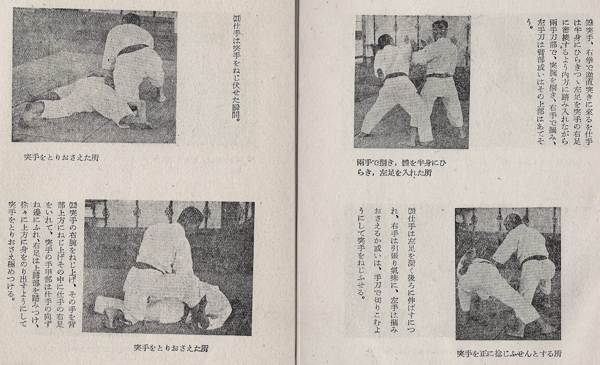
    The next entry is a short forward written by Yasuhiro Konishi, who according to Wikipedia was “one of the first karateka to teach karate on mainland Japan. He was instrumental in developing modern karate, as well as a driving force in the art’s acceptance in Japan. He is credited with developing the style known as Shindō jinen-ryū (神道自然流).”

    Additionally, Konishi was an early student (1920’s) of Morihei Ueshiba. In at least two of Konishi’s books (please forgive me, I have the books but they are currently somewhere in “the Pile”, and I cannot recall the titles but you have my word that this is the case) he refers to Ueshiba as the head of the Aioi Ryu, a name which Ueshiba only used for a brief period in the 1920’s. Admiral Takeshita also trained with the Aioi group, and Takeshita is mentioned by Kunigoshi in her interviews with Stan Pranin. Additionally, one of the few pictures available of Fujiko SUzuki is of her being instructed by Admiral Takeshita. I’ll speculate on Takeshita and his influence later.

    (Note:*There are some tantalizing tidbits in the internal power department concerning Konishi from the Japan Karate Do Ryobu Kai:

    At the same time, it is said that Yasuhiro learned from Ueshiba that the art had two kinds of spirit, one expressed externally and one expressed only in mind.

    In addition to this little bit of information, Konishi’s 1957 Karate manual touches on Tenchijin theory and how heaven and earth are expressed through the body.

    Yasuhiro Konishi in Karate Nyumon - 1958Yasuhiro Konishi in “Karate Nyumon” – 1958
    Some more information about Konishi and Ueshiba from Fighting Arts.com:

    In about 1935, Konishi Sensei developed another kata – Seiryu. During this period, Konishi Sensei, Ueshiba Sensei, Mabuni Sensei, and Ohtsuka Sensei were training together almost daily. At this time, the Japanese government was largely controlled by top officers of the Imperial Army. Konishi Sensei was asked by the commanding general of the Japanese Army to develop women’s self-defense techniques. His first step in fulfilling the Army’s request was to ask Mabuni Sensei to help him develop standardized training methods, to help the students remember the techniques.

    Together, they developed a karate kata that incorporated the essence of both their styles. As they worked to finalize the kata, they shared it with Ueshiba Sensei, who approved some sections, but advised certain changes. Ueshiba Sensei strongly felt that the kata should be modified based on the gender of the practitioner, because of the need to protect very different sensitive areas. Also a woman’s training was normally executed from a natural (higher) stance. Another factor which greatly influenced the kata was the female position in Japanese society. At the time, a woman’s life was defined by cultural customs, though both sexes wore kimono and used geta. All these factors were considered in the process of developing the kata.

    So beginning in 1935, plans were afoot to develop a women’s self-defense system, at the behest of a high-ranking military official.

    Continuing from the Japan Karate Do Ryobu Kai:

    Yasuhiro’s incessant eagerness to acquire the secret of various kinds of martial arts brought him the chance to meet Seiko Fujita, the 14th generation of master of “Koga Ninjutsu” and made him to obtain the license from “Nanban Kito-Ryu”.

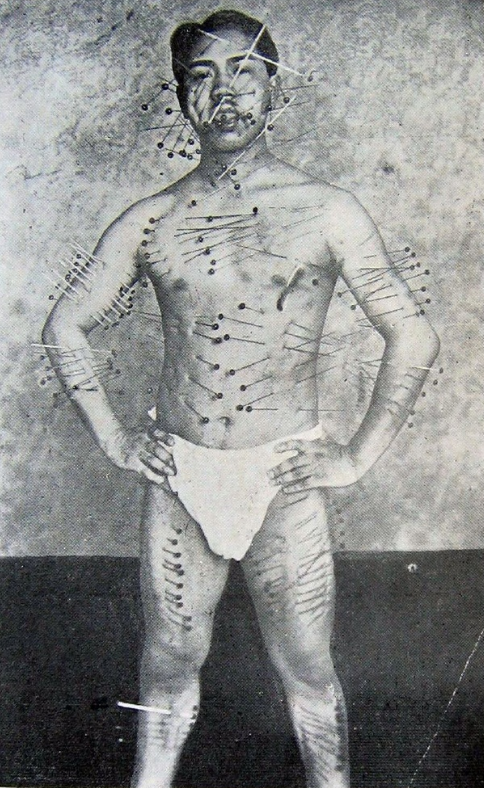
    Seiko Fujita is the third author featured in the foreword of the Yamato Ryu Goshinjutsu manual. 14th Headmaster or Soke of Kōga-ryū Ninjutsu. aka “The Last Ninja”.

    Fujita Seiko - 1936Hard training – Seiko Fujita pierced with 258 tatami needles
    from “Ninjutsu Hiroku” (忍術秘録) – 1936

    And here we have a ninja master, and an instructor of the Imperial Army’s Nakano School writing a foreword to this women’s self defense manual. Ninjutsu is an area where I am out of my depth, so I’ll gladly bend an ear and see what people in that area have to say.

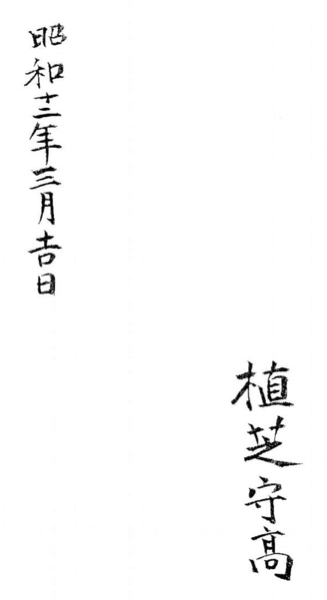
    Ueshiba Moritaka 1937Ueshiba Moritaka, March 1937
    Yamato Ryu Goshinjutsu – Page 242

    Taken together, all of this data points to the idea of a long lost training manual greatly influenced by the teachings of Ueshiba Moritaka, his signature placed down inside the book on an auspicious day, March 1937. One Japanese rare book dealer called this the “phantom book of Morihei Ueshiba”.

    Yamato Ryu Goshinjutsu Yamato Ryu Goshinjutsu – Page 206
    It is also possible that this is the sum total of multiple actors working together to create a women’s self-defense manual under the aegis of Yamato Ryu. Or it could be the sole product of a lost talent, Fujiko Suzuki, Soke of the Yamato Ryu. This “phantom book” has been sitting on my desk for a little too long, but now that the picture restoration is completed I’ve decided it is best to release it along with my limited findings in the hope that individuals with more information can shed some light on this previously unknown work. I’ve chased this one for years now. I hope you enjoy giving it a look as much as I did pursuing it.

    Yours in the Internal Power/Aiki pursuit,
    Scott


    Published by: Christopher Li – Honolulu, HI

  • Aikido und die schwebende Himmelsbrücke [German Version]

    Aikido und die schwebende Himmelsbrücke [German Version]

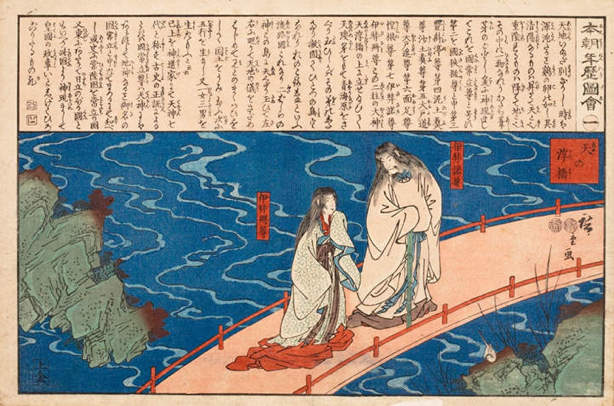
    The Gods Izanagi and Izanami on the Floating Bridge of Heaven

    Die Götter Izanagi und Izanami
    auf der schwebenden Himmelsbrücke,

    aus der Reihe “Eine illustrierte Geschichte Japans”
    von Utagawa Hiroshige, ca. 1847-1852

    Honolulu Academy of Arts

    *This is a German translation of the article  “Aikido and the Floating Bridge of Heaven“, provided courtesy of Ian Eisterer.

    Izanagi und Izanami auf der Brücke, die Himmel und Erde verbindet

    Die “schwebende Himmelsbrücke“ (“Ame no Uki Hashi”) ist ein wichtiger Bestandteil des japanischen Schöpfungsmythos.

    Laut dem Kojiki (“Bericht alter Angelegenheiten”), riefen die ersten Götter zwei himmlische Wesen ins Dasein – das männliche Prinzip Izanagi (“Der Mann der einlädt”/ 伊邪那岐) und das weibliche Prinzip Izanami (“die Frau die einlädt”/ 伊邪那美命). Diese zwei Wesen wurden damit beauftragt, die ersten Landmassen zu erschaffen. Sie nahmen einen mit Juwelen besetzten Speer und standen auf der schwebenden Himmelbrücke über dem Wasser und rührten damit im Meer bis ein Wirbel entstand. Vom Speer fallende Salzwassertropfen verwandelten sich in die ersten Inseln, worauf Izanagi und Izanami von der Brücke an Land gingen.

    Es gibt noch viel mehr darüber zu sagen (das Kojiki ist eine großartige Geschichte, eine der ersten Soap Operas der Welt), aber kehren wir zur Bedeutung für das Aikido zurück.

    Hier bezieht sich der Gründer des Aikido, Morihei Ueshiba, auf die schwebende Himmelsbrücke, Ame no Uki Hashi:

    合気道は「天の浮橋に立たされて」ということである。

    Es wird gesagt, Aikido sei das „Stehen auf der schwebenden Himmelsbrücke”.

    Dies ist einer jener poetischen Sätze des Gründers, den die Leute lieben – und kurz danach wieder vergessen, ohne sich zu fragen, ob O-Sensei implizit (oder gar explizit) auf eines der wichtigsten Prinzipien seiner Kunst hingewiesen haben könnte (Aikido; vielleicht schon mal davon gehört?).

    Ist es überhaupt wichtig? Vielleicht nicht – die Prinzipien zu verstehen, macht einen nicht notwendigerweise besser, wenn es darum geht, eine gewisse Aktivität auszuüben, egal ob Ballett oder Fussball. Andererseits kann ein Verständnis der Prinzipien dabei behilflich sein, herauszufinden, welche Aspekte des eigenen Trainings man noch verbessern kann. Es eröffnet oft auch völlig neue Perspektiven.

    Wenn Du ein Aikidoka bist, ist es für mich auch selbstverständlich, dass Du daran interessiert sein solltest, was der Gründer zu sagen hatte. Ich denke sogar, dass alle Aikidoka eigentlich eine Verantwortung haben, seine Aussprüche zumindest zu verstehen versuchen und ihnen so gut es geht auf den Grund zu gehen.

    Wenn Du kein Aikidoka bist – nun ja, ich setze mich mit vielen Sachen auseinander, die nicht von Aikidoka geschrieben wurden, die aber sehr interessante Dinge machen, die mich interessieren und über die ich mehr wissen will, selbst wenn ich nicht immer verstehe, worüber sie reden, da es mir hilft zu verstehen, wo meine Grenzen liegen. Du kannst mir glauben, wenn jemand wie Chen Xiaowang Informationen ausgibt, werde ich zumindest vorbeischauen.

    Zurück zu Morihei Ueshiba – hier spricht er noch direkter an, warum ihm das so wichtig ist:

    この道は、天の浮橋に最初に立たなければならないのです。天の浮橋に立たねば合気は出て来ないのです。

    Was den Weg (Do) anbelangt, muss man zuerst auf der schwebenden Himmelsbrücke stehen. Wenn man nicht auf der schwebenden Himmelsbrücke steht, wird Aiki nicht hervorkommen.

    Das klingt ziemlich endgültig – keine schwebende Himmelsbrücke, kein Aiki. Und natürlich weiters – kein Aiki, kein Aikido.

    Was also ist “Aiki”? Im Blogeintrag, “Aikido without peace or harmony“, haben wir versucht, eine brauchbare Übersetzung der Begriffe “Aiki” und “Take Musu Aiki” zu finden, und was wir schlussendlich als gut befunden haben ist:

    “Gegensätzliche Kräfte mit Ki vereinen und die anziehenden Kräfte trainieren, die dadurch entstehen.”

    Sehen wir mal, wie sich das mit der schwebenden Himmelsbrücke verträgt.

    Aus dem obigen Zitat wissen wir, dass Morihei Ueshiba die schwebende Himmelsbrücke für eine Bedingung hält, ohne die Aiki nicht hergestellt warden kann. Das wird noch klarer wenn der Gründer folgendes sagt:

    天の浮橋は、天の武産の合気の土台の発祥であります。

    Die schwebende Himmelsbrücke ist der Ursprung der Grundlage für das himmlische Take Musu Aiki.

    Jetzt sollte es langsam klarer warden (hoffe ich) – auf der schwebenden Himmelsbrücke zu stehen, ist eine notwendige Bedingung für Aikido, da es die Grundlage für Take Musu Aiki ist (“Gegensätzliche Kräfte mit Ki vereinen und die anziehenden Kräfte trainieren, die dadurch entstehen.” siehe oben). Sehen wir uns an, wie die Brücke gebaut wird:

    合気道は「天の浮橋に立たされて」ということである。天の浮橋は水火結んでめぐるということ。火は水を動かし、水は火によって動かさる。火も水も一つのものである。螺旋状にめぐる。気をもって絡むのである。それは、息によるものであり、この息が合気であります。

    Es wird gesagt, Aikido sei das “Stehen auf der schwebenden Himmelsbrücke”. Die schwebende Himmelsbrücke ist sich drehendes, verbundenes Feuer und Wasser. Feuer bewegt Wasser, Wasser wird durch Feuer bewegt. Feuer und Wasser sind eins. Sie drehen sich in einer Spirale. Sie sind durch Ki verflochten. Das ist etwas, das durch den Atem (“iki”) hervorgebracht wird. Dieser Atem (“iki”) ist Aiki.

    Wir kommen der Sache näher – “Feuer” und “Wasser” stehen für gegensätzliche “In” und “Yo” Kräfte. In “Aikido without peace or harmony” haben wir gesehen, wie wichtig die gegensätzlichen Kräfte sind, die durch Ki verbunden oder verflochten werden. O-Sensei sagt, dass “Take Musu” das trainieren von “Inryoku” (“anziehender Kraft”) sei, welches dann entsteht, wenn gegensätzliche Kräft durch Ki verbunden werden.

    Nun sehen wir, dass die schwebende Himmelsbrücke, da sie ja durch verbundene gegensätzliche Kräfte entsteht, in der Tat als Grundlage des “Take Musu Aiki” betrachtet werden kann.

    In diesem Zitat aus “Aikido without peace or harmony” geht es ebenfalls um die Verbindung von gegensätzlichen Kräften:

    上にア下にオ声と対照で気を結び、そこに引力が発生するのである。

    Oben der Klang des “A” und unten der Klang des “O” – Gegensätze, verbunden mit Ki, wo anziehende Kraft (“Inryoku”) entsteht.

    Sehen wir uns die Laute genauer an, und wie sie von Morihei Ueshiba als Erinnerungsstütze verwendet wurden.

    Die “schwebende Himmelsbrücke” (天の浮橋) ist “AME-NO-U-UKI-HASHI” und enthält alle Grundvokale“ A I U E O” (vielleicht hast Du diese Laute schon mal bei Misogi-Uebungen gehört). Die Laute sind eine Gedächtnisstütze um zu verstehen, wie die schwebende Himmelsbrücke Himmel und Erde verbindet:

    A: 天(ア) 高天原    TA・KA・A・MA・HA・RA
    “Die hohe Ebene des Himmels” ist selbst eine Gedächtnisstütze, die wir ein andermal unter die Lupe nehmen werden.

    I: 火(イ)
    “Feuer”

    U: 結(ウ) 産       MU・SU
    Das “Tai-Kyoku” bzw. das “grosse Ultimative” verbindet Feuer und Wasser, Himmel und Erde. Auch die Verbindung, das “Musu” in “Takemusu”

    E: 水(エ)
    “Wasser”

    O: 地(オ) 淤能碁呂島 O・NO・KO・RO
    “Erde”, eigentlich “die Insel Onokoro”, die ursprüngliche Insel Japans, von jenen Göttern gestaltet, die auf der schwebenden Himmelsbrücke standen.

    Hier ist es – eine saubere Beschreibung der schwebenden Brücke. Zufälligerweise (oder vielleicht nicht so zufällig) ist es auch eine gute Beschreibung der chinesischen Trainingsmethode Himmel-Erde-Mensch, die wir in “Aikido without peace or harmony“ beschrieben haben.

    Ten-Chi-Jin, Heaven-Earth-Man

    Himmel-Erde-Mensch,
    aus den illustrierten Erläuterungen des
    Taijiquan der Chen Familie

    Wenn man beide vergleicht, kann man sehen dass die schwebende Himmelsbrücke und Himmel-Erde-Mensch die selbe Übungsmethode beschreiben.

    Die oben genannte Folge von Lauten beschreibt das Konzept der körperlichen Methode der schwebenden Himmelsbrücke (auch als “Himmel-Erde-Mensch” bekannt). Diese Laute wurden von Morihei Ueshiba oft anders angeordnet um unterschiedliche Ideen darzustellen. Beispielsweise wurden die Laute in einer anderen Reihenfolge angeordnet, um den Fortschritt des spirituellen Trainings und seiner Entwicklung auszudrücken. Eventuell werde ich darauf in einem anderen Beitrag eingehen, aber ich möchte es jetzt erwähnen, um Verwirrung zu vermeiden.

    Es macht nichts, wenn man nicht selber auf das draufkommt – nicht jeder hat begriffen, was vor sich ging in den Momenten in denen Ueshiba Silbenlaute vor sich hin sang um sie als Gedächtnisstützen zu verwenden und seinen Erklärungen noch eine zusätzliche Bedeutungsebene zu verleihen – hier ist ein Zitat von Koichi Tohei:

    Ich habe Aikido von Morihei Ueshiba gelernt, indem ich zuerst geübt und erst danach Fragen gestellt habe. Ueshiba Sensei war ein Meister des Ki, sowie der Gründer des Aikido. Er war aber auch ein überzeugter Anhänger der Omotokyo Religion, und dies hatte eine grossen Einfluss auf seine Art, Aikido zu unterrichten. Es war oft unmöglich seine esoterischen Erklärungen zu verstehen. Ich habe die Übungen die er uns gab gründlich trainiert, auch wenn viele dieser Übungen aus der Omotokyo Religion kamen und uns als sinnlos erschienen. Beispielsweise wurde von uns erwartet, das Alphabet in einer anderen Reihenfolge zu rezitieren. Anstelle der üblichen Reihenfolge der Japanischen Vokale “AIUEO” mussten wir sie endlos als “AOUEI” aufsagen, als ob diese neue Reihenfolge eine tiefere Bedeutung hätte.

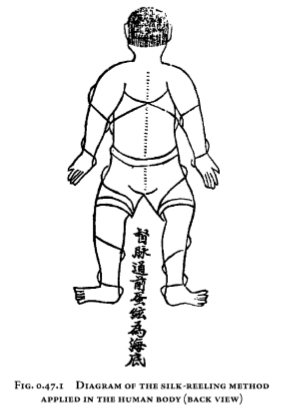
    Wir sehen dass diese gegensätzlichen Kräfte, durch Ki vereint, einander in durchgehenden Spiralen verstärken. Wir sehen auch, dass Ueshiba über “iki” spricht, was auch sehr wichtig ist, wir aber hier nicht besprechen können. Kannst Du dich an diese Spiralen aus “Morihei Ueshiba, Budo and Kamae“ erinnern?

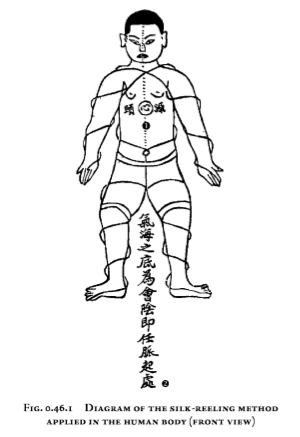
    Chen Silk Reeling, front view

    Chen Silk Reeling, back view

    Seide-Ziehen,
    aus “Illustrated Explanations of Chen Family Taijiquan”

    Hier oben wird im Chen Tai Chi der selbe Prozess beschrieben den Morihei Ueshiba beschreibt, wenn er von der schwebenden Himmelsbrücke spricht: die positiven und negative Spiralen, die sich durch den Körper winden (Fluss und gegen-Fluss von Shun und Ni.

    Und noch ein Zitat von Morihei Ueshiba:

    左手は伊耶那岐、右手は伊耶那美、真中は天之御中主(あめのみなかぬし)、これは自分のことである。天の浮橋に立たされて、螺旋状にめぐることである。これを高天原(たかあまはら)という。天も地も一つのもの、水も火も一つのもの、みんな息から現れるのである。神の常動の現れである。合気の技は常動により出てくるのである。

    Die linke Hand ist Izanagi, die rechte ist Izanami, in der Mitte ist Ame-no-minakanushi, das bist Du selbst. Das ist auf der schwebenden Himmelsbrücke Stehen und sich in einer Spirale drehen. Das wird Taka-ama-hara genannt. Himmel und Erde bilden eine Einheit, Wasser und Feuer sind auch eine Einheit, alles erscheint durch Iki (Atem). Dies ist das endlose Erscheinen der Kami. Aiki-Techniken entstehen ohne Ende.

    Izanagai und Izanami, die zwei Götter, welche auf der schwebenden Himmelsbrücke standen und die Welt erschufen, stehen für In und Yo, so wie in diesem sehr ähnlichen Doka von Morihei Ueshiba:

    右手をば陽にあらわし左手は陰にかえして相手みちびけ

    Offenbare Yo (Yang) in der rechten Hand, verwandle die linke Hand in In (Yin) und führe den Gegner.

    Ame-no-minakanushi war die erste Gottheit, die im Himmel erschien – mit anderen Worten, der “Chef” der in der Mitte steht.

    Ueshiba sagt, dass Du selbst der “Chef” bist – so wie in 我即宇宙・宇宙即我 ”Ich bin das Universum, das Universum ist ich.” Das ist ein sehr einfacher, aber sehr wichtiger Punkt. Es ist ein weiteres jener poetischen Zitate, das Leute lieben, ohne jemals daran gedacht zu haben, dass es eine der wichtigsten technischen Anweisungen ist, die er gegeben hat.

    Der “Chef” steht auf der schwebenden Himmelsbrücke, vereint die gegensätzlichen Kräfte von In und Yo und bewegt sich in einer Spirale. Interessanterweise werden die Bewegung der beiden Götter Izanagi und Izanami als sie sich vereinten und paarten oft als Spirale dargestellt. Außerdem wurde eine Spirale bzw. ein Wirbel erschaffen, als Izanagi mit dem Juwelenbesetzten Speer im Meer rührte, um Land zu erschaffen.

    Dieser Zustand, sagt O-Sensei, auf der schwebenden Himmelsbrücke stehen und die gegensätzlichen In-Yo Käfte vereinen und sich in Spiralen bewegen, ist Taka-ama-hara – der Himmel. Wie in “Aikido and the Structure of the Universe“ bereits erwähnt, ist dies ein Zustand, der sich laut O-Sensei in Dir befindet. Mit anderen Worten, Aiki ist ein Zustand der in Deinem eigenen Körper und Geist erschaffen wird.

    Dies ist etwas völlig anderes als eine Situation, in der Aiki als sich-an-eine-äussere-Gegebenheit (Partner, Gegner) Anpassen definiert wird. Es bestärkt auch die Erkenntnis, die wir oben gewonnen haben – Du selbst bist der “Chef”.

    Um zusammenzufassen: die schwebende Himmelsbrücke, auch als Himmel-Erde-Mensch (“Tenchijin”) bekannt, besteht darin, einen Zustand in sich selbst zu erzeugen, in dem man in der Lage ist, gegensätzliche Kräfte zu verbinden und diese Verbindung als Spiralen und Schrauben durch den Körper auszudrücken.


    Published by: Christopher Li – Honolulu, HI